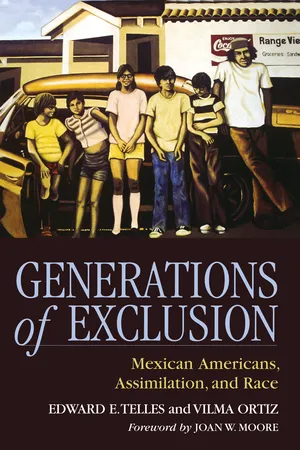
Foreword by Joan W. Moore When boxes of original files from a 1965 survey of Mexican Americans were discovered behind a dusty bookshelf at UCLA, sociologists Edward Telles and Vilma Ortiz recognized a unique opportunity to examine how the Mexican American experience has evolved over the past four decades. Telles and Ortiz located and re-interviewed most of the original respondents and many of their children. Then, they combined the findings of both studies to construct a thirty-five year analysis of Mexican American integration into American society. Generations of Exclusion is the result of this extraordinary project. Generations of Exclusion measures Mexican American integration across a wide number of dimensions: education, English and Spanish language use, socioeconomic status, intermarriage, residential segregation, ethnic identity, and political participation. The study contains some encouraging findings, but many more that are troubling. Linguistically, Mexican Americans assimilate into mainstream America quite well—by the second generation, nearly all Mexican Americans achieve English proficiency. In many domains, however, the Mexican American story doesn't fit with traditional models of assimilation. The majority of fourth generation Mexican Americans continue to live in Hispanic neighborhoods, marry other Hispanics, and think of themselves as Mexican. And while Mexican Americans make financial strides from the first to the second generation, economic progress halts at the second generation, and poverty rates remain high for later generations. Similarly, educational attainment peaks among second generation children of immigrants, but declines for the third and fourth generations. Telles and Ortiz identify institutional barriers as a major source of Mexican American disadvantage. Chronic under-funding in school systems predominately serving Mexican Americans severely restrains progress. Persistent discrimination, punitive immigration policies, and reliance on cheap Mexican labor in the southwestern states all make integration more difficult. The authors call for providing Mexican American children with the educational opportunities that European immigrants in previous generations enjoyed. The Mexican American trajectory is distinct—but so is the extent to which this group has been excluded from the American mainstream. Most immigration literature today focuses either on the immediate impact of immigration or what is happening to the children of newcomers to this country. Generations of Exclusion shows what has happened to Mexican Americans over four decades. In opening this window onto the past and linking it to recent outcomes, Telles and Ortiz provide a troubling glimpse of what other new immigrant groups may experience in the future.
eBook - ePub
Generations of Exclusion
Mexican-Americans, Assimilation, and Race
- 383 pages
- English
- ePUB (mobile friendly)
- Available on iOS & Android
eBook - ePub
About this book
Information
Table of contents
- Cover Page
- Title Page
- Copyright Page
- Dedication
- Contents
- About the Authors
- Acknowledgments
- Foreword
- Chapter 1 - Introduction
- Chapter 2 - Theoretical Background
- Chapter 3 - The Mexican American Study Project
- Chapter 4 - The Historical Context
- Chapter 5 - Education
- Chapter 6 - Economic Status
- Chapter 7 - Interethnic Relations
- Chapter 8 - Culture and Language
- Chapter 9 - Ethnic Identity
- Chapter 10 - Politics
- Chapter 11 - Conclusions
- Appendix A - Descriptive Statistics
- Appendix B - Multivariate Analyses
- Notes
- References
- Index
Trusted by 375,005 students
Access to over 1.5 million titles for a fair monthly price.
Study more efficiently using our study tools.
Frequently asked questions
Yes, you can cancel anytime from the Subscription tab in your account settings on the Perlego website. Your subscription will stay active until the end of your current billing period. Learn how to cancel your subscription
No, books cannot be downloaded as external files, such as PDFs, for use outside of Perlego. However, you can download books within the Perlego app for offline reading on mobile or tablet. Learn how to download books offline
Perlego offers two plans: Essential and Complete
- Essential is ideal for learners and professionals who enjoy exploring a wide range of subjects. Access the Essential Library with 800,000+ trusted titles and best-sellers across business, personal growth, and the humanities. Includes unlimited reading time and Standard Read Aloud voice.
- Complete: Perfect for advanced learners and researchers needing full, unrestricted access. Unlock 1.5M+ books across hundreds of subjects, including academic and specialized titles. The Complete Plan also includes advanced features like Premium Read Aloud and Research Assistant.
We are an online textbook subscription service, where you can get access to an entire online library for less than the price of a single book per month. With over 1.5 million books across 990+ topics, we’ve got you covered! Learn about our mission
Look out for the read-aloud symbol on your next book to see if you can listen to it. The read-aloud tool reads text aloud for you, highlighting the text as it is being read. You can pause it, speed it up and slow it down. Learn more about Read Aloud
Yes! You can use the Perlego app on both iOS and Android devices to read anytime, anywhere — even offline. Perfect for commutes or when you’re on the go.
Please note we cannot support devices running on iOS 13 and Android 7 or earlier. Learn more about using the app
Please note we cannot support devices running on iOS 13 and Android 7 or earlier. Learn more about using the app
Yes, you can access Generations of Exclusion by Edward E. Telles,Vilma Ortiz in PDF and/or ePUB format, as well as other popular books in Social Sciences & Emigration & Immigration. We have over 1.5 million books available in our catalogue for you to explore.