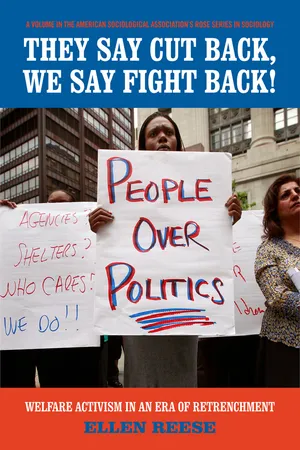
In 1996, President Bill Clinton hailed the "end of welfare as we know it" when he signed the Personal Responsibility and Work Opportunity Act. The law effectively transformed the nation's welfare system from an entitlement to a work-based one, instituting new time limits on welfare payments and restrictions on public assistance for legal immigrants. In They Say Cutback, We Say Fight Back, Ellen Reese offers a timely review of welfare reform and its controversial design, now sorely tested in the aftermath of the Great Recession. The book also chronicles the largely untold story of a new grassroots coalition that opposed the law and continues to challenge and reshape its legacy. While most accounts of welfare policy highlight themes of race, class and gender, They Say Cutback examines how welfare recipients and their allies contested welfare reform from the bottom-up. Using in-depth case studies of campaigns in Wisconsin and California, Reese argues that a crucial phase in policymaking unfolded after the bill's passage. As counties and states set out to redesign their welfare programs, activists scored significant victories by lobbying officials at different levels of American government through media outreach, protests and organizing. Such efforts tended to enjoy more success when based on broad coalitions that cut across race and class, drawing together a shifting alliance of immigrants, public sector unions, feminists, and the poor. The book tracks the tensions and strategies of this unwieldy group brought together inadvertently by their opposition to four major aspects of welfare reform: immigrants' benefits, welfare-to-work policies, privatization of welfare agencies, and child care services. Success in scoring reversals was uneven and subject to local demographic, political and institutional factors. In California, for example, workfare policies created a large and concentrated pool of new workers that public sector unions could organize in campaigns to change policies. In Wisconsin, by contrast, such workers were scattered and largely placed in private sector jobs, leaving unions at a disadvantage. Large Latino and Asian immigrant populations in California successfully lobbied to restore access to public assistance programs, while mobilization in Wisconsin remained more limited. On the other hand, the unionization of child care providers succeeded in Wisconsin – but failed in California – because of contrasting gubernatorial politics. With vivid descriptions of the new players and alliances in each of these campaigns, Reese paints a nuanced and complex portrait of the modern American welfare state. At a time when more than 40 million Americans live in poverty, They Say Cutback offers a sobering assessment of the nation's safety net. As policymakers confront budget deficits and a new era of austerity, this book provides an authoritative guide for both scholars and activists looking for lessons to direct future efforts to change welfare policy. A Volume in the American Sociological Association's Rose Series in Sociology
eBook - ePub
They Say Cutback, We Say Fight Back!
Welfare Activism in an Era of Retrenchment
- 286 pages
- English
- ePUB (mobile friendly)
- Available on iOS & Android
eBook - ePub
About this book
Information
Table of contents
- Cover Page
- Title Page
- Copyright Page
- Contents
- About the Author
- Acknowledgments
- Chapter 1. Welfare Reform and Its Challengers
- Chapter 2. Policy Implementation as Policymaking: The Case of U.S. Welfare Reform
- Chapter 3. Challenging Welfare Racism: Cross-Racial Coalitions to Restore Legal Immigrants' Benefits
- Chapter 4. Battling the Welfare Profiteers: Campaigns Against Welfare Privatization
- Chapter 5. Confronting the Workfare State: Community and Labor Campaigns for Workfare Workers' Rights
- Chapter 6. But Who Will Watch the Children? State and Local Campaigns to Improve Child Care Policies
- Chapter 7. Challenges and Prospects for the Welfare Rights Movement
- Appendix
- Notes
- References
- Index
Trusted by 375,005 students
Access to over 1.5 million titles for a fair monthly price.
Study more efficiently using our study tools.
Frequently asked questions
Yes, you can cancel anytime from the Subscription tab in your account settings on the Perlego website. Your subscription will stay active until the end of your current billing period. Learn how to cancel your subscription
No, books cannot be downloaded as external files, such as PDFs, for use outside of Perlego. However, you can download books within the Perlego app for offline reading on mobile or tablet. Learn how to download books offline
Perlego offers two plans: Essential and Complete
- Essential is ideal for learners and professionals who enjoy exploring a wide range of subjects. Access the Essential Library with 800,000+ trusted titles and best-sellers across business, personal growth, and the humanities. Includes unlimited reading time and Standard Read Aloud voice.
- Complete: Perfect for advanced learners and researchers needing full, unrestricted access. Unlock 1.5M+ books across hundreds of subjects, including academic and specialized titles. The Complete Plan also includes advanced features like Premium Read Aloud and Research Assistant.
We are an online textbook subscription service, where you can get access to an entire online library for less than the price of a single book per month. With over 1.5 million books across 990+ topics, we’ve got you covered! Learn about our mission
Look out for the read-aloud symbol on your next book to see if you can listen to it. The read-aloud tool reads text aloud for you, highlighting the text as it is being read. You can pause it, speed it up and slow it down. Learn more about Read Aloud
Yes! You can use the Perlego app on both iOS and Android devices to read anytime, anywhere — even offline. Perfect for commutes or when you’re on the go.
Please note we cannot support devices running on iOS 13 and Android 7 or earlier. Learn more about using the app
Please note we cannot support devices running on iOS 13 and Android 7 or earlier. Learn more about using the app
Yes, you can access They Say Cutback, We Say Fight Back! by Ellen Reese in PDF and/or ePUB format, as well as other popular books in Politics & International Relations & Political Economy. We have over 1.5 million books available in our catalogue for you to explore.