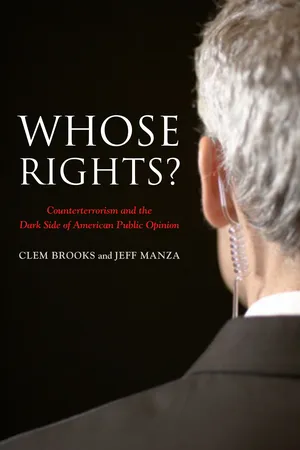
In the wake of the September 11 attacks, the U.S. government adopted a series of counterterrorism policies that radically altered the prevailing balance between civil liberties and security. These changes allowed for warrantless domestic surveillance, military commissions at Guantanamo Bay and even extralegal assassinations. Now, more than a decade after 9/11, these sharply contested measures appear poised to become lasting features of American government. What do Americans think about these policies? Where do they draw the line on what the government is allowed to do in the name of fighting terrorism? Drawing from a wealth of survey and experimental data, Whose Rights? explores the underlying sources of public attitudes toward the war on terror in a more detailed and comprehensive manner than has ever been attempted. In an analysis that deftly deploys the tools of political science and psychology, Whose Rights? addresses a vexing puzzle: Why does the counterterrorism agenda persist even as 9/11 recedes in time and the threat from Al Qaeda wanes? Authors Clem Brooks and Jeff Manza provocatively argue that American opinion, despite traditionally showing strong support for civil liberties, exhibits a "dark side" that tolerates illiberal policies in the face of a threat. Surveillance of American citizens, heightened airport security, the Patriot Act and targeted assassinations enjoy broad support among Americans, and these preferences have remained largely stable over the past decade. There are, however, important variations: Waterboarding and torture receive notably low levels of support, and counterterrorism activities sanctioned by formal legislation, as opposed to covert operations, tend to draw more favor. To better evaluate these trends, Whose Rights? examines the concept of "threat-priming" and finds that getting people to think about the specter of terrorism bolsters anew their willingness to support coercive measures. A series of experimental surveys also yields fascinating insight into the impact of national identity cues. When respondents are primed to think that American citizens would be targeted by harsh counterterrorism policies, support declines significantly. On the other hand, groups such as Muslims, foreigners, and people of Middle Eastern background elicit particularly negative attitudes and increase support for counterterrorism measures. Under the right conditions, Brooks and Manza show, American support for counterterrorism activities can be propelled upward by simple reminders of past terrorism plots and communication about disliked external groups. Whose Rights? convincingly argues that mass opinion plays a central role in the politics of contemporary counterterrorism policy. With their clarity and compelling evidence, Brooks and Manza offer much-needed insight into the policy responses to the defining conflict of our age and the psychological impact of terrorism.
eBook - ePub
Whose Rights?
Counterterrorism and the Dark Side of American Public Opinion
- 188 pages
- English
- ePUB (mobile friendly)
- Available on iOS & Android
eBook - ePub
About this book
Information
Table of contents
- Cover Page
- Title Page
- Copyright Page
- Contents
- List of Figures and Tables
- About the Authors
- Preface
- Acknowledgments
- Introduction
- Chapter 1 - From Rights Revolution to War on Terror
- Chapter 2 - The Puzzle of Counterterrorism Policy Attitudes
- Chapter 3 - A Critical Era?
- Chapter 4 - Threat Priming and National Identity Targets
- Chapter 5 - Who Is “Us”?
- Chapter 6 - Policy Feedback?
- Conclusion
- Notes
- References
- Index
Trusted by 375,005 students
Access to over 1.5 million titles for a fair monthly price.
Study more efficiently using our study tools.
Frequently asked questions
Yes, you can cancel anytime from the Subscription tab in your account settings on the Perlego website. Your subscription will stay active until the end of your current billing period. Learn how to cancel your subscription
No, books cannot be downloaded as external files, such as PDFs, for use outside of Perlego. However, you can download books within the Perlego app for offline reading on mobile or tablet. Learn how to download books offline
Perlego offers two plans: Essential and Complete
- Essential is ideal for learners and professionals who enjoy exploring a wide range of subjects. Access the Essential Library with 800,000+ trusted titles and best-sellers across business, personal growth, and the humanities. Includes unlimited reading time and Standard Read Aloud voice.
- Complete: Perfect for advanced learners and researchers needing full, unrestricted access. Unlock 1.5M+ books across hundreds of subjects, including academic and specialized titles. The Complete Plan also includes advanced features like Premium Read Aloud and Research Assistant.
We are an online textbook subscription service, where you can get access to an entire online library for less than the price of a single book per month. With over 1.5 million books across 990+ topics, we’ve got you covered! Learn about our mission
Look out for the read-aloud symbol on your next book to see if you can listen to it. The read-aloud tool reads text aloud for you, highlighting the text as it is being read. You can pause it, speed it up and slow it down. Learn more about Read Aloud
Yes! You can use the Perlego app on both iOS and Android devices to read anytime, anywhere — even offline. Perfect for commutes or when you’re on the go.
Please note we cannot support devices running on iOS 13 and Android 7 or earlier. Learn more about using the app
Please note we cannot support devices running on iOS 13 and Android 7 or earlier. Learn more about using the app
Yes, you can access Whose Rights? by Clem Brooks,Jeff Manza in PDF and/or ePUB format, as well as other popular books in Politics & International Relations & Civil Rights in Politics. We have over 1.5 million books available in our catalogue for you to explore.