Were Renaissance women merely passive and voiceless subjects in the cultures of portraiture through which they were represented? Did they have the opportunity to challenge the prevailing visual tropes that reproduced gender stereotypes? Did they create iconographical programmes for their own social and political ends?
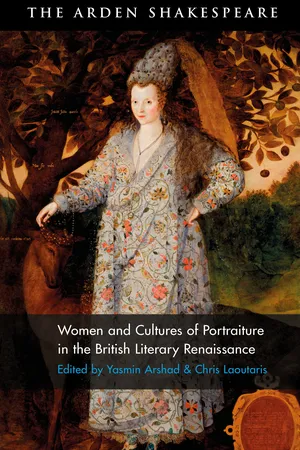
This collection of interdisciplinary essays examines the representation of women at the intersection between portraiture, literature, drama, heritage and material culture in Renaissance Britain. It explores how power, politics and patronage manifested across text, cultural inscription and 'portraiture' – defined in its broadest sense as a cultural artefact expressive of the female image and identity. Contributors cover (self-)portraits, miniatures, engravings, sculptures, embroideries, murals, emblems, illuminated manuscripts, jewellery, coins, curated collections, theatrical props, calligraphy and other decorative and architectural features.
Bringing together art historians, curators, heritage specialists and scholars of early modern history and literature, this volume situates women as the active subjects and creators of 'cultures of portraiture'. It reveals how female power was negotiated through the royal icon; how women used patronage, pedagogy and encryption to forge female networks and navigate the dangerous worlds of religious and courtly factionalism; and how art, drama and literature reflected anxieties around women's creative agency. It demonstrates that these practices were not purely localised, but that women's portraiture connected England – conceptually, materially and ideologically – to Scotland, Wales, Ireland, France, Spain, Rome, the Netherlands, Africa, Persia and the Islamic world; that women employed an 'activist intermediality' to re-define their 'portraits' as tools for public identity-building, political commentary, social disruption and cross-national dialogue.
eBook - ePub
Women and Cultures of Portraiture in the British Literary Renaissance
- 330 pages
- English
- ePUB (mobile friendly)
- Available on iOS & Android
eBook - ePub
Women and Cultures of Portraiture in the British Literary Renaissance
About this book
Information
Table of contents
- Cover
- Half-Title
- Series
- Dedication
- Title
- Contents
- List of PLATES
- List of ILLUSTRATIONS
- Notes On Contributors
- Acknowledgements
- Abbreviations
- Introduction
- PART I Negotiating royal power: Propaganda, encryption and the visual rhetoric of persuasion
- 1 Susanna Horenbout, Tudor queens and the politics of illumination at the Court of Henry VIII
- 2 Joint iconography for joint sovereigns: Mary Queen of Scots, James VI of Scotland, and the Campaign for the Association, c.1578–1584
- 3 Elizabeth I at sixty
- 4 ‘Still Renewing Wronges’? Politis,croyal power and encryption in Gheeraerts’ ‘Persian Lady’ Portrait
- 5 ‘A Moor to a Maiden’: The presence of Black Africans in the portraiture of Louise de Kérouaille, Duchess of Portsmouth
- PART II Intermedial interventions: Identity, agency and confrontations with the self
- 6 Embroidery and self-portraiture
- 7 The dead shadow: Portraiture, murder and female agency in the early modern dumb show
- 8 Capitalizing on beauty: Blazons, portraiture and religion in early modern England
- 9 The portrait of a lady from the Islamic world in early modern England: ‘Teresia, Countess Shirley’, by William Larkin, c.1611–1613
- 10 Flights of fancy and practical matters: Creativity in self-portraiture of Margaret Cavendish and Hannah Woolley
- PART III Visualizing women’s networks: Patronage, curating and collecting
- 11 Catholicae Virgines nos sumus mutare vel tempore spernimus: Helena Wintour’s subversive embroideries
- 12 Mary Ward and the figuring of female networks
- 13 Locating the Cavendish women in Ben Jonson’s The New Inn and the murals at Bolsover Castle
- 14 Richard Crashaw’s Lady Margaret Beaufort in the Liber Memorialis at St John’s College, Cambridge
- SELECT BIBLIOGRAPHY
- Index
- Plates1
- Copyright
Trusted by 375,005 students
Access to over 1.5 million titles for a fair monthly price.
Study more efficiently using our study tools.
Frequently asked questions
Yes, you can cancel anytime from the Subscription tab in your account settings on the Perlego website. Your subscription will stay active until the end of your current billing period. Learn how to cancel your subscription
No, books cannot be downloaded as external files, such as PDFs, for use outside of Perlego. However, you can download books within the Perlego app for offline reading on mobile or tablet. Learn how to download books offline
We are an online textbook subscription service, where you can get access to an entire online library for less than the price of a single book per month. With over 1.5 million books across 990+ topics, we’ve got you covered! Learn about our mission
Look out for the read-aloud symbol on your next book to see if you can listen to it. The read-aloud tool reads text aloud for you, highlighting the text as it is being read. You can pause it, speed it up and slow it down. Learn more about Read Aloud
Yes! You can use the Perlego app on both iOS and Android devices to read anytime, anywhere — even offline. Perfect for commutes or when you’re on the go.
Please note we cannot support devices running on iOS 13 and Android 7 or earlier. Learn more about using the app
Please note we cannot support devices running on iOS 13 and Android 7 or earlier. Learn more about using the app
Yes, you can access Women and Cultures of Portraiture in the British Literary Renaissance by Yasmin Arshad,Chris Laoutaris, Lena Cowen Orlin,Catherine Richardson,Evelyn Tribble,Helen Smith in PDF and/or ePUB format, as well as other popular books in Literature & Art General. We have over 1.5 million books available in our catalogue for you to explore.