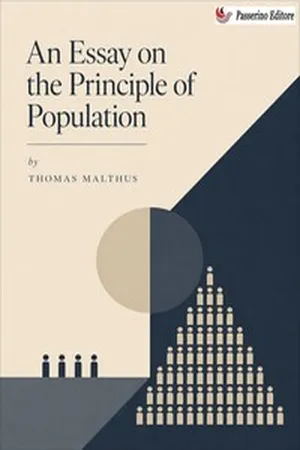
First published in 1798, An Essay on the Principle of Population by Thomas Robert Malthus remains one of the most provocative and influential works in the history of economic thought. In this groundbreaking study, Malthus presents a stark and unsettling idea: while population tends to grow geometrically, the means of subsistence increase only arithmetically. From this imbalance arises an inevitable tension—one that shapes societies through cycles of prosperity, crisis, and hardship. Famine, disease, and war, he argues, are not mere accidents of history, but natural checks that restore equilibrium. Both controversial and visionary, Malthus’s essay sparked debates that continue to this day, influencing thinkers from Charles Darwin to modern economists and policymakers. His insights remain strikingly relevant in a world grappling with overpopulation, resource scarcity, and environmental limits. This edition invites readers to engage with a timeless question: can human progress overcome the constraints of nature, or are we bound by laws we cannot escape? A foundational text—challenging, unsettling, and essential.
Thomas Robert Malthus (1766–1834) was an English economist, cleric, and scholar best known for his influential work on population dynamics. A fellow of Jesus College, Cambridge, and later a professor of political economy at the East India Company College, Malthus became one of the founding figures of classical economics.
His most famous work, An Essay on the Principle of Population, introduced the idea that population growth tends to outpace food production, leading to inevitable social and economic pressures. This theory sparked widespread debate and deeply influenced thinkers such as Charles Darwin and Alfred Russel Wallace. Malthus’s writings remain central to discussions on economics, sustainability, and the limits of human progress, securing his place as one of the most enduring and controversial voices in modern intellectual history.
- English
- ePUB (mobile friendly)
- Available on iOS & Android
eBook - ePub
An Essay on the Principle of Population
About this book
Information
Subtopic
UtilitarianismIndex
Social SciencesTable of contents
- Cover
- An Essay on the Principle of Population
- Table of contents
- Preface
- Chapter 1
- Chapter 2
- Chapter 3
- Chapter 4
- Chapter 5
- Chapter 6
- Chapter 7
- Chapter 8
- Chapter 9
- Chapter 10
- Chapter 11
- Chapter 12
- Chapter 13
- Chapter 14
- Chapter 15
- Chapter 16
- Chapter 17
- Chapter 18
- Chapter 19
Trusted by 375,005 students
Access to over 1.5 million titles for a fair monthly price.
Study more efficiently using our study tools.
Frequently asked questions
Yes, you can cancel anytime from the Subscription tab in your account settings on the Perlego website. Your subscription will stay active until the end of your current billing period. Learn how to cancel your subscription
No, books cannot be downloaded as external files, such as PDFs, for use outside of Perlego. However, you can download books within the Perlego app for offline reading on mobile or tablet. Learn how to download books offline
Perlego offers two plans: Essential and Complete
- Essential is ideal for learners and professionals who enjoy exploring a wide range of subjects. Access the Essential Library with 800,000+ trusted titles and best-sellers across business, personal growth, and the humanities. Includes unlimited reading time and Standard Read Aloud voice.
- Complete: Perfect for advanced learners and researchers needing full, unrestricted access. Unlock 1.5M+ books across hundreds of subjects, including academic and specialized titles. The Complete Plan also includes advanced features like Premium Read Aloud and Research Assistant.
We are an online textbook subscription service, where you can get access to an entire online library for less than the price of a single book per month. With over 1.5 million books across 990+ topics, we’ve got you covered! Learn about our mission
Look out for the read-aloud symbol on your next book to see if you can listen to it. The read-aloud tool reads text aloud for you, highlighting the text as it is being read. You can pause it, speed it up and slow it down. Learn more about Read Aloud
Yes! You can use the Perlego app on both iOS and Android devices to read anytime, anywhere — even offline. Perfect for commutes or when you’re on the go.
Please note we cannot support devices running on iOS 13 and Android 7 or earlier. Learn more about using the app
Please note we cannot support devices running on iOS 13 and Android 7 or earlier. Learn more about using the app
Yes, you can access An Essay on the Principle of Population by Thomas Malthus in PDF and/or ePUB format, as well as other popular books in Social Sciences & Utilitarianism. We have over 1.5 million books available in our catalogue for you to explore.