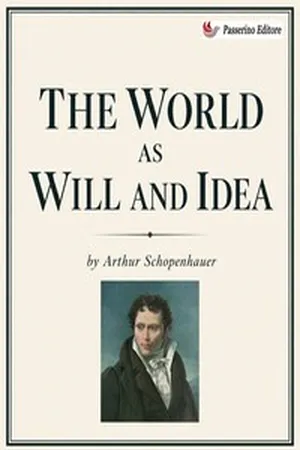
Few works have confronted the human condition with the depth, severity, and brilliance of Arthur Schopenhauer’s The World as Will and Idea. First published in 1818, this monumental philosophical masterpiece presents a vision of reality that is at once metaphysical, psychological, and profoundly existential.
For Schopenhauer, the world we perceive is not reality in itself, but representation: an image shaped by the structures of our mind. Beneath this world of appearances lies the blind, restless force he calls the Will—a universal striving that drives nature, life, desire, suffering, and human action.
Drawing on Kant, Plato, Eastern thought, and his own uncompromising insight, Schopenhauer develops a philosophy that explores the roots of suffering, the limits of reason, the power of art, and the possibility of liberation through aesthetic contemplation, compassion, and renunciation.
Dark, lucid, and visionary, The World as Will and Idea influenced generations of writers, philosophers, artists, and psychologists, from Nietzsche and Wagner to Freud and modern existential thought. It remains one of the most powerful attempts ever made to understand desire, pain, beauty, and the hidden structure of existence.
Arthur Schopenhauer (1788–1860) was a German philosopher best known for his masterpiece The World as Will and Idea — also translated as The World as Will and Representation. Deeply influenced by Immanuel Kant, Plato, and Eastern philosophy, Schopenhauer developed a powerful vision of existence centered on the concept of the Will, a blind and restless force behind all life and desire. His philosophy is often associated with pessimism, but also with profound insights into art, compassion, suffering, and human nature. Although largely overlooked during much of his lifetime, Schopenhauer later became one of the most influential thinkers of the nineteenth century, inspiring writers, philosophers, musicians, and psychologists, including Friedrich Nietzsche, Richard Wagner, Thomas Mann, and Sigmund Freud.
- English
- ePUB (mobile friendly)
- Available on iOS & Android
eBook - ePub
The World as Will and Idea
About this book
Information
Topic
PhilosophySubtopic
Ethics & Moral PhilosophyTable of contents
- Cover
- The World as Will and Idea
- Table of contents
- Translators’ Preface
- Preface To The First Edition
- Preface To The Second Edition
- First Book. The World As Idea
- First Aspect. The Idea Subordinated To The Principle Of Sufficient Reason: The Object Of Experience And Science
- Second Book. The World As Will
- First Aspect. The Objectification Of The Will
- Third Book. The World As Idea
- Second Aspect. The Idea Independent Of The Principle Of Sufficient Reason: The Platonic Idea: The Object Of Art
- Fourth Book. The World As Will
- Second Aspect. The Assertion And Denial Of The Will To Live, When Self-Consciousness Has Been Attained
- Appendix: Criticism Of The Kantian Philosophy
- Supplements To The First Book
- First Half. The Doctrine Of The Idea Of Perception. (To § 1-7 Of The First Volume)
- I. The Standpoint Of Idealism
- II. The Doctrine Of Perception Or Knowledge Of The Understanding
- III. On The Senses
- IV. On Knowledge A Priori
- Second Half. The Doctrine Of The Abstract Idea, Or Thinking
- V. On The Irrational Intellect
- VI. On The Doctrine Of Abstract Or Rational Knowledge
- VII. On The Relation Of The Concrete Knowledge Of Perception To Abstract Knowledge
- VIII. On The Theory Of The Ludicrous
- IX. On Logic In General
- X. On The Syllogism
- XI. On Rhetoric
- XII. On The Doctrine Of Science
- XIII. On The Methods Of Mathematics
- XIV. On The Association Of Ideas
- XV. On The Essential Imperfections Of The Intellect
- XVI. On The Practical Use Of Reason And On Stoicism
- XVII. On Man’s Need Of Metaphysics
- Supplements To The Second Book
- XVIII. On The Possibility Of Knowing The Thing In Itself
- XIX. On The Primacy Of The Will In Self-Consciousness
- XX. Objectification Of The Will In The Animal Organism
- Note On What Has Been Said About Bichat
- Supplements To The Second Book
- XXI. Retrospect And More General View
- XXII. Objective View Of The Intellect
- XXIII. On The Objectification Of The Will In Unconscious Nature
- XXIV. On Matter
- XXV. Transcendent Considerations Concerning The Will As Thing In Itself
- XXVI. On Teleology
- XXVII. On Instinct And Mechanical Tendency
- XXVIII. Characterisation Of The Will To Live
- Supplements To The Third Book
- XXIX. On The Knowledge Of The Ideas
- XXX. On The Pure Subject Of Knowledge
- XXXI. On Genius
- XXXII. On Madness
- XXXIII. Isolated Remarks On Natural Beauty
- XXXIV. On The Inner Nature Of Art
- XXXV. On The Æsthetics Of Architecture
- XXXVI. Isolated Remarks On The Æsthetics Of The Plastic And Pictorial Arts
- XXXVII. On The Æsthetics Of Poetry
- XXXVIII. On History
- XXXIX. On The Metaphysics Of Music
- Supplements To The Fourth Book
- XL. Preface
- XLI. On Death And Its Relation To The Indestructibility Of Our True Nature
- XLII. The Life Of The Species
- XLIII. On Heredity
- XLIV. The Metaphysics Of The Love Of The Sexes
- XLV. On The Assertion Of The Will To Live
- XLVI. On The Vanity And Suffering Of Life
- XLVII. On Ethics
- XLVIII. On The Doctrine Of The Denial Of The Will To Live
- XLIX. The Way Of Salvation
- L. Epiphilosophy
- Appendix
Trusted by 375,005 students
Access to over 1.5 million titles for a fair monthly price.
Study more efficiently using our study tools.
Frequently asked questions
Yes, you can cancel anytime from the Subscription tab in your account settings on the Perlego website. Your subscription will stay active until the end of your current billing period. Learn how to cancel your subscription
No, books cannot be downloaded as external files, such as PDFs, for use outside of Perlego. However, you can download books within the Perlego app for offline reading on mobile or tablet. Learn how to download books offline
Perlego offers two plans: Essential and Complete
- Essential is ideal for learners and professionals who enjoy exploring a wide range of subjects. Access the Essential Library with 800,000+ trusted titles and best-sellers across business, personal growth, and the humanities. Includes unlimited reading time and Standard Read Aloud voice.
- Complete: Perfect for advanced learners and researchers needing full, unrestricted access. Unlock 1.5M+ books across hundreds of subjects, including academic and specialized titles. The Complete Plan also includes advanced features like Premium Read Aloud and Research Assistant.
We are an online textbook subscription service, where you can get access to an entire online library for less than the price of a single book per month. With over 1.5 million books across 990+ topics, we’ve got you covered! Learn about our mission
Look out for the read-aloud symbol on your next book to see if you can listen to it. The read-aloud tool reads text aloud for you, highlighting the text as it is being read. You can pause it, speed it up and slow it down. Learn more about Read Aloud
Yes! You can use the Perlego app on both iOS and Android devices to read anytime, anywhere — even offline. Perfect for commutes or when you’re on the go.
Please note we cannot support devices running on iOS 13 and Android 7 or earlier. Learn more about using the app
Please note we cannot support devices running on iOS 13 and Android 7 or earlier. Learn more about using the app
Yes, you can access The World as Will and Idea by Arthur Schopenhauer in PDF and/or ePUB format, as well as other popular books in Philosophy & Ethics & Moral Philosophy. We have over 1.5 million books available in our catalogue for you to explore.