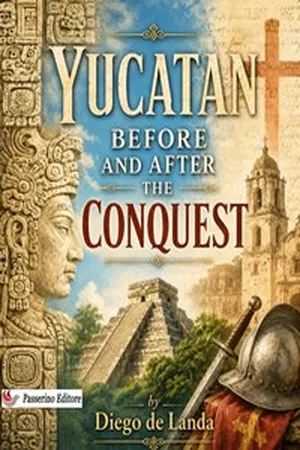
Yucatan Before and After the Conquest is one of the most remarkable and controversial accounts of the encounter between the Spanish conquerors and the Maya world.
Written by Diego de Landa, the Franciscan friar and later bishop of Yucatán, this work offers a vivid description of the land, customs, religion, calendar, rituals, social organization, and daily life of the Maya people in the sixteenth century. At once a historical document, an ethnographic testimony, and a window into a lost civilization, it remains an essential source for anyone seeking to understand pre-Columbian Mesoamerica and the dramatic transformations brought by the Spanish conquest.
Landa’s text is especially important because it preserves precious information about Maya beliefs, ceremonies, writing, and chronology—details that might otherwise have disappeared forever. Yet it is also marked by the contradictions of its author: the same man who recorded invaluable knowledge of Maya culture also played a role in the destruction of many Maya manuscripts and religious objects.
This tension gives the book its enduring power. It is not only a chronicle of conquest, but also a complex testimony to cultural encounter, loss, violence, memory, and survival.
For historians, students, and general readers interested in the Maya, the Spanish conquest, colonial history, and the origins of modern Yucatán, Yucatan Before and After the Conquest remains an indispensable classic.
Diego de Landa (1524–1579) was a Spanish Franciscan friar, missionary, and later bishop of Yucatán. He is best known for his work Yucatan Before and After the Conquest, also known as Relación de las cosas de Yucatán, one of the most important early accounts of Maya civilization. Landa arrived in Yucatán in the sixteenth century and studied the language, customs, religion, calendar, and social life of the Maya. His writings preserved valuable information about Maya culture that might otherwise have been lost. At the same time, he remains a deeply controversial figure because he was responsible for the destruction of many Maya manuscripts, idols, and religious objects during campaigns against native religious practices. For this reason, Diego de Landa is remembered both as a crucial witness to Maya civilization and as one of the figures involved in the cultural devastation that followed the Spanish conquest of the Americas.
- English
- ePUB (mobile friendly)
- Available on iOS & Android
eBook - ePub
Yucatan Before and After the Conquest
About this book
Information
Subtopic
North American HistoryIndex
HistoryTable of contents
- Cover
- Yucatan Before and After the Conquest
- Table of contents
- Dedication
- Introduction
- 1. Description Of Yucatan. Variety Of Seasons
- 2. Etymology Of The Name Of This Province. Its Situation
- 3. Captivity Of Geronimo De Aguilar
- 4. Expedition Of Cortes To Cozumel. Letter To Aguilar And His Friends
- 5. Provinces Of Yucatan. Its Principal. Ancient Structures
- 6. Cuculcan. Foundation Of Mayapan
- 7. Government, Priesthood, Sciences, Letters And Books In Yucatan
- 8. Arrival Of The Tutul-Xius And The Alliance They Made With The Lords Of Mayapan
- 9. Chronological Monuments Of Yucatan. Foundation Of The Kingdom Of Sotuta
- 10. Various Calamities Felt In Yucatan In The Period Before The Conquest By The Spaniards
- 11. Prophecies Of The Coming Of The Spaniards
- 12. Montejo Sails For Yucatan And Takes Possession Of The Country
- 13. Montejo Leaves Yucatan With All His People And Returns To Mexico
- 14. State Of Yucatan After The Departure Of The Spaniards
- 15. Cruelties Of The Spaniards Toward The Indians. How They Excused Themselves
- 16. State Of The Country Before The Conquest
- 17. Arrival Of The Spanish Franciscan Friars In Yucatan
- 18. Vices Of The Indians. Studies Of The Friars In The Language Of The Country
- 19. Arrival Of Bishop Toral And Release Of The Imprisoned Indians
- 20. Construction Of The Houses Of Yucatan
- 21. Food And Drink Of The Indians Of Yucatan
- 22. Painting And Tattooing Of The Indians
- 23. Industry, Commerce And Money
- 24. Method Of Counting Of The Yucatecans
- 25. Divorces Frequent Among The Yucatecans
- 26. Method Of Baptism In Yucatan; How It Was Celebrated
- 27. Kind Of Confessions Among The Indians
- 28. Sacrifices And Self-Mortifications, Both Cruel And Obscene, Among The Yucatecans
- 29. Arms Of The Yucatecans
- 30. Penalties And Punishments For Adulterers, Homicides And Thieves
- 31. Clothing And Ornaments Of The Indian Women
- 32. Chastity And Education Of The Indian Women Of Yucatan
- 33. Funerals, Burials Of The Priests
- 34. Count Of The Yucatecan Year
- 35. Festivals Of The 'Unlucky' Days
- 36. Sacrifices For The New Year Of The Character Muluc
- 37. Sacrifices For The New Year With The Sign Ix
- 38. Sacrifices Of The New Year Of The Letter Cauac
- 39. The Author's Explanation As To Various Things In The Calendar
- 40. Months And Festivals Of The Yucatecan Calendar
- 41. Cycle Of The Mayas. Their Writings
- 42. Multitude Of Buildings In Yucatan
- 43. For What Other Things The Indians Made Sacrifices
- 44. The Soil And Its Products
- 45. The Waters And The Fishes Found In Them
- 46. How There Are Serpents And Other Poisonous Animals
- 47. Of The Bees And Their Honey And Wax
- 48. Of The Plants, Flowers And Trees; Of The Fruits And Other Edibles
- 49. Of The Birds
- 50. Of The Larger Animals, And Of The Smaller Ones
- 51. The Author's Conclusion And Appeal
- 52. Criticism And Correction Of Certain Statements
- Letter In Maya To The King
- Letter Of Francisco De Montejo Xiu
- Letter Of Diego Rodríguez Bibanco
- The Xiu Family Papers
- The Map, And The Meeting At Maní
- The 1685 Page By Juan Xiu
- Yucatan In 1549 And 1579
- The Ordinances Of Tomás López
- Proclamation
- Identification Of Plant Names Mentioned In Landa's Text
Trusted by 375,005 students
Access to over 1.5 million titles for a fair monthly price.
Study more efficiently using our study tools.
Frequently asked questions
Yes, you can cancel anytime from the Subscription tab in your account settings on the Perlego website. Your subscription will stay active until the end of your current billing period. Learn how to cancel your subscription
No, books cannot be downloaded as external files, such as PDFs, for use outside of Perlego. However, you can download books within the Perlego app for offline reading on mobile or tablet. Learn how to download books offline
Perlego offers two plans: Essential and Complete
- Essential is ideal for learners and professionals who enjoy exploring a wide range of subjects. Access the Essential Library with 800,000+ trusted titles and best-sellers across business, personal growth, and the humanities. Includes unlimited reading time and Standard Read Aloud voice.
- Complete: Perfect for advanced learners and researchers needing full, unrestricted access. Unlock 1.5M+ books across hundreds of subjects, including academic and specialized titles. The Complete Plan also includes advanced features like Premium Read Aloud and Research Assistant.
We are an online textbook subscription service, where you can get access to an entire online library for less than the price of a single book per month. With over 1.5 million books across 990+ topics, we’ve got you covered! Learn about our mission
Look out for the read-aloud symbol on your next book to see if you can listen to it. The read-aloud tool reads text aloud for you, highlighting the text as it is being read. You can pause it, speed it up and slow it down. Learn more about Read Aloud
Yes! You can use the Perlego app on both iOS and Android devices to read anytime, anywhere — even offline. Perfect for commutes or when you’re on the go.
Please note we cannot support devices running on iOS 13 and Android 7 or earlier. Learn more about using the app
Please note we cannot support devices running on iOS 13 and Android 7 or earlier. Learn more about using the app
Yes, you can access Yucatan Before and After the Conquest by Diego de Landa in PDF and/or ePUB format, as well as other popular books in History & North American History. We have over 1.5 million books available in our catalogue for you to explore.