eBook - PDF
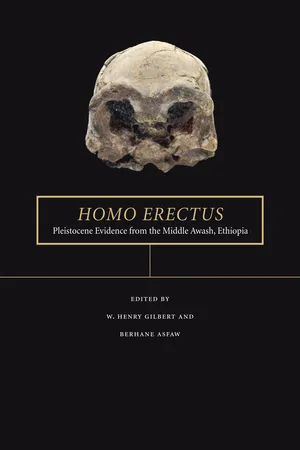
Homo erectus
Pleistocene Evidence from the Middle Awash, Ethiopia
- 481 pages
- English
- PDF
- Available on iOS & Android
eBook - PDF
Homo erectus
Pleistocene Evidence from the Middle Awash, Ethiopia
About this book
This volume, the first in a series devoted to the paleoanthropological resources of the Middle Awash Valley of Ethiopia, studies Homo erectus, a close relative of Homo sapiens. Written by a team of highly regarded scholars, this book provides the first detailed descriptions, photographs, and analysis of the fossil vertebrates—from elephants and hyenas to humans—from the Daka Member of the Bouri Formation of the Afar, a place renowned for an abundant and lengthy record of human ancestors. These fossils contribute to our understanding human evolution, and the associated fauna provide new information about the distribution and variability of Pleistocene mammals in eastern Africa. The contributors are all active researchers who worked on the paleontology and geology of these unique deposits. Here they have combined their disparate efforts into a single volume, making the original research results accessible to both the specialist and the general reader. The volume synthesizes environmental backdrop and anatomical detail to open an unparalleled window on the African Pleistocene and its inhabitants.
Information
Publisher
University of California PressYear
2009Print ISBN
9780520251205
Edition
1eBook ISBN
9780520933774
Table of contents
- Cover
- Table of Contents
- Contributors
- Foreword
- Series Preface
- Acknowledgments
- 1. Introduction
- 2. Geology and Geochronology
- 3. Bovidae
- 4. Carnivora
- 5. Cercopithecidae
- 6. Equidae
- 7. Giraffidae
- 8. Hippopotamidae
- 9. Elephantidae
- 10. Rhinocerotidae
- 11. Suidae
- 12. Rare Taxa
- 13.Homo erectus Cranial Anatomy
- 14. Tomographic Analysis of the Daka Calvaria
- 15.Hominid Systematics
- 16. Daka Member HominidPostcranial Remains
- 17. Ecological and BiogeographicContext of the Daka Member
- 18. Conclusions
- Bibliography
- Index
Trusted by 375,005 students
Access to over 1.5 million titles for a fair monthly price.
Study more efficiently using our study tools.
Frequently asked questions
Yes, you can cancel anytime from the Subscription tab in your account settings on the Perlego website. Your subscription will stay active until the end of your current billing period. Learn how to cancel your subscription
No, books cannot be downloaded as external files, such as PDFs, for use outside of Perlego. However, you can download books within the Perlego app for offline reading on mobile or tablet. Learn how to download books offline
Perlego offers two plans: Essential and Complete
- Essential is ideal for learners and professionals who enjoy exploring a wide range of subjects. Access the Essential Library with 800,000+ trusted titles and best-sellers across business, personal growth, and the humanities. Includes unlimited reading time and Standard Read Aloud voice.
- Complete: Perfect for advanced learners and researchers needing full, unrestricted access. Unlock 1.5M+ books across hundreds of subjects, including academic and specialized titles. The Complete Plan also includes advanced features like Premium Read Aloud and Research Assistant.
We are an online textbook subscription service, where you can get access to an entire online library for less than the price of a single book per month. With over 1.5 million books across 990+ topics, we’ve got you covered! Learn about our mission
Look out for the read-aloud symbol on your next book to see if you can listen to it. The read-aloud tool reads text aloud for you, highlighting the text as it is being read. You can pause it, speed it up and slow it down. Learn more about Read Aloud
Yes! You can use the Perlego app on both iOS and Android devices to read anytime, anywhere — even offline. Perfect for commutes or when you’re on the go.
Please note we cannot support devices running on iOS 13 and Android 7 or earlier. Learn more about using the app
Please note we cannot support devices running on iOS 13 and Android 7 or earlier. Learn more about using the app
Yes, you can access Homo erectus by W. Henry Gilbert, Berhane Asfaw, W. Henry Gilbert,Berhane Asfaw in PDF and/or ePUB format, as well as other popular books in Social Sciences & Evolution. We have over 1.5 million books available in our catalogue for you to explore.