- 252 pages
- English
- PDF
- Available on iOS & Android
eBook - PDF
About this book
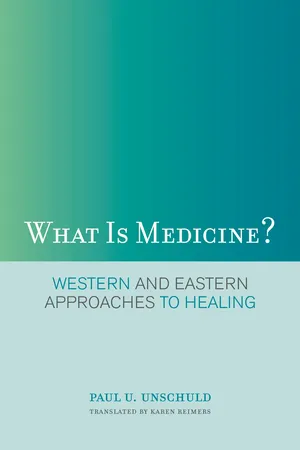
What Is Medicine? Western and Eastern Approaches to Healing is the first comparative history of two millennia of Western and Chinese medicine from their beginnings in the centuries BCE through present advances in sciences like molecular biology and in Western adaptations of traditional Chinese medicine. In his revolutionary interpretation of the basic forces that undergird shifts in medical theory, Paul U. Unschuld relates the history of medicine in both Europe and China to changes in politics, economics, and other contextual factors. Drawing on his own extended research of Chinese primary sources as well as his and others' scholarship in European medical history, Unschuld argues against any claims of "truth" in former and current, Eastern and Western models of physiology and pathology. What Is Medicine? makes an eloquent and timely contribution to discussions on health care policies while illuminating the nature of cognitive dynamics in medicine, and it stimulates fresh debate on the essence and interpretation of reality in medicine's attempts to manage the human organism.
Information
Publisher
University of California PressYear
2009Print ISBN
9780520257658
Edition
1eBook ISBN
9780520944701
Table of contents
- Cover
- Title
- Copyright
- Contents
- Preface
- 1 Life = Body Plus X
- 2 Medicine, or Novelty Appeal
- 3 Why Laws of Nature?
- 4 Longing for Order
- 5 Ethics and Legality
- 6 Why Here? Why Now?
- 7 Thales’ Trite Observation
- 8 Polis, Law, and Self-determination
- 9 The Individual and the Whole
- 10 Nonmedical Healing
- 11 Mawangdui: Early Healing in China
- 12 Humans Are Biologically Identical across Cultures. So Why Not Medicine?
- 13 The Yellow Thearch’s Body Image
- 14 The Birth of Chinese Medicine
- 15 The Division of the Elite
- 16 A View to the Visible, and Opinions on the Invisible
- 17 State Concept and Body Image
- 18 Farewell to Demons and Spirits
- 19 New Pathogens, and Morality
- 20 Medicine without Pharmaceutics
- 21 Pharmaceutics without Medicine
- 22 Puzzling Parallels
- 23 The Beginning of Medicine in Greece
- 24 The End of Monarchy
- 25 Troublemakers and Ostracism
- 26 I See Something You Don’t See
- 27 Powers of Self-healing: Self-evident?
- 28 Confucians’ Fear of Chaos
- 29 Medicine: Expression of the General State of Mind
- 30 Dynamic Ideas and Faded Model Images
- 31 The Hour of the Dissectors
- 32 Manifold Experiences of the World
- 33 Greek Medicine and Roman Incomprehension
- 34 Illness as Stasis
- 35 Head and Limbs
- 36 The Rediscovery of Wholeness
- 37 To Move the Body to a Statement
- 38 Galen of Pergamon: Collector in All Worlds
- 39 Europe’s Ancient Pharmacology
- 40 The Wheel of Progress Turns No More
- 41 Constancy and Discontinuity of Structures
- 42 Arabian Interlude
- 43 The Tang Era: Cultural Diversity, Conceptual Vacuum
- 44 Changes in the Song Era
- 45 The Authority of Distant Antiquity
- 46 Zhang Ji’s Belated Honors
- 47 Chinese Pharmacology
- 48 The Diagnosis Game
- 49 The Physician as the Pharmacist’s Employee
- 50 Relighting the Torch of European Antiquity
- 51 The Primacy of the Practical
- 52 The Variety of Therapeutics
- 53 Which Model Image for a New Medicine?
- 54 The Real Heritage of Antiquity
- 55 Galenism as Trade in Antiques
- 56 Integration and Reductionism in the Song Dynasty
- 57 The New Freedom to Expand Knowledge
- 58 Healing the State, Healing the Organism
- 59 Trapped in the Cage of Tradition
- 60 Xu Dachun, Giovanni Morgagni, and Intra-abdominal Abscesses
- 61 Acupuncturists, Barbers, and Masseurs
- 62 No Scientific Revolution in Medicine
- 63 The Discovery of New Worlds
- 64 Paracelsus: A Tumultuous Mind with an Overview
- 65 Durable and Fragile Cage Bars
- 66 The Most Beautiful Antiques and the Most Modern Images in One Room
- 67 Harvey and the Magna Carta
- 68 A Cartesian Case for Circulation
- 69 Long Live the Periphery!
- 70 Out of the Waiting Shelter, into the Jail Cell
- 71 Sensations That Pull into the Lower Parts of the Body
- 72 Homeopathy Is Not Medicine
- 73 “God with Us” on the Belt Buckle
- 74 Medicine Independent of Theology
- 75 Virchow: The Man of Death as the Interpreter of Life
- 76 Robert Koch: Pure Science?
- 77 Wash Your Hands, Keep the Germs Away
- 78 AIDS: The Disease That Fits
- 79 China in the Nineteenth Century: A New Cage Opens Up
- 80 Two Basic Ideas of Medicine
- 81 Value-free Biology and Cultural Interpretation
- 82 A Transit Visa and a Promise
- 83 Scorn, Mockery, and Invectives for Chinese Medicine
- 84 Traditional Medicine in the PRC: Faith in Science
- 85 The Arabs of the Twentieth Century, or Crowding in the Playpen
- 86 When the Light Comes from Behind
- 87 In the Beginning Was the Word
- 88 Out of Touch with Nature
- 89 Theology without Theos
- 90 Everything Will Be Fine
- 91 Left Alone in the Computer Tomograph
- 92 Healing and the Energy Crisis
- 93 TCM: Western Fears, Chinese Set Pieces
- 94 Harmony, Not War
- 95 The Loss of the Center
- 96 Contented Customers in a Supermarket of Possibilities
- 97 The More Things Change
- 98 One World, or Tinkering with Building Blocks
- 99 A Vision of Unity over All Diversity
- Afterword
- Notes
- Index
Trusted by 375,005 students
Access to over 1.5 million titles for a fair monthly price.
Study more efficiently using our study tools.
Frequently asked questions
Yes, you can cancel anytime from the Subscription tab in your account settings on the Perlego website. Your subscription will stay active until the end of your current billing period. Learn how to cancel your subscription
No, books cannot be downloaded as external files, such as PDFs, for use outside of Perlego. However, you can download books within the Perlego app for offline reading on mobile or tablet. Learn how to download books offline
Perlego offers two plans: Essential and Complete
- Essential is ideal for learners and professionals who enjoy exploring a wide range of subjects. Access the Essential Library with 800,000+ trusted titles and best-sellers across business, personal growth, and the humanities. Includes unlimited reading time and Standard Read Aloud voice.
- Complete: Perfect for advanced learners and researchers needing full, unrestricted access. Unlock 1.5M+ books across hundreds of subjects, including academic and specialized titles. The Complete Plan also includes advanced features like Premium Read Aloud and Research Assistant.
We are an online textbook subscription service, where you can get access to an entire online library for less than the price of a single book per month. With over 1.5 million books across 990+ topics, we’ve got you covered! Learn about our mission
Look out for the read-aloud symbol on your next book to see if you can listen to it. The read-aloud tool reads text aloud for you, highlighting the text as it is being read. You can pause it, speed it up and slow it down. Learn more about Read Aloud
Yes! You can use the Perlego app on both iOS and Android devices to read anytime, anywhere — even offline. Perfect for commutes or when you’re on the go.
Please note we cannot support devices running on iOS 13 and Android 7 or earlier. Learn more about using the app
Please note we cannot support devices running on iOS 13 and Android 7 or earlier. Learn more about using the app
Yes, you can access What Is Medicine? by Paul U. Unschuld in PDF and/or ePUB format, as well as other popular books in Social Sciences & Medical Theory, Practice & Reference. We have over 1.5 million books available in our catalogue for you to explore.