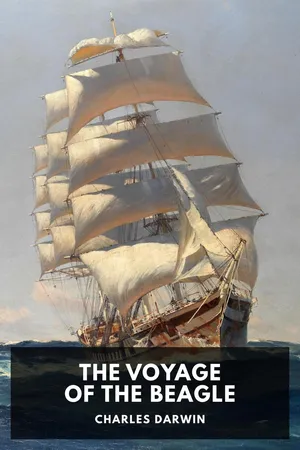
In 1831, the twenty-two-year old Charles Darwin embarked on the Royal Navy ship H.M.S. Beagle as it set off on what was to be a five-year-long surveying expedition around South America and across the Pacific. Darwin was employed officially as a naturalist and geologist to assist in the survey, but unofficially as a companion to the captain, Robert Fitz Roy.
Darwin was a keen and intelligent observer, and made a number of discoveries on the journey, including the observations at the Galapagos Archipelago which eventually led him to his theory of evolution (later outlined in The Origin of Species). His voyage across the Pacific also led him to propose a now largely accepted theory of the formation of coral atolls.
Darwin submitted his journal and notes as part of the official report of the expedition, but in 1839 he published a more readable account of his experiences in this book. Adding to the interest of Darwin's detailed and thorough observations of nature and geology are his deeply critical remarks on the institution of slavery, which he witnessed during his time in Brazil.