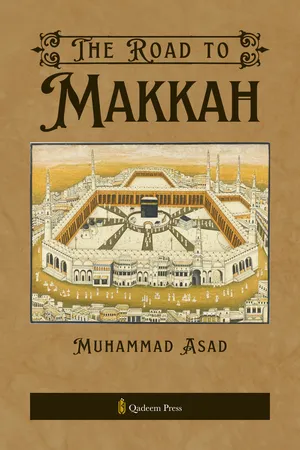
When The Road to Makkah appeared in 1954, the New York publisher who accepted it had little reason to anticipate what followed. Its author had resigned the previous year as Pakistan's first Minister Plenipotentiary to the United Nations in order to write a memoir he later admitted he had never originally intended to compose. Yet the book became one of the unexpected publishing successes of the postwar decade — reviewed in The New York Times, the Times Literary Supplement, and widely discussed across the European Catholic and Protestant press. Within two decades it had been translated into more than two dozen languages and absorbed into the reading lives of audiences crossing many of the same cultural and religious boundaries its author himself had crossed.
The reasons for its enduring appeal are not difficult to understand. Muhammad Asad — born Leopold Weiss in 1900 to a family of Galician rabbis — was uniquely positioned to write the story he wrote. He came to Islam not after lifelong residence among Muslims but before it, declaring the shahada in Berlin in September 1926 after several years of journalism in the Middle East and an intellectually restless youth in Vienna and Berlin. His training in Hebrew, Aramaic, and Talmudic commentary gave him an unusual sensitivity to sacred-language scholarship, one that later informed his approach to Arabic and Islamic thought. His six years in Saudi Arabia placed him at the centre of an emerging modern state during its formative years, while his later intellectual association with Muhammad Iqbal in British India connected him directly to the philosophical foundations of Pakistan. Few twentieth-century memoirs draw upon such a breadth of lived historical experience.
The architecture of the book itself distinguishes it from most spiritual autobiographies. Asad frames the narrative around the twenty-three-day desert journey he undertook in 1932 from the Iraqi frontier oasis of Qasr Athaymin southwestward across the Great Nufud to Mecca alongside his Najdi companion Zayd ibn Ghanim. The present-tense account of that journey — the wells, campsites, Bedouin encounters, long conversations beside desert fires — becomes the thread upon which memories from earlier years are gradually woven. His childhood in Galicia, the intellectual atmosphere of Vienna, his hunger years in Berlin, the death of his first wife in Mecca, his friendship with Ibn Saud, his travels in Libya, and his meeting with Iqbal in Lahore all emerge organically from the movement of the road itself.
The result is a memoir that enacts the very transformation it describes. The physical movement toward Mecca becomes inseparable from a gradual movement toward conviction. Asad does not merely tell the reader that he accepted Islam; he demonstrates the experiences, observations, conversations, and reflections through which Islam became intellectually and spiritually intelligible to him. The journey itself becomes the argument.
That argument unfolds not as formal apologetics but through lived experience. Through years among Muslim communities, Asad came to believe that Islam offered a coherent vision of human life — one that integrated spiritual, intellectual, social, and political dimensions without severing sacred life from ordinary existence. He concluded that the Western understanding of Islam had been distorted from the time of the Crusades onward and that many assumptions modern Europeans regarded as universal were in fact products of specific European historical developments. Islam, in his experience, offered a fundamentally different civilizational possibility.
These ideas emerge not through abstract theorizing but through conversations with Ibn Saud about kingship and justice, with Iqbal about the future of Muslim civilization, with scholars in Medina about hadith and tradition, and with Bedouin companions about honor, loyalty, and hospitality. Asad's prose remains disciplined, lucid, and free from devotional excess. He writes as a journalist shaped by the European intellectual tradition who learned to read the Islamic tradition from within.
The Arabia preserved in The Road to Makkah is the Arabia of the late 1920s and early 1930s — before oil wealth transformed the region beyond recognition. The book records, with unusual fidelity, the textures of a world that disappeared within a generation: Bedouin caravan routes, the etiquette of the majlis, the marketplaces of Mecca and Medina before modern reconstruction, the politics of the Ikhwan revolt, and the fragile process through which Ibn Saud consolidated rule over Arabia. As a historical document alone, the work possesses extraordinary value.
Its portrait of Ibn Saud remains equally remarkable. Asad knew the king personally over many years and records not only his political abilities but also his humanity: his eloquence, melancholy, pragmatism, grief, and eventual accommodation to the pressures of oil wealth and foreign concessions. The portrait is neither hagiographic nor hostile; it reflects the honesty of someone who admired a ruler while observing him without illusion.
Beneath the historical and political narrative runs a more intimate reflection on belonging, faith, and identity. Asad writes movingly about what it means to enter a tradition not by inheritance but by conscious choice. The emotional centre of the book lies not merely in conversion itself, nor even in the pilgrimage to Mecca, but in the realization that the restlessness that had carried him from Lwow to Vienna, Berlin, Jerusalem, and Arabia was ultimately a search for spiritual and communal belonging.
More than seventy years after its first publication, The Road to Makkah remains one of the finest examples of religious autobiography written in the modern period. It continues to serve simultaneously as memoir, travel narrative, intellectual history, historical witness, and meditation on faith. Read alongside Asad's later works — particularly The Message of the Qur'an and Islam at the Crossroads — it provides indispensable insight into the experiences that shaped one of the twentieth century's most important Muslim intellectual voices.
This edition preserves the complete original text together with Asad's glossary and notes, presenting a modern readership with a work whose literary, historical, and spiritual significance has only deepened with time.