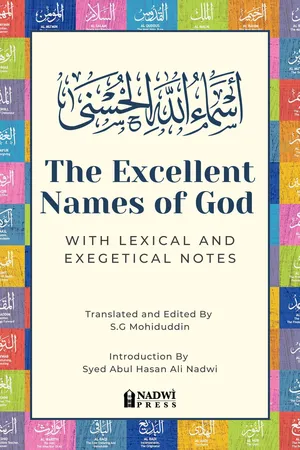
THE EXCELLENT NAMES OF GOD: With Lexical and Exegetical Notes presents one of the most theologically significant dimensions of Islamic faith — the ninety-nine Most Beautiful Names of God (al-asma al-husna) — in a format that serves both devotional practice and scholarly inquiry. Published by the Academy of Islamic Research and Publications (AIRP) at Nadwatul Ulama, Lucknow, this second edition (2018) continues a long tradition of authoritative Islamic scholarly publication in English from one of South Asia's most distinguished Islamic institutions.
The Qur'an commands: "Allah's are the excellent names, so call Him by them" (Surah al-Araf: 180). The Prophetic Tradition records that anyone who encompasses these Names in memory, faith, and practice shall enter Paradise. From these twin foundations — Qur'anic command and Prophetic promise — has grown one of the richest traditions in Islamic theology and spirituality: the study, recitation, and contemplation of the Divine Names. This volume serves as both an entry point into that tradition and a reliable scholarly reference for those who already inhabit it.
The text is organised into three sections. A learned Introduction by S. Abul Hasan Ali Nadwi — for decades the rector of Nadwatul Ulama and among the most eminent Islamic scholars and writers of the twentieth century — sets out the theological rationale for the study of divine attributes. Nadwi traces the human need to know God's names and qualities, arguing that without such knowledge, faith becomes cold formalism incapable of generating the love, devotion, and ethical transformation that authentic religion demands. He engages the history of philosophy and comparative religion — Greek metaphysics, Hindu polytheism, Biblical monotheism — with scholarly confidence, identifying the Qur'anic conception of God as avoiding the twin errors of abstract negation (the Greek philosophical God, stripped of attributes and therefore incapable of inspiring devotion) and mythological excess (the deification of individual attributes producing a pantheon of lesser gods). Islam, he argues, maintains the Unity of God while affirming the full range of His attributes: power and mercy, transcendence and nearness, justice and forgiveness, all in perfect coherence.
The Preliminary Remarks section provides the scholarly framework for the main text. It identifies the source of the ninety-nine Names as the Awrad-i-Rahmani Azkar-i-Subhani of Mawlana Ashraf Ali Thanwi — the great Deobandi scholar and spiritual guide — and explains the distribution of Names across the three categories of divine glorification: Subhan Allah (five Names denoting separation from all imperfections), Al-hamdulillah (sixty-eight Names relating to divine praise), and Allahu Akbar (twenty-one Names glorifying divine greatness). It also lists the full scholarly apparatus employed throughout the notes: Lane's Arabic-English Lexicon (LL), the Tafsir al-Qur'an of Abdul Majid Daryabadi (AM), al-Raghib al-Asfahani's al-Mufradat fi Gharib al-Qur'an (Rgh), The Meaning of the Glorious Qur'an by Abdullah Yusuf Ali (AYA), The Meaning of the Quran by Mawdudi (M), Vocabulary of the Quran by Abdullah Abbas Nadwi (AA), and Hughes's Dictionary of Islam (H).
The main text presents each of the ninety-nine Names in a consistent three-part structure. The Arabic name is given in full script alongside its transliteration and English rendering. The moral application (marked A), drawn from Mawlana Thanwi's work and supplemented by Mawlana Muhammad Qutb-ud-Din, draws out the practical and ethical implication of each Name for the believer's life: how does the knowledge that God is al-Ghaffar (the Most Forgiving) shape one's own capacity for forgiveness? How does meditating on al-Adl (the Just) discipline the exercise of justice in one's dealings? This dimension of the text rooted in the classical Islamic tradition of taking the divine attributes as a model for human character and conduct (takhallaqu bi-akhlaq Allah) makes the volume more than a reference work; it is a guide to a way of being.
The exegetical note (marked B), written by translator and editor Syed Ghulam Mohiuddin, furnishes the lexical, philological, and theological substance. For names occurring in the Qur'an — as most of them do — the relevant verses are cited in Arabic with English translation, and the exegetical tradition is brought to bear through the major sources listed. For Names that do not appear directly in the Qur'an but are established through hadith, the relevant traditions are cited and the Qur'anic concept underlying the Name is traced through cognate verses. In this way, every Name is firmly anchored in the scriptural and scholarly tradition, and the reader is given not only the meaning but the full theological weight of each attribute.
The range of divine attributes presented spans the complete theological landscape of Islamic theology (ilm al-kalam) and Sufi spiritual psychology. Among the Names treated with particular depth are Allah (the essential proper Name of the Divine Being, the Ismau'z-Zat, carefully distinguished from al-ilah and shown to resist derivation or pluralisation), Ar-Rahman and Ar-Rahim (the two forms of divine mercy — the former embracing all creation prior to any act of deserving, the latter operative in specific response to faith and repentance), Al-Hayy (the Ever-Living, affirmed in contrast to the dying deities of pagan mythologies), Al-Qayyum (the Self-Subsisting Sustainer of all, whose independence negates any notion of Godhead requiring complement), Al-Nur (the Light, interpreted through the magnificent Ayat al-Nur of Surah al-Nur), and Al-Samad (the Absolute and Eternal, to whom all recourse is owed and who depends upon no one). The treatment of Names like Al-Mutakabbir (the Supreme and Majestic), Al-Jabbar (the Irresistible and Mender), Al-Muntaqim (the Avenger), and Al-Mani (the Withholder) demonstrates the theological sophistication required to hold together divine majesty and divine mercy — a task this volume performs with notable care and balance.
Throughout, the text situates Islamic theology in dialogue with other religious and philosophical traditions. This is not polemics but scholarship: the reader encounters Greek Neoplatonism, Jewish Alexandrian philosophy, Hindu cosmology, and Christian Trinitarian doctrine not as adversaries to be refuted but as intellectual contexts within which the distinctive features of the Qur'anic conception of God become clearly visible.
The volume is part of AIRP Series No. 239, and its second edition in 2018 attests to its enduring relevance. It functions equally well as a text for mosque study circles, university courses in Islamic studies and comparative religion, interfaith dialogue, personal devotional practice, and scholarly reference. The breadth of its sources and the clarity of its English expression make it accessible to readers new to Islamic theology while its scholarly rigour ensures it meets the demands of the advanced student and researcher. In presenting the ninety-nine Names of God in their full lexical, exegetical, and spiritual richness, this volume embodies the conviction — shared by the scholars whose work it transmits — that knowing God's Names is not an academic exercise but the foundation of a fully human life.