Based on years of careful ethnographic fieldwork in Hanoi, Haunting Images offers a frank and compassionate account of the moral quandaries that accompany innovations in biomedical technology. At the center of the book are case studies of thirty pregnant women whose fetuses were labeled "abnormal" after an ultrasound examination. By following these women and their relatives through painful processes of reproductive decision making, Tine M. Gammeltoft offers intimate ethnographic insights into everyday life in contemporary Vietnam and a sophisticated theoretical exploration of how subjectivities are forged in the face of moral assessments and demands.
Across the globe, ultrasonography and other technologies for prenatal screening offer prospective parents new information and present them with agonizing decisions never faced in the past. For anthropologists, this diagnostic capability raises important questions about individuality and collectivity, responsibility and choice. Arguing for more sustained anthropological attention to human quests for belonging, Haunting Images addresses existential questions of love and loss that concern us all.
eBook - PDF
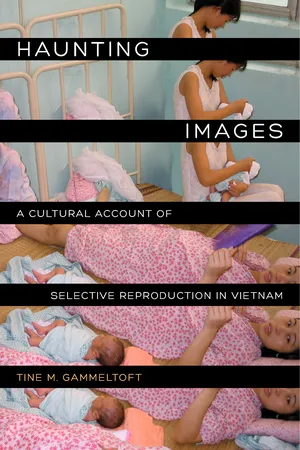
Haunting Images
A Cultural Account of Selective Reproduction in Vietnam
- 332 pages
- English
- PDF
- Available on iOS & Android
eBook - PDF
About this book
Information
Publisher
University of California PressYear
2014Print ISBN
9780520278424
Edition
1eBook ISBN
9780520958159
Table of contents
- Cover
- Contents
- List of Illustrations
- Acknowledgments
- Prologue: Haunting Decisions
- Introduction: Choice as Belonging
- 1. Sonographic Imaging and Selective Reproduction in Hanoi
- 2. A Collectivizing Biopolitics
- 3. Precarious Maternal Belonging
- 4. “Like a Loving Mother”: Moral Engagements in Medical Worlds
- 5. “How Have We Lived?” Accounting for Reproductive Misfortune
- 6. Beyond Knowledge: Everyday Encounters with Disability
- 7. Questions of Conscience
- Conclusion: Toward an Anthropology of Belonging
- Appendix: Core Cases
- Notes
- Bibliography
- Index
Trusted by 375,005 students
Access to over 1.5 million titles for a fair monthly price.
Study more efficiently using our study tools.
Frequently asked questions
Yes, you can cancel anytime from the Subscription tab in your account settings on the Perlego website. Your subscription will stay active until the end of your current billing period. Learn how to cancel your subscription
No, books cannot be downloaded as external files, such as PDFs, for use outside of Perlego. However, you can download books within the Perlego app for offline reading on mobile or tablet. Learn how to download books offline
Perlego offers two plans: Essential and Complete
- Essential is ideal for learners and professionals who enjoy exploring a wide range of subjects. Access the Essential Library with 800,000+ trusted titles and best-sellers across business, personal growth, and the humanities. Includes unlimited reading time and Standard Read Aloud voice.
- Complete: Perfect for advanced learners and researchers needing full, unrestricted access. Unlock 1.5M+ books across hundreds of subjects, including academic and specialized titles. The Complete Plan also includes advanced features like Premium Read Aloud and Research Assistant.
We are an online textbook subscription service, where you can get access to an entire online library for less than the price of a single book per month. With over 1.5 million books across 990+ topics, we’ve got you covered! Learn about our mission
Look out for the read-aloud symbol on your next book to see if you can listen to it. The read-aloud tool reads text aloud for you, highlighting the text as it is being read. You can pause it, speed it up and slow it down. Learn more about Read Aloud
Yes! You can use the Perlego app on both iOS and Android devices to read anytime, anywhere — even offline. Perfect for commutes or when you’re on the go.
Please note we cannot support devices running on iOS 13 and Android 7 or earlier. Learn more about using the app
Please note we cannot support devices running on iOS 13 and Android 7 or earlier. Learn more about using the app
Yes, you can access Haunting Images by Tine M. Gammeltoft in PDF and/or ePUB format, as well as other popular books in Social Sciences & Anthropology. We have over 1.5 million books available in our catalogue for you to explore.