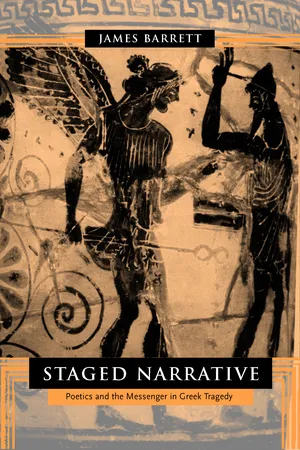
The messenger who reports important action that has occurred offstage is a familiar inhabitant of Greek tragedy. A messenger informs us about the death of Jocasta and the blinding of Oedipus, the madness of Heracles, the slaughter of Aigisthos, and the death of Hippolytus, among other important events. Despite its prevalence, this conventional figure remains only little understood. Combining several critical approaches—narrative theory, genre study, and rhetorical analysis—this lucid study develops a synthetic view of the messenger of Greek tragedy, showing how this role illuminates some of the genre's most persistent concerns, especially those relating to language, knowledge, and the workings of tragic theater itself.
James Barrett gives close readings of several plays including Aeschylus's Persians, Sophocles' Electra and Oedipus Tyrannus, and Euripides' Bacchae and Rhesos. He traces the literary ancestry of the tragic messenger, showing that the messenger's narrative constitutes an unexplored site of engagement with Homeric epic, and that the role illuminates fifth-century b.c. experimentation with modes of speech. Breaking new ground in the study of Athenian tragedy, Barrett deepens our understanding of many central texts and of a form of theater that highlights the fragility and limits of human knowledge, a theme explored by its use of the messenger.
- 277 pages
- English
- PDF
- Available on iOS & Android
eBook - PDF
About this book
Information
Publisher
University of California PressYear
2002Print ISBN
9780520231801
Edition
1eBook ISBN
9780520927933
Table of contents
- Cover
- Contents
- Acknowledgments
- List of Abbreviations
- Preface
- Introduction
- 1. Aeschylus’s Persians: The Messenger and Epic Narrative
- 2. The Literary Messenger, the Tragic Messenger
- 3. Euripides’ Bacchae: The Spectator in the Text
- 4. Homer and the Art of Fiction in Sophocles’ Electra
- 5. Rhesos and Poetic Tradition
- 6. Sophocles’ Oedipus Tyrannus: Epistemology and Tragic Practice
- Appendix: Messengers in Greek Tragedy
- Works Cited
- Index Locorum
- General Index
Trusted by 375,005 students
Access to over 1.5 million titles for a fair monthly price.
Study more efficiently using our study tools.
Frequently asked questions
Yes, you can cancel anytime from the Subscription tab in your account settings on the Perlego website. Your subscription will stay active until the end of your current billing period. Learn how to cancel your subscription
No, books cannot be downloaded as external files, such as PDFs, for use outside of Perlego. However, you can download books within the Perlego app for offline reading on mobile or tablet. Learn how to download books offline
Perlego offers two plans: Essential and Complete
- Essential is ideal for learners and professionals who enjoy exploring a wide range of subjects. Access the Essential Library with 800,000+ trusted titles and best-sellers across business, personal growth, and the humanities. Includes unlimited reading time and Standard Read Aloud voice.
- Complete: Perfect for advanced learners and researchers needing full, unrestricted access. Unlock 1.5M+ books across hundreds of subjects, including academic and specialized titles. The Complete Plan also includes advanced features like Premium Read Aloud and Research Assistant.
We are an online textbook subscription service, where you can get access to an entire online library for less than the price of a single book per month. With over 1.5 million books across 990+ topics, we’ve got you covered! Learn about our mission
Look out for the read-aloud symbol on your next book to see if you can listen to it. The read-aloud tool reads text aloud for you, highlighting the text as it is being read. You can pause it, speed it up and slow it down. Learn more about Read Aloud
Yes! You can use the Perlego app on both iOS and Android devices to read anytime, anywhere — even offline. Perfect for commutes or when you’re on the go.
Please note we cannot support devices running on iOS 13 and Android 7 or earlier. Learn more about using the app
Please note we cannot support devices running on iOS 13 and Android 7 or earlier. Learn more about using the app
Yes, you can access Staged Narrative by James Barrett in PDF and/or ePUB format, as well as other popular books in Literature & Ancient & Classical Literary Criticism. We have over 1.5 million books available in our catalogue for you to explore.