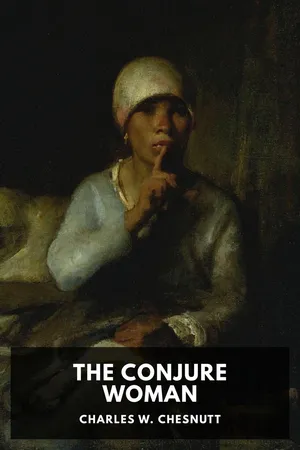
The Conjure Woman is a collection of fantastical stories narrated by Julius, a former slave, about life on the nearby plantations prior to the Civil War. Each involves an element of magic, be it a vine that dooms those who eat from it or a man transformed into a tree to avoid being separated from his wife. Julius's audience, a married couple who have just moved to the South to cultivate grapes, listen on with mixed sympathy and disbelief. They disagree on whether Julius is telling the truth and whether there is some deeper significance to the tales. At turns humorous and unsettling, these stories provide a surprising lens into the realities of slavery.
The text is notable for spelling out Julius's spoken accent. Although Julius has some stereotypical features of a simple-minded old slave, he is often regarded as a more clever and complicated figure. He seems to tell his tales not only to entertain his listeners, but to trick them to his advantage.
Many of these stories first appeared in national magazines, where they received popular acclaim, before being assembled as their own volume in 1899. Charles W. Chesnutt's race was not mentioned by the publisher, nor could many guess his African heritage based on his appearance. However, Chesnutt embraced his African-American identity and was a prominent activist for black rights. The Conjure Woman, his first book, is considered an important early work of African-American fiction.
This edition includes four additional Julius tales that appeared in magazines but were not collected during Chesnutt's lifetime.
Perfect for readers who love richly atmospheric tales that blend folklore with unflinching social commentary, this groundbreaking collection showcases Chesnutt's masterful storytelling and deep insight into the African American experience. These haunting, magical stories will captivate anyone drawn to the mysterious intersection of history, mythology, and human resilience.
The source for this public-domain ebook is Standard Ebooks (standardebooks.org). Ebooks from other sources often have typos, inconsistent spelling, missing accent marks, and missing punctuation. Ebooks from Standard Ebooks are proofread line by line against a scan of the original printed pages, then proofread again from cover to cover. They are also formatted and typeset following a professional-grade style manual, resulting in new editions supporting state-of-the-art ereader technology: automatic hyphenation, popup footnotes, complete and consistent metadata, high-resolution and scalable vector graphics, and ereader-compatible tables of contents. All of this makes the finished ebooks accurate, functional, and beautiful, a pleasure to read. (Waking Lion Press is not affiliated with or endorsed by Standard Ebooks.)