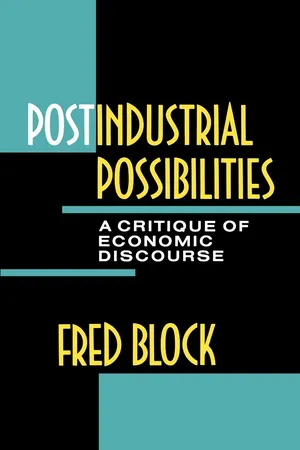
While it is often acknowledged that we live in a "postindustrial" age, our economic concepts have lagged far behind our postmodern sensibility. In this incisive new work, the well-known sociologist, Fred Block, sheds obsolete and shopworn economic analysis by presenting a bold, sweeping reconceptualization of the economy. Postindustrial Possibilities provides a fresh understanding of the dynamics of postindustrial change while offering a roadmap for future economic thinking.
Block takes as his point of departure the tired concepts of neo-classical economics which, while still dominant, fall short as tools for comprehending contemporary economic forces. In Block's mind, the failure to revise the concepts of industrial economics means that the reality of today's economy is increasingly understood as "through a glass darkly." Intent on reinvigorating thinking in this area, Block masterfully critiques the central categories of neo-classical economics, such as the market, labor, and capital.
Block argues that the neo-classical tradition has obscured the fact that capitalist prosperity has been built not on "free markets" but rather on systematic constraints on market freedom. He further suggests that measurements of capital have become increasingly problematic and that the concept obscures the critical sources of productivity within organizations. In his far-reaching analysis of the Gross National Product, Block shows that there is a growing divergence between the factors that determine people's well-being and trends in measured GNP.
Postindustrial Possibilities sets forth a new intellectual paradigm that might be called "Qualitative Growth." One of its primary foci is a shift toward improved product quality and greater priority for various non-commodity satisfactions such as leisure, interesting work, economic security and a safe and clean environment. It also promotes a recognition that greater economic efficiency rests not on infusions of capital but on cooperative labor relations and on institutional reform.
Wide-ranging, intellectually vibrant and lucid, Postindustrial Possibilities will engender controversy and debate. It is an enormous contribution that social scientists and policymakers will need to come to terms with.
- 238 pages
- English
- PDF
- Available on iOS & Android
eBook - PDF
About this book
Information
Table of contents
- Cover
- Contents
- Preface
- 1. The Postindustrial Context
- 2. Economic Sociology
- 3. The Market
- 4. Labor
- 5. Capital
- 6. Output
- 7. Alternatives: Qualitative Growth
- Index
Trusted by 375,005 students
Access to over 1.5 million titles for a fair monthly price.
Study more efficiently using our study tools.
Frequently asked questions
Yes, you can cancel anytime from the Subscription tab in your account settings on the Perlego website. Your subscription will stay active until the end of your current billing period. Learn how to cancel your subscription
No, books cannot be downloaded as external files, such as PDFs, for use outside of Perlego. However, you can download books within the Perlego app for offline reading on mobile or tablet. Learn how to download books offline
Perlego offers two plans: Essential and Complete
- Essential is ideal for learners and professionals who enjoy exploring a wide range of subjects. Access the Essential Library with 800,000+ trusted titles and best-sellers across business, personal growth, and the humanities. Includes unlimited reading time and Standard Read Aloud voice.
- Complete: Perfect for advanced learners and researchers needing full, unrestricted access. Unlock 1.5M+ books across hundreds of subjects, including academic and specialized titles. The Complete Plan also includes advanced features like Premium Read Aloud and Research Assistant.
We are an online textbook subscription service, where you can get access to an entire online library for less than the price of a single book per month. With over 1.5 million books across 990+ topics, we’ve got you covered! Learn about our mission
Look out for the read-aloud symbol on your next book to see if you can listen to it. The read-aloud tool reads text aloud for you, highlighting the text as it is being read. You can pause it, speed it up and slow it down. Learn more about Read Aloud
Yes! You can use the Perlego app on both iOS and Android devices to read anytime, anywhere — even offline. Perfect for commutes or when you’re on the go.
Please note we cannot support devices running on iOS 13 and Android 7 or earlier. Learn more about using the app
Please note we cannot support devices running on iOS 13 and Android 7 or earlier. Learn more about using the app
Yes, you can access Postindustrial Possibilities by Fred L. Block in PDF and/or ePUB format, as well as other popular books in Politica e relazioni internazionali & Economia politica. We have over 1.5 million books available in our catalogue for you to explore.