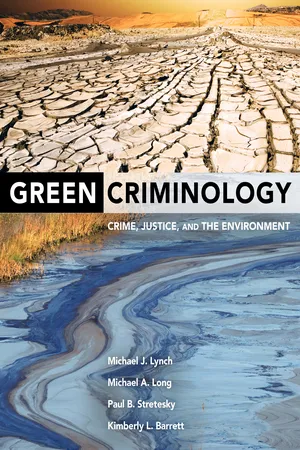
This groundbreaking text provides students with an overview and assessment of green criminology as well as a call to action. Green Criminology draws attention to the ways in which the political-economic organization of capitalism causes ecological destruction and disorganization. Focusing on real-world issues of green crime and environmental justice, chapters examine ecological withdrawals, ecological additions, toxic towns, wildlife poaching and trafficking, environmental laws, and nongovernmental environmental organizations. The book also presents an unintimidating introduction to research from the physical sciences on issues such as climate change, pollution levels, and the ecological footprint of humans, providing a truly interdisciplinary foundation for green criminological analysis.
To help students succeed in the course—and to encourage them to see themselves as future green criminology researchers—the end-of-chapter study guides include:
• Questions and Activities for Students that review topics students should be able to conceptualize and address.
• Lessons for Researchers that suggest additional areas of research in the study of green crime.
eBook - PDF
Green Criminology
Crime, Justice, and the Environment
- 326 pages
- English
- PDF
- Available on iOS & Android
eBook - PDF
Green Criminology
Crime, Justice, and the Environment
About this book
Information
Publisher
University of California PressYear
2017Print ISBN
9780520289635
Edition
1eBook ISBN
9780520964228

21
CHAPTER
C
hapter
1
provided
an
introduction
to
and
overview
of
green
criminology
and
green
crimes.
is
chap-
ter
assesses
the
current
state
of
green
criminology
by
posing
two
broad
questions:
(1)
What
specific
environ-
mental
issues
do
green
criminologists
study,
and
(2)
how
do
green
criminologists
produce
knowledge
about
green
crimes?
To
address
the
first
question,
we
briefly
review
the
kinds
of
research
green
criminologists
undertake
and
identify
key
themes
in
green
criminology
scholarship.
To
address
the
second
question,
we
describe
criminologists’
use
of
social
science
methods
to
identify,
describe,
and
explain
numerous
forms
of
green
crime
and
discuss
five
different
approaches
criminologists
have
taken
to
the
study
of
green
and
environmental
crimes.
TOPICS
OF
INTEREST
FOR
GREEN
CRIMINOLOGISTS
e
term
green
criminology
was
first
introduced
into
the
literature
in
1990,
when
Michael
J.
Lynch
(1990)
argued
that
criminologists
should
study
green
crimes
as
specific
examples
of
crimes
against
justice
committed
by
the
pow-
erful.
Of
particular
concern,
Lynch
argued,
is
the
relation-
ship
between
destruction
of
the
natural
environment
The
State
of
Green
Criminology
2
Table of contents
- Cover
- Contents
- List of Illustrations
- Preface
- Acknowledgments
- 1. Introduction: Green Criminology and Political Economy
- 2. The State of Green Criminology
- 3. Pollution Crimes
- 4. Withdrawal Crimes
- 5. Crimes of Ecological Additions and Illness
- 6. Crimes of Overproduction and Overconsumption
- 7. Toxic Towns and Studies of Ecologically Devastated Communities
- 8. Wildlife Trafficking, Smuggling, and Poaching
- 9. Environmental Justice and Green Criminology
- 10. The Treadmill of Environmental Law
- 11. Environmental Social Movements and Environmental Nongovernmental Organizations
- 12. Connecting the Dots: Explaining Green Crimes
- References
- Index
Trusted by 375,005 students
Access to over 1.5 million titles for a fair monthly price.
Study more efficiently using our study tools.
Frequently asked questions
Yes, you can cancel anytime from the Subscription tab in your account settings on the Perlego website. Your subscription will stay active until the end of your current billing period. Learn how to cancel your subscription
No, books cannot be downloaded as external files, such as PDFs, for use outside of Perlego. However, you can download books within the Perlego app for offline reading on mobile or tablet. Learn how to download books offline
Perlego offers two plans: Essential and Complete
- Essential is ideal for learners and professionals who enjoy exploring a wide range of subjects. Access the Essential Library with 800,000+ trusted titles and best-sellers across business, personal growth, and the humanities. Includes unlimited reading time and Standard Read Aloud voice.
- Complete: Perfect for advanced learners and researchers needing full, unrestricted access. Unlock 1.5M+ books across hundreds of subjects, including academic and specialized titles. The Complete Plan also includes advanced features like Premium Read Aloud and Research Assistant.
We are an online textbook subscription service, where you can get access to an entire online library for less than the price of a single book per month. With over 1.5 million books across 990+ topics, we’ve got you covered! Learn about our mission
Look out for the read-aloud symbol on your next book to see if you can listen to it. The read-aloud tool reads text aloud for you, highlighting the text as it is being read. You can pause it, speed it up and slow it down. Learn more about Read Aloud
Yes! You can use the Perlego app on both iOS and Android devices to read anytime, anywhere — even offline. Perfect for commutes or when you’re on the go.
Please note we cannot support devices running on iOS 13 and Android 7 or earlier. Learn more about using the app
Please note we cannot support devices running on iOS 13 and Android 7 or earlier. Learn more about using the app
Yes, you can access Green Criminology by Michael J. Lynch,Michael A. Long,Paul B. Stretesky,Kimberly L. Barrett in PDF and/or ePUB format, as well as other popular books in Social Sciences & Environmental Law. We have over 1.5 million books available in our catalogue for you to explore.