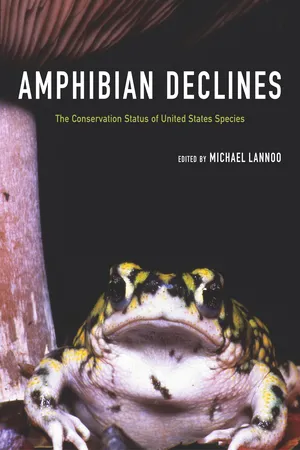
This benchmark volume documents in comprehensive detail a major environmental crisis: rapidly declining amphibian populations and the disturbing developmental problems that are increasingly prevalent within many amphibian species. Horror stories on this topic have been featured in the scientific and popular press over the past fifteen years, invariably asking what amphibian declines are telling us about the state of the environment. Are declines harbingers of devastated ecosystems or simply weird reflections of a peculiar amphibian world?
This compendium—presenting new data, reviews of current literature, and comprehensive species accounts—reinforces what scientists have begun to suspect, that amphibians are a lens through which the state of the environment can be viewed more clearly. And, that the view is alarming and presages serious concerns for all life, including that of our own species.
The first part of this work consists of more than fifty essays covering topics from the causes of declines to conservation, surveys and monitoring, and education. The second part consists of species accounts describing the life history and natural history of every known amphibian species in the United States.
- 1,117 pages
- English
- PDF
- Available on iOS & Android
eBook - PDF
About this book
Information
Publisher
University of California PressYear
2005Print ISBN
9780520235922
Edition
1eBook ISBN
9780520929432
Table of contents
- CONTENTS
- ACKNOWLEDGMENTS
- ADVISORY BOARD
- CONTRIBUTORS
- PREFACE
- PART ONE - Conservation Essays
- INTRODUCTION
- 1 Diverse Phenomena Influencing Amphibian Population Declines
- 2 Why Are Some Species in Decline but Others Not?
- 3 Philosophy, Value Judgements, and Declining Amphibians
- 4 Embracing Human Diversity in Conservation
- 5 Declining Amphibian Populations Task Force
- DECLINES
- 6 Meeting the Challenge of Amphibian Declines with an Interdisciplinary Research Program
- 7 Biology of Amphibian Declines
- 8 Declines of Eastern North American Woodland Salamanders
- 9 Decline of Northern Cricket Frogs (Acris crepitans)
- 10 Overwintering in Northern Cricket Frogs (Acris crepitans)
- CAUSES
- 11 Repercussions of Global Change
- 12 Lessons from Europe
- 13 Risk Factors and Declines in Northern Cricket Frogs (Acris crepitans)
- 14 Ultraviolet Radiation
- 15 Xenobiotics
- 16 Variation in Pesticide Tolerance
- 17 Lucké Renal Adenocarcinoma
- 18 Malformed Frogs in Minnesota: History and Interspecific Differences
- 19 Parasites of North American Frogs
- 20 Parasite Infection and Limb Malformations: A Growing Problem in Amphibian Conservation
- 21 Pine Silviculture
- 22 Commercial Trade
- CONSERVATION
- 23 Houston Toads and Texas Politics
- 24 Amphibian Conservation Needs
- 25 Amphibian Population Cycles and Long-Term Data Sets
- 26 Landscape Ecology
- 27 Conservation of Texas Spring and Cave Salamanders (Eurycea)
- 28 Lessons from the Tropics
- 29 Taxonomy and Amphibian Declines
- 30 Conservation Systematics: The Bufo boreas Species Group
- 31 Factors Limiting the Recovery of Boreal Toads (Bufo b. boreas)
- 32 Southwestern Desert Bufonids
- 33 Amphibian Ecotoxicology
- 34 Museum Collections
- 35 Critical Areas
- 36 Creating Habitat Reserves for Migratory Salamanders
- 37 Population Manipulations
- 38 Exotic Species
- 39 Protecting Amphibians While Restoring Fish Populations
- 40 Reflections Upon Amphibian Conservation
- SURVEYS AND MONITORING
- 41 Distribution of South Dakota Anurans
- 42 Nebraska’s Declining Amphibians
- 43 Museum Collections Can Assess Population Trends
- 44 Monitoring Salamander Populations in Great Smoky Mountains National Park
- 45 North American Amphibian Monitoring Program (NAAMP)
- 46 Evaluating Calling Surveys
- 47 Geographical Information Systems and Survey Designs
- 48 Impacts of Forest Management on Amphibians
- 49 Monitoring Pigment Pattern Morphs of Northern Leopard Frogs
- EDUCATION
- 50 The National Amphibian Conservation Center
- 51 A Thousand Friends of Frogs: Its Origins
- A PERSPECTIVE
- 52 Of Men and Deformed Frogs: A Journalist's Lament
- PART TWO - SPECIES ACCOUNTS
- Introduction
- ANURA
- Ascaphidae
- Bufonidae
- Dendrobatidae
- Hylidae
- Leptodactylidae
- Microhylidae
- Pelobatidae
- Pipidae
- Ranidae
- Rhinophrynidae
- CAUDATA
- Ambystomatidae
- Amphiumidae
- Cryptobranchidae
- Dicamptodontidae
- Plethodontidae
- Proteidae
- Rhyacotritonidae
- Salamandridae
- Sirenidae
- FACTORS IMPLICATED IN AMPHIBIAN POPULATION DECLINES IN THE UNITED STATES
- CONCLUSION
- LITERATURE CITED
- INDEX
Trusted by 375,005 students
Access to over 1.5 million titles for a fair monthly price.
Study more efficiently using our study tools.
Frequently asked questions
Yes, you can cancel anytime from the Subscription tab in your account settings on the Perlego website. Your subscription will stay active until the end of your current billing period. Learn how to cancel your subscription
No, books cannot be downloaded as external files, such as PDFs, for use outside of Perlego. However, you can download books within the Perlego app for offline reading on mobile or tablet. Learn how to download books offline
Perlego offers two plans: Essential and Complete
- Essential is ideal for learners and professionals who enjoy exploring a wide range of subjects. Access the Essential Library with 800,000+ trusted titles and best-sellers across business, personal growth, and the humanities. Includes unlimited reading time and Standard Read Aloud voice.
- Complete: Perfect for advanced learners and researchers needing full, unrestricted access. Unlock 1.5M+ books across hundreds of subjects, including academic and specialized titles. The Complete Plan also includes advanced features like Premium Read Aloud and Research Assistant.
We are an online textbook subscription service, where you can get access to an entire online library for less than the price of a single book per month. With over 1.5 million books across 990+ topics, we’ve got you covered! Learn about our mission
Look out for the read-aloud symbol on your next book to see if you can listen to it. The read-aloud tool reads text aloud for you, highlighting the text as it is being read. You can pause it, speed it up and slow it down. Learn more about Read Aloud
Yes! You can use the Perlego app on both iOS and Android devices to read anytime, anywhere — even offline. Perfect for commutes or when you’re on the go.
Please note we cannot support devices running on iOS 13 and Android 7 or earlier. Learn more about using the app
Please note we cannot support devices running on iOS 13 and Android 7 or earlier. Learn more about using the app
Yes, you can access Amphibian Declines by Michael Lannoo in PDF and/or ePUB format, as well as other popular books in Biological Sciences & Biology. We have over 1.5 million books available in our catalogue for you to explore.