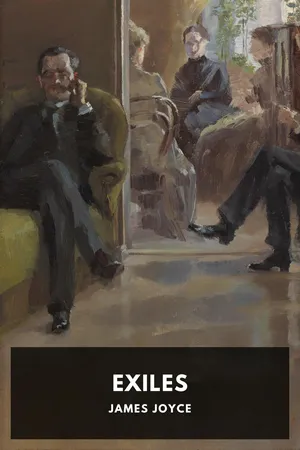
Having spent nine years in Italy, writer Richard Rowan and his de facto wife Bertha have recently returned to Dublin with their eight-year-old son Archie. Beatrice Justice, who arrives at the Rowans' house at the play's opening, has corresponded with Richard throughout their absence, and her appointment as his son's piano teacher is an excuse for them to see one another. The beginnings of a relationship have also formed between Bertha and Richard's friend the journalist Robert Hand.
Exiles, James Joyce's only surviving play, explores without fully resolving a possible outcome of this premise. Its main themes are freedom and doubt in personal relationships, marital infidelity, and what Joyce refers to in his notes as Richard's "spiritual abandonment" of Bertha. Without being entirely autobiographical, Exiles contains elements of Joyce's own life: he and his wife Nora did not marry until long after their children had been born in Italy, where they too lived as "exiles" from Ireland.
Reception of Exiles was initially mixed, mostly drawing unfavorable comparisons with Joyce's first novel, A Portrait of the Artist as a Young Man. Just as he had struggled to find a publisher for Portrait and Dubliners, Joyce too struggled to find a theater willing to stage Exiles. It was sent to the Stage Society in early 1916, who then rejected it. Joyce then sent it to W. B. Yeats in the hope of acceptance at the Abbey Theatre, but Yeats also rejected it.
The first performance of Exiles was in German in 1919 at a theater in Munich, where it was withdrawn after that single performance. It was not until 1925 that it was first staged in English, where it ran for forty-one performances in New York.
Exiles has tended to be regarded by critics and readers alike as an ignorable aberration within a canon of more important prose works, at best passably derivative of the dramas of Joyce's early literary hero Henrik Ibsen. But far from considering his first published foray into drama an imitation or failed experiment, Joyce pursued its publication with the same energy as he did his more successful works.
Joyce's notes for Exiles date from late 1913, shortly before work started in earnest on Ulysses. This fact, and the conception of Exiles itself, were natural consequences of Joyce's longstanding fascination with both drama as a literary form and the connection between "drama and life."
Exiles was first published in 1918 in London. This Standard Ebooks edition is based on the 1921 Egoist Press second English edition, proofs of which Joyce reviewed and annotated with corrections before publication.
Perfect for readers who appreciate Joyce's masterful exploration of human psychology and complex relationships, this compelling drama delves into themes of love, betrayal, and moral ambiguity with the author's signature literary brilliance.
The s