- English
- ePUB (mobile friendly)
- Available on iOS & Android
eBook - ePub
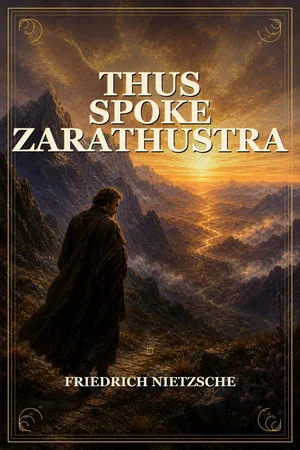
Thus Spoke Zarathustra
About this book
Thus Spake Zarathustra was Friedrich Nietzsche's favorite of the books he wrote, and has been his most popular amongst general readers. Yet some scholars dislike it because of its unphilosophical nature: it eschews jargon and the scaffolding of arguments, which engage only the intellect, in favor of an artistic approach that engages the whole mind. After ten years of solitude in a cave high in the mountains, Zarathustra wishes to share with humanity the wisdom he has accumulated during this time. He reaches the nearest town and addresses the crowd on the marketplace. He tells them of the Overman: the next step in human evolution, a being who creates their own values, freed from the weight of tradition and morality, and who takes responsibility for their own successes and failures. But the crowd doesn't understand him; his discourse is met only with rude ignorance. Zarathustra then decides to gather a small group of disciples and share his wisdom with them. The bulk of the book is Zarathustra's speeches on topics such as morality, society, individualism, religion, and how suffering and its overcoming are what give meaning to our existence. While already wiser than most, Zarathustra still learns from those he talks to, re-evaluating his thoughts as he deals with disappointment (such as when his disciples prove to be mere followers), and confronting his own doubts. His greatest challenge, though, comes when he faces the existential test of the eternal recurrence of the same: the thought that our lives could repeat indefinitely without the minutest of change. The inspiration for Zarathustra came to Nietzsche during one of the long hikes he often indulged in despite his failing health. It was a decade of solitude: his physical condition had worsened to the point of forcing him to retire from his position at the University of Basel, and each change of season prompted him to relocate to kinder climes in Switzerland, France, or Italy. The book took two years to write. Each of its four parts was written in a ten-day period of creative effervescence followed by months of gloom, plagued by terrible, debilitating migraines. Zarathustra was initially received with indifference at best and frustration at worst. It's a work of philosophy as much as aesthetics: the language is modeled after the Luther Bible and contains numerous references to Homer, Heraclitus, Plato, Goethe, Emerson, and Wagner, to name a few. Later Nietzsche attempted to address the book's lack of popularity by framing the same concepts in a more traditional, approachable manner in his following book, Beyond Good and Evil, but that book also struggled to find an audience. With his health steadily deteriorating, Nietzsche's mind broke down in 1889 and never recovered. His body would live on for 11 more years, and he ended up in the care of his sister, Elisabeth. A stalwart nationalist and anti-Semite, she saw in her brother's illness the opportunity to turn him into a German hero. Despite her brother's firm opposition to nationalism, anti-Semitism, and power politics, she perverted his work by promoting it for her own ends. Scores of commentators partook in her lie and enthusiastically used Nietzsche's work to buttress their own contrary views. Doing so requires one to selectively ignore half the content of the book: Zarathustra's discourses regularly touch on a priori dark and violent themes, but they also clearly state that these are to be directed towards oneself. Reaching the Overman requires us to know ourselves, and such introspection, given the darker side of human nature, leads to contempt. This contempt for ourselves, says Nietzsche, should be embraced as the first step towards awareness of what we could be. Cruelty, likewise, stems from that knowledge as a necessity to hammer ourselves into the proper shape.
Information
Topic
PhilosophySubtopic
Philosophy History & TheoryTable of contents
- Cover
- Titlepage
- Copyright
- Part I: Zarathustra’s Discourses
- Part II
- Part III
- Part IV
Trusted by 375,005 students
Access to over 1.5 million titles for a fair monthly price.
Study more efficiently using our study tools.
Frequently asked questions
Yes, you can cancel anytime from the Subscription tab in your account settings on the Perlego website. Your subscription will stay active until the end of your current billing period. Learn how to cancel your subscription
No, books cannot be downloaded as external files, such as PDFs, for use outside of Perlego. However, you can download books within the Perlego app for offline reading on mobile or tablet. Learn how to download books offline
Perlego offers two plans: Essential and Complete
- Essential is ideal for learners and professionals who enjoy exploring a wide range of subjects. Access the Essential Library with 800,000+ trusted titles and best-sellers across business, personal growth, and the humanities. Includes unlimited reading time and Standard Read Aloud voice.
- Complete: Perfect for advanced learners and researchers needing full, unrestricted access. Unlock 1.5M+ books across hundreds of subjects, including academic and specialized titles. The Complete Plan also includes advanced features like Premium Read Aloud and Research Assistant.
We are an online textbook subscription service, where you can get access to an entire online library for less than the price of a single book per month. With over 1.5 million books across 990+ topics, we’ve got you covered! Learn about our mission
Look out for the read-aloud symbol on your next book to see if you can listen to it. The read-aloud tool reads text aloud for you, highlighting the text as it is being read. You can pause it, speed it up and slow it down. Learn more about Read Aloud
Yes! You can use the Perlego app on both iOS and Android devices to read anytime, anywhere — even offline. Perfect for commutes or when you’re on the go.
Please note we cannot support devices running on iOS 13 and Android 7 or earlier. Learn more about using the app
Please note we cannot support devices running on iOS 13 and Android 7 or earlier. Learn more about using the app
Yes, you can access Thus Spoke Zarathustra by Friedrich Nietzsche in PDF and/or ePUB format, as well as other popular books in Philosophy & Philosophy History & Theory. We have over 1.5 million books available in our catalogue for you to explore.