This book provides a new literary treatment of an often-overlooked collection of fragmentary poems from the third century B.C.E. Alexandrian poet Callimachus. Callimachus' Iambi form a collection of thirteen poems, which rework archaic Greek iambography and look forward to Roman satire and other genres, especially to such collections as Horace's Epodes. The poems are especially significant as examples of cultural memory since they are composed both as an act of commemorating earlier poetry and as a manipulation of traditional features of iambic poetry to refashion the iambic genre. This book fills a significant gap by providing the first complete translation of several of these fragmentary poems in English, along with line-by-line commentary, notes, and literary analysis.
The structure of the book is thematic, with chapters focusing on such topics as poetic voice, fable, ethical criticism, and statuary. Each chapter consists of an introduction, text and selected critical apparatus, translation, and comprehensive thematic discussion. Acosta-Hughes focuses especially on Callimachus' manipulation of traditional features of archaic iambic poetry such as persona loquens, ethical and critical message, and eristic dialogue. He also includes a detailed analysis of the Alexandrian poet's artistic relationship with the earlier iambic poets Archilochus and Hipponax.
Polyeideia will interest not only readers of Greek and Hellenistic poetry but also readers of Roman satire and invective verse, as well as those intrigued by the processes of memorializing and fashioning poetic culture.
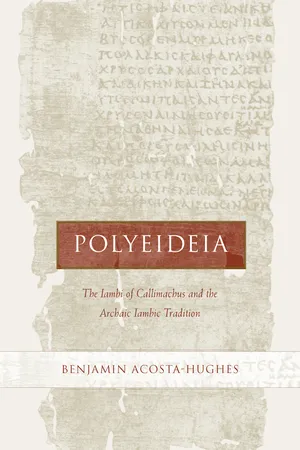
eBook - PDF
Polyeideia
The Iambi of Callimachus and the Archaic Iambic Tradition
- 371 pages
- English
- PDF
- Available on iOS & Android
eBook - PDF
About this book
Information
Publisher
University of California PressYear
2002Print ISBN
9780520220607
Edition
1eBook ISBN
9780520923683
Table of contents
- Cover
- Title
- Copyright
- Contents
- Acknowledgments
- Abbreviations
- Author’s Note
- Introduction
- 1. Callimachus and the Adaptation of Hipponax: Iambus 1
- 2. On Not Going to Ephesus: Iambus 13
- 3. The Elevated Paradigm: Iambi 12 and 1 (Lines 32–77)
- 4. Fable: Iambi 2 and 4
- 5. Ethical Behavior: Iambi 3 and 5
- 6. The Statues: Iambi 6, 7, and 9
- Select Bibliography
- Index of Passages Cited
- Greek Index
- General Index
Trusted by 375,005 students
Access to over 1.5 million titles for a fair monthly price.
Study more efficiently using our study tools.
Frequently asked questions
Yes, you can cancel anytime from the Subscription tab in your account settings on the Perlego website. Your subscription will stay active until the end of your current billing period. Learn how to cancel your subscription
No, books cannot be downloaded as external files, such as PDFs, for use outside of Perlego. However, you can download books within the Perlego app for offline reading on mobile or tablet. Learn how to download books offline
Perlego offers two plans: Essential and Complete
- Essential is ideal for learners and professionals who enjoy exploring a wide range of subjects. Access the Essential Library with 800,000+ trusted titles and best-sellers across business, personal growth, and the humanities. Includes unlimited reading time and Standard Read Aloud voice.
- Complete: Perfect for advanced learners and researchers needing full, unrestricted access. Unlock 1.5M+ books across hundreds of subjects, including academic and specialized titles. The Complete Plan also includes advanced features like Premium Read Aloud and Research Assistant.
We are an online textbook subscription service, where you can get access to an entire online library for less than the price of a single book per month. With over 1.5 million books across 990+ topics, we’ve got you covered! Learn about our mission
Look out for the read-aloud symbol on your next book to see if you can listen to it. The read-aloud tool reads text aloud for you, highlighting the text as it is being read. You can pause it, speed it up and slow it down. Learn more about Read Aloud
Yes! You can use the Perlego app on both iOS and Android devices to read anytime, anywhere — even offline. Perfect for commutes or when you’re on the go.
Please note we cannot support devices running on iOS 13 and Android 7 or earlier. Learn more about using the app
Please note we cannot support devices running on iOS 13 and Android 7 or earlier. Learn more about using the app
Yes, you can access Polyeideia by Benjamin Acosta-Hughes in PDF and/or ePUB format, as well as other popular books in Literature & Ancient & Classical Literary Criticism. We have over 1.5 million books available in our catalogue for you to explore.