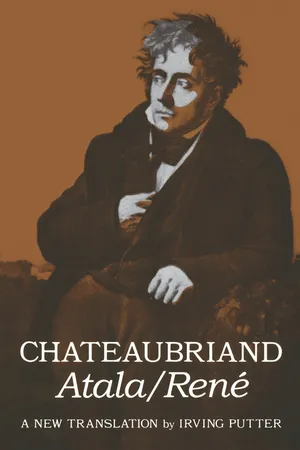
Chateaubriand was the giant of French literature in the early nineteenth century. Drawing on eighteenth-century English romanticists, on explorers in America, and on Goethe's Werther, he had a profound effect on French writers from Victor Hugo and Lamartine to George Sand and Flaubert. A quixotic and paradoxical personality, he combined impressive careers as a brilliant prose-poet, a spiritual guide, a high-ranking diplomat, and an enterprising lover.
Atala and René are his two best-known works, reflecting not only his own joys, aspirations, and despair, but the emerging tastes of a new literary era. Atala is the passionate and tragic love story of a young Indian couple wandering in the wilderness, enthralled by the beauties of nature, drawn to a revivified Christianity by its esthetic charm and consoling beneficence, and finally succumbing to the cruelty of fate. Perhaps even more than Werther or Childe Harold, René embodies the romantic hero, and is not wholly foreign to the disorientation of youth today. Solitary, mysterious, ardent, and poetic, he is in open revolt against a society whose values he rejects. Withough question this archetype played a large part in determining the course of French literature up to the 1850's.
- 127 pages
- English
- PDF
- Available on iOS & Android
eBook - PDF
Atala and Rene
About this book
Information
Publisher
University of California PressYear
1952Print ISBN
9780520002234
Edition
1eBook ISBN
9780520904811
122
Notes
attitude:
the
aspiración
to
something
superior
to
life
on
the
one
hand,
and
the
desire
for
the
pleasures
of
life
on
the
other.
Page
98.
/
was
no
more
than
a
traveler.
This
feeling
that
the
earth
is
a
place
of
exile
was
soon
to
become
common
among
the
romantics.
Lamartine,
íor
instance,
expresses
it
in
Solitude
(L'Isolement)
and
God
(Dieu).
Page
98.
Alas!
I
was
alone.
This
paragraph
is
a
concise
rendition
o£
the
romantic
malady,
the
French
"mal
du
siécle"
or
"ennui."
Byron
describes
it
as
"that
settled
ceaseless
gloom...
That
will
not
look
beyond
the
tomb,
But
cannot
hope
for
rest
before."
Page
98.
/
resolved
to
give
up
my
life.
Chateaubriand
tells
us
that
he
had
tried
to
take
his
life
in
his
youth,
but
the
gun
failed
to
go
ofE.
"I
assumed
that
my
time
had
not
yet
come,
and
I
postponed
putting
my
plan
into
effect
until
another
day."
Page
99.
The
final
moments
of
my
existence.
Werther
had
gone
about
his
suicide
with
this
same
delibérate
calmness.
Page
loz.
The
world
has
nothing
...
worthy
of
you.
Similarly
Átala
at
iirst
rejoices
in
the
unfortunate
situation
her
mother
has
created
because
she
sees
all
about
her
only
unworthy
people.
In
his
Memoirs
Chateaubriand
writes:
"A
hidden
instinct
warned
me
that,
as
I
went
forth
in
the
world,
I
would
find
nothing
I
sought."
Page
102.
Better
to
resemble
ordinary
men.
The
author
says
of
himself
in
the
Memoirs:
"Had
I
been
more
like
other
men,
I
should
nave
been
happier.
If,
without
robbing
me
of
my
intelligence,
someone
had
succeeded
in
killing
my
so-called
talent,
he
would
have
treated
me
as
a
friend."
Werther,
too,
laments:
"Gracious
Providence
...
why
didst
thou
not
withhold
some
of
those
blessings
I
possess,
and
substitute
in
their
place
a
feeling
of
self-
confidence
and
contentraent?"
(October
20.)
Page
104.
A
last
farewell.
This
is
based
on
an
actual
visit
of
Chateaubriand
to
Combourg;
he
saw
the
oíd
cháteau
again
in
1791
before
leaving
for
America,
and
once
more
around
1801,
before
publishing
Rene.
At
this
latter
date
the
Revolution
had
already
occurred,
and
this
may
explain
the
aban-
doned
condition
of
the
cháteau.
Page
106.
So
beautiful
was
she
...
flowers
and
aromas.
When
Chateau-
briand
was
twelve
years
oíd,
he
had
witnessed
a
cousin
of
his
taking
the
veil.
This
probably
left
a
deep
impression
on
him.
Page
109.
Satisfaction
in
the
fullness
of
my
anguish.
Expressions
such
as
these
(cf.
"cherished
melancholy"
and
"sorrow
cióse
akin
to
joy")
are
too
significant
to
be
mere
literary
paradoxes;
in
the
Memoirs,
too,
Chateau-
briand
speaks
of
"this
sadness
which
has
been
my
torment
and
my
felicity."
Page
113.
Why,
what
a
shame.
The
same
type
of
reproval
condueles
Adolphe:
"I
hate
that
type
of
vanity
which
is
concerned
with
itself
while
telling
of
the
harm
it
has
done,
which
means
to
draw
pity
by
describing
itself,
and
which,
hovering
invulnerable
amidst
the
ruins,
analyzes
itself
iristead
of
repenting."
Page
114.
A
rock
.
..in
the
setting
sun.
This
last
evocative
picture
again
represcnts
one
of
the
author's
personal
postures.
In
the
Memoirs
he
writes:
"North
of
the
cháteau
stretched
a
plain
strewn
with
druidic
rocks;
I
would
go
off
and
sit
on
one
of
these
in
the
setting
sun.
The
gilded
summit
of
the
woods,
the
splendor
of
the
earth
and
the
evening
star
twinkling
through
the
pink
clouds
brought
me
back
to
my
dreams..."
Table of contents
- Atala / René
Trusted by 375,005 students
Access to over 1.5 million titles for a fair monthly price.
Study more efficiently using our study tools.
Frequently asked questions
Yes, you can cancel anytime from the Subscription tab in your account settings on the Perlego website. Your subscription will stay active until the end of your current billing period. Learn how to cancel your subscription
No, books cannot be downloaded as external files, such as PDFs, for use outside of Perlego. However, you can download books within the Perlego app for offline reading on mobile or tablet. Learn how to download books offline
Perlego offers two plans: Essential and Complete
- Essential is ideal for learners and professionals who enjoy exploring a wide range of subjects. Access the Essential Library with 800,000+ trusted titles and best-sellers across business, personal growth, and the humanities. Includes unlimited reading time and Standard Read Aloud voice.
- Complete: Perfect for advanced learners and researchers needing full, unrestricted access. Unlock 1.5M+ books across hundreds of subjects, including academic and specialized titles. The Complete Plan also includes advanced features like Premium Read Aloud and Research Assistant.
We are an online textbook subscription service, where you can get access to an entire online library for less than the price of a single book per month. With over 1.5 million books across 990+ topics, we’ve got you covered! Learn about our mission
Look out for the read-aloud symbol on your next book to see if you can listen to it. The read-aloud tool reads text aloud for you, highlighting the text as it is being read. You can pause it, speed it up and slow it down. Learn more about Read Aloud
Yes! You can use the Perlego app on both iOS and Android devices to read anytime, anywhere — even offline. Perfect for commutes or when you’re on the go.
Please note we cannot support devices running on iOS 13 and Android 7 or earlier. Learn more about using the app
Please note we cannot support devices running on iOS 13 and Android 7 or earlier. Learn more about using the app
Yes, you can access Atala and Rene by François-René de Chateaubriand,François-René de Chateaubriand in PDF and/or ePUB format, as well as other popular books in Literature & European Literary Criticism. We have over 1.5 million books available in our catalogue for you to explore.