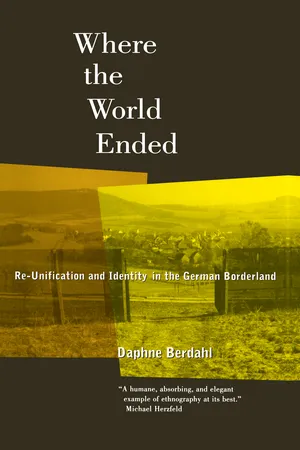
Where the World Ended
About this book
When the Berlin Wall fell, people who lived along the dismantled border found their lives drastically and rapidly transformed. Daphne Berdahl, through ongoing ethnographic research in a former East German border village, explores the issues of borders and borderland identities that have accompanied the many transitions since 1990. What happens to identity and personhood, she asks, when a political and economic system collapses overnight? How do people negotiate and manipulate a liminal condition created by the disappearance of a significant frame of reference? Berdahl concentrates especially on how these changes have affected certain "border zones" of daily life—including social organization, gender, religion, and nationality—in a place where literal, indeed concrete, borders were until recently a very powerful presence. Borders, she argues, are places of ambiguity as well as of intense lucidity; these qualities may in fact be mutually constitutive. She shows how, in a moment of headlong historical transformation, larger political, economic, and social processes are manifested locally and specifically. In the process of a transition between two German states, people have invented, and to some extent ritualized, cultural practices that both reflect and constitute profound identity transformations in a period of intense social discord. Where the World Ended combines a vivid ethnographic account of everyday life under socialist rule and after German reunification with an original investigation of the paradoxical human condition of a borderland.
Trusted by 375,005 students
Access to over 1 million titles for a fair monthly price.
Study more efficiently using our study tools.
Information
Table of contents
- Cover
- Contents
- Maps and Figures
- Acknowledgments
- Introduction
- 1. The Village on the Border
- 2. Publicity, Secrecy, and the Politics of Everyday Life
- 3. The Seventh Station
- 4. Consuming Differences
- 5. Borderlands
- 6. Designing Women
- 7. The Dis-membered Border
- Epilogue: The Tree of Unity
- Glossary
- Notes
- Works Cited
- Index
Frequently asked questions
- Essential is ideal for learners and professionals who enjoy exploring a wide range of subjects. Access the Essential Library with 800,000+ trusted titles and best-sellers across business, personal growth, and the humanities. Includes unlimited reading time and Standard Read Aloud voice.
- Complete: Perfect for advanced learners and researchers needing full, unrestricted access. Unlock 1.4M+ books across hundreds of subjects, including academic and specialized titles. The Complete Plan also includes advanced features like Premium Read Aloud and Research Assistant.
Please note we cannot support devices running on iOS 13 and Android 7 or earlier. Learn more about using the app