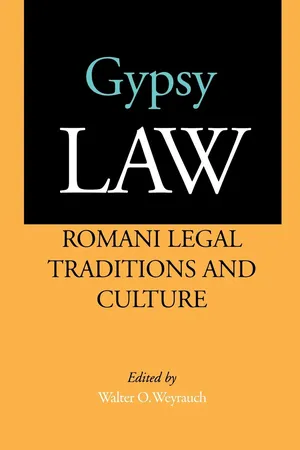
Approximately one thousand years ago Gypsies, or Roma, left their native India. Today Gypsies can be found in countries throughout the world, their distinct culture still intact in spite of the intense persecution they have endured. This authoritative collection brings together leading Gypsy and non-Gypsy scholars to examine the Romani legal system, an autonomous body of law based on an oral tradition and existing alongside dominant national legal networks.
For centuries the Roma have survived by using defensive strategies, especially the absolute exclusion of gadje (non-Gypsies) from their private lives, their values, and information about Romani language and social institutions. Sexuality, gender, and the body are fundamental to Gypsy law, with rules that govern being pure (vujo) or impure (marime). Women play an important role in maintaining legal customs, having the power to sanction and to contaminate, but they are not directly involved in legal proceedings.
These essays offer a comparative perspective on Romani legal procedures and identity, including topics such as the United States' criminalization of many aspects of Gypsy law, parallels between Jewish and Gypsy law, and legal distinctions between Romani communities. The contributors raise broad theoretical questions that transcend the specific Gypsy context and offer important insights into understanding oral legal traditions. Together they suggest a theoretical framework for explaining the coexistence of formal and informal law within a single legal system. They also highlight the ethical dilemmas encountered in comparative law research and definitions of "human rights."
- 304 pages
- English
- PDF
- Available on iOS & Android
eBook - PDF
About this book
Information
Publisher
University of California PressYear
2001Print ISBN
9780520221857
Edition
1eBook ISBN
9780520924277
Table of contents
- Cover
- Gypsy Law
- Title
- Copyright
- Contents
- EDITOR'S NOTE ON TERMINOLOGY
- FOREWORD
- 1. Romanba: An Introduction to Gypsy Law
- 2. Autonomous Lawmaking: The Case of the "Gypsies"
- 3. Theorizing Gypsy Law
- 4. Informal Systems of Justice: The Formation of Law within Gypsy Communities
- 5. Gypsy Law and Jewish Law
- 6. Juridical Autonomy among Fifteenth and Sixteenth Century Gypsies
- 7. Institutional Non-Marriage in the Finnish Roma Community and Its Relationship to Rom Traditional Law
- 8. A Glossary of Romani Terms
- 9. The Rom-Vlach Gypsies and the Kris-Romani
- 10. Complexities of U.S. Law and Gypsy Identity
- 11. Oral Legal Traditions of Gypsies and Some American Equivalents
- CONTRIBUTORS
- INDEX
Trusted by 375,005 students
Access to over 1.5 million titles for a fair monthly price.
Study more efficiently using our study tools.
Frequently asked questions
Yes, you can cancel anytime from the Subscription tab in your account settings on the Perlego website. Your subscription will stay active until the end of your current billing period. Learn how to cancel your subscription
No, books cannot be downloaded as external files, such as PDFs, for use outside of Perlego. However, you can download books within the Perlego app for offline reading on mobile or tablet. Learn how to download books offline
Perlego offers two plans: Essential and Complete
- Essential is ideal for learners and professionals who enjoy exploring a wide range of subjects. Access the Essential Library with 800,000+ trusted titles and best-sellers across business, personal growth, and the humanities. Includes unlimited reading time and Standard Read Aloud voice.
- Complete: Perfect for advanced learners and researchers needing full, unrestricted access. Unlock 1.5M+ books across hundreds of subjects, including academic and specialized titles. The Complete Plan also includes advanced features like Premium Read Aloud and Research Assistant.
We are an online textbook subscription service, where you can get access to an entire online library for less than the price of a single book per month. With over 1.5 million books across 990+ topics, we’ve got you covered! Learn about our mission
Look out for the read-aloud symbol on your next book to see if you can listen to it. The read-aloud tool reads text aloud for you, highlighting the text as it is being read. You can pause it, speed it up and slow it down. Learn more about Read Aloud
Yes! You can use the Perlego app on both iOS and Android devices to read anytime, anywhere — even offline. Perfect for commutes or when you’re on the go.
Please note we cannot support devices running on iOS 13 and Android 7 or earlier. Learn more about using the app
Please note we cannot support devices running on iOS 13 and Android 7 or earlier. Learn more about using the app
Yes, you can access Gypsy Law by Walter O. Weyrauch in PDF and/or ePUB format, as well as other popular books in History & European History. We have over 1.5 million books available in our catalogue for you to explore.