Divided Rule
About this book
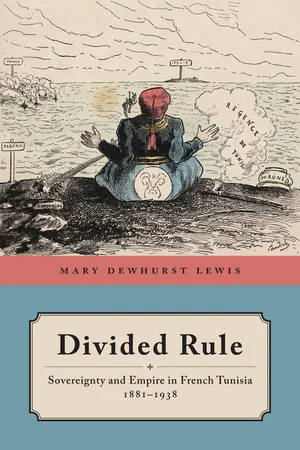
After invading Tunisia in 1881, the French installed a protectorate in which they shared power with the Tunisian ruling dynasty and, due to the dynasty's treaties with other European powers, with some of their imperial rivals. This "indirect" form of colonization was intended to prevent the violent clashes marking France's outright annexation of neighboring Algeria. But as Mary Dewhurst Lewis shows in Divided Rule, France's method of governance in Tunisia actually created a whole new set of conflicts. In one of the most dynamic crossroads of the Mediterranean world, residents of Tunisia— whether Muslim, Jewish, or Christian—navigated through the competing power structures to further their civil rights and individual interests and often thwarted the aims of the French state in the process. Over time, these everyday challenges to colonial authority led France to institute reforms that slowly undermined Tunisian sovereignty and replaced it with a more heavy-handed form of rule—a move also intended to ward off France's European rivals, who still sought influence in Tunisia. In so doing, the French inadvertently encouraged a powerful backlash with major historical consequences, as Tunisians developed one of the earliest and most successful nationalist movements in the French empire. Based on archival research in four countries, Lewis uncovers important links between international power politics and everyday matters of rights, identity, and resistance to colonial authority, while re-interpreting the whole arc of French rule in Tunisia from the 1880s to the mid-20th century. Scholars, students, and anyone interested in the history of politics and rights in North Africa, or in the nature of imperialism more generally, will gain a deeper understanding of these issues from this sophisticated study of colonial Tunisia.
Tools to learn more effectively

Saving Books

Keyword Search

Annotating Text

Listen to it instead
Information
Table of contents
- Cover
- Divided Rule
- Title
- Copyright
- Dedication
- CONTENTS
- Preface and Acknowledgments
- Note on Arabic Spelling
- Introduction
- 1 • Tunisia in the Imperial Mediterranean
- 2 • Ending Extraterritoriality?
- 3 • The Politics of Protection
- 4 • Contested Terrain
- 5 • Over Our Dead Bodies
- Conclusion and Epilogue
- Notes
- Bibliography
- Index
Frequently asked questions
- Essential is ideal for learners and professionals who enjoy exploring a wide range of subjects. Access the Essential Library with 800,000+ trusted titles and best-sellers across business, personal growth, and the humanities. Includes unlimited reading time and Standard Read Aloud voice.
- Complete: Perfect for advanced learners and researchers needing full, unrestricted access. Unlock 1.4M+ books across hundreds of subjects, including academic and specialized titles. The Complete Plan also includes advanced features like Premium Read Aloud and Research Assistant.
Please note we cannot support devices running on iOS 13 and Android 7 or earlier. Learn more about using the app