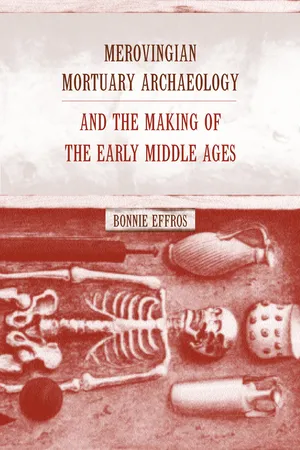
Clothing, jewelry, animal remains, ceramics, coins, and weaponry are among the artifacts that have been discovered in graves in Gaul dating from the fifth to eighth century. Those who have unearthed them, from the middle ages to the present, have speculated widely on their meaning. This authoritative book makes a major contribution to the study of death and burial in late antique and early medieval society with its long overdue systematic discussion of this mortuary evidence. Tracing the history of Merovingian archaeology within its cultural and intellectual context for the first time, Effros exposes biases and prejudices that have colored previous interpretations of these burial sites and assesses what contemporary archaeology can tell us about the Frankish kingdoms.
Working at the intersection of history and archaeology, and drawing from anthropology and art history, Effros emphasizes in particular the effects of historical events and intellectual movements on French and German antiquarian and archaeological studies of these grave goods. Her discussion traces the evolution of concepts of nationhood, race, and culture and shows how these concepts helped shape an understanding of the past. Effros then turns to contemporary multidisciplinary methodologies and finds that we are still limited by the types of information that can be readily gleaned from physical and written sources of Merovingian graves. For example, since material evidence found in the graves of elite families and particularly elite men is more plentiful and noteworthy, mortuary goods do not speak as directly to the conditions in which women and the poor lived.
The clarity and sophistication with which Effros discusses the methods and results of European archaeology is a compelling demonstration of the impact of nationalist ideologies on a single discipline and of the struggle toward the more pluralistic vision that has developed in the post-war years.
- 291 pages
- English
- PDF
- Available on iOS & Android
eBook - PDF
Merovingian Mortuary Archaeology and the Making of the Early Middle Ages
About this book
Information
Publisher
University of California PressYear
2003Print ISBN
9780520232440
Edition
1eBook ISBN
9780520928183
Table of contents
- Contents
- List of Illustrations
- Acknowledgments
- List of Abbreviations
- INTRODUCTION
- 1. ANTIQUARIES, HISTORIANS, AND ARCHAEOLOGISTS: CREATING A CULTURAL CONTEXT FOR EARLY MEDIEVAL GRAVES
- 2. MODERN ASSESSMENTS OF MEROVINGIAN BURIAL
- 3. GRAVE GOODS AND THE RITUAL EXPRESSION OF IDENTITY
- 4. THE VISUAL LANDSCAPE: CEMETERIAL TOPOGRAPHY AND COMMUNITY HIERARCHY
- EPILOGUE
- Select Bibliography
- Index
Trusted by 375,005 students
Access to over 1.5 million titles for a fair monthly price.
Study more efficiently using our study tools.
Frequently asked questions
Yes, you can cancel anytime from the Subscription tab in your account settings on the Perlego website. Your subscription will stay active until the end of your current billing period. Learn how to cancel your subscription
No, books cannot be downloaded as external files, such as PDFs, for use outside of Perlego. However, you can download books within the Perlego app for offline reading on mobile or tablet. Learn how to download books offline
Perlego offers two plans: Essential and Complete
- Essential is ideal for learners and professionals who enjoy exploring a wide range of subjects. Access the Essential Library with 800,000+ trusted titles and best-sellers across business, personal growth, and the humanities. Includes unlimited reading time and Standard Read Aloud voice.
- Complete: Perfect for advanced learners and researchers needing full, unrestricted access. Unlock 1.5M+ books across hundreds of subjects, including academic and specialized titles. The Complete Plan also includes advanced features like Premium Read Aloud and Research Assistant.
We are an online textbook subscription service, where you can get access to an entire online library for less than the price of a single book per month. With over 1.5 million books across 990+ topics, we’ve got you covered! Learn about our mission
Look out for the read-aloud symbol on your next book to see if you can listen to it. The read-aloud tool reads text aloud for you, highlighting the text as it is being read. You can pause it, speed it up and slow it down. Learn more about Read Aloud
Yes! You can use the Perlego app on both iOS and Android devices to read anytime, anywhere — even offline. Perfect for commutes or when you’re on the go.
Please note we cannot support devices running on iOS 13 and Android 7 or earlier. Learn more about using the app
Please note we cannot support devices running on iOS 13 and Android 7 or earlier. Learn more about using the app
Yes, you can access Merovingian Mortuary Archaeology and the Making of the Early Middle Ages by Bonnie Effros in PDF and/or ePUB format, as well as other popular books in Social Sciences & Ancient History. We have over 1.5 million books available in our catalogue for you to explore.