By the time Matthias was in seventh grade, he felt he’d better belong to some group, lest he be alone and vulnerable. The punks and anarchists were identifiable by their tattoos and hairstyles and music. But it was the skinheads who captured his imagination. They had great parties, and everyone seemed afraid of them. “They really represented what it meant to be a strong man,” he said.
What draws young men into violent extremist groups? What are the ideologies that inspire them to join? And what are the emotional bonds forged that make it difficult to leave, even when they want to?
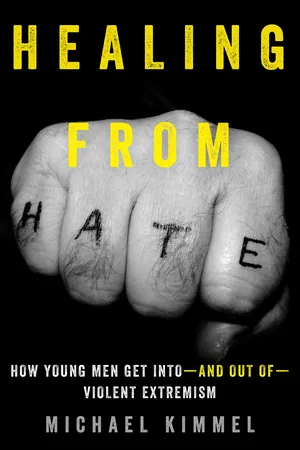
Having conducted in-depth interviews with ex–white nationalists and neo-Nazis in the United States, as well as ex-skinheads and ex-neo-Nazis in Germany and Sweden, renowned sociologist Michael Kimmel demonstrates the pernicious effects that constructions of masculinity have on these young recruits. Kimmel unveils how white extremist groups wield masculinity to recruit and retain members—and to prevent them from exiting the movement. Young men in these groups often feel a sense of righteous indignation, seeing themselves as victims, their birthright upended in a world dominated by political correctness. Offering the promise of being able to "take back their manhood," these groups leverage stereotypes of masculinity to manipulate despair into white supremacist and neo-Nazi hatred.
Kimmel combines individual stories with a multiangled analysis of the structural, political, and economic forces that marginalize these men to shed light on their feelings, yet make no excuses for their actions. Healing from Hate reminds us of some men's efforts to exit the movements and reintegrate themselves back into society and is a call to action to those who make it out to help those who are still trapped.
- 288 pages
- English
- ePUB (mobile friendly)
- Available on iOS & Android
eBook - ePub
About this book
Information
Publisher
University of California PressYear
2018Print ISBN
9780520305526
Edition
1eBook ISBN
9780520966086
1
The Making—and Unmaking—of Violent Men
Nationalism typically springs from masculinized memory, masculinized humiliation and masculinized hope.
Cynthia Enloe (1989)1
My grandmother used to keep a small suitcase by the door of her apartment in Brooklyn. An “overnighter,” you’d call it. Once she showed me what was in it: a change of clothes, some toiletries, an envelope with about $100 in cash, and a nightgown.
“Why?” I asked her.
“Just in case,” she said.
“In case what?” I asked, the naïve eight-year-old.
“In case they ever come again,” she said.
The year was 1959. Her apartment was on the fifth floor of an apartment facing the water on Shore Road in Brooklyn. As in, New York City. As in, the United States of America. From her balcony we watched the building of the Verrazano Bridge.
When I was a young child in the 1950s, the Holocaust was not ancient history; it was a distinct memory, a terror that lingered. Both the neighborhood butcher and the shoemaker had numbers tattooed on their forearms. The Holocaust was so present that it was never to be spoken of, lest the fates be tempted to return it and this time bring it to our shores.
It is always difficult to approach a historical event in hindsight. My father lied about his age to enlist in the navy in 1944, and I used to ask him, What was it like to not know the end of the story? To not know that when the war ended, we would have won? To fight in a war is, by definition, to not know the ending; indeed, you feel yourself part of what will create the ending your side wants. You hope.
According to an ever-growing number of young men in Europe and the United States and across the Muslim world, we are at the beginning of just such a war. And no one knows how it will end.
To me, what is interesting in the paragraph you just read is not the indeterminacy of the outcome. All crises are like that. No; it is the fact that “ever-growing number of young men” probably does not seem notable to most readers. The fact that virtually all of those mobilizing on all sides of this growing clash are young men—whether right-wing extremists, anti-immigrant zealots, anti-Muslim skinheads and neo-Nazis, or young Muslims readying for jihad. It’s so obvious, it barely needs noting.
And so it isn’t noted. When then-president Barack Obama and Secretary of State John Kerry convened a three-day conference titled “Combating Violent Extremism” at the White House in February 2015, hundreds of experts from the diverse fields of law enforcement, security personnel, psychology, international relations, and criminology discussed how young people are recruited into these extremist groups, including scrutiny of recruits’ backgrounds, mental health statuses, and religious beliefs. Legal and penal experts discussed court proceedings and incarceration issues. During the entire conference, participants heard not one word about “masculinity.” (Indeed, the big controversy was whether President Obama sufficiently and specifically addressed Islamic terrorists.)
“We have to confront squarely and honestly the twisted ideologies that these terrorist groups use to incite people to violence,” Mr. Obama told the audience. A year earlier, Secretary Kerry had argued that countering terrorism should involve “better alternatives for a whole bunch of young people” and greater “opportunity for marginalized youth.” “People.” “Youth.”2
But which “people” exactly? What “youth?” If we close our eyes and imagine those people, those young people, whom do we see? And what is their gender?
If we imagine for a moment that all those amassing on all the different sides of this looming cataclysm, all those drifting to the edges of the political spectrum and toward violent extremism, were female, would there be any other story? Would not magazines be filled with individual profiles, TV news shows highlighting the relationship between femininity and violence, bookshelves sagging from the weight of the “gender” analysis? Yet the fact that virtually every single violent extremist is male creates hardly a ripple.
It can be easy to think, “But wait, what about those female suicide bombers? What about those skinhead girls? Those women of the Klan?” This proves my point. We notice the minuscule percentage of female activists. We overnotice them precisely because they are so counterintuitive. Man bites dog.
To be sure, there are plenty of women attracted to extreme politics. Some are comrades in arms, and many more are involved as wives and mothers. About 10 percent of jihadist recruits from the United States are female—in France it’s about double that percentage—and many more visit their partners and sons and brothers in prison, even if they are not as often the inmates. Women drink and party at the White Power festivals, but they rarely venture into the mosh pit. Women are definitely part of the movement, but they are underrepresented as activists; they rarely train for war or engage in terrorist activities. It’s what makes them interesting to study, of course, and we will meet a few in this book.
When others have examined the women who are attracted to extremism, gender has been front and center in the analysis.3 When we look at female skinheads or suicide bombers, female neo-Nazis or women of the Klan, we ask about gender, about how their ideas and actions are shaped by, through, and often against their notions of femininity. Gender is visible. In fact, sometimes gender might be overemphasized at the expense of other aspects of women’s experience. That’s how evident it is.
It can be easy to shrug off this remarkably skewed gender difference with a bemused eye-rolling nod toward biology. Boys will be boys, right? Man-the-hunter avatars, cavemen in caftans or cargo pants, biologically predisposed toward violent rapacious predation, their eyes glazed over with testosterone-fueled rage. Except that only a tiny fraction of young males, driven by their endocrine systems or their evolutionary imperative, ever remotely consider such extremist violence. Those 99+ percent—are they not men?
If we do acknowledge something about the prevalence of men—as men—we’re pretty quick to change the subject. It’s psychological trauma. Political disenfranchisement. Downward economic mobility. Gradual irrelevance in a globalizing world. Religion.
I want to start by asking some different questions. Who are these young men? What draws them to violent extremism? What are the ideologies that inspire them, the psychological predispositions that lead some and not others to sign up? What emotional bonds are forged and sustained through membership in violent extremist groups?
An answer cannot be found in popular media analysis. In an otherwise insightful 2015 article in The New Yorker, “Journey to Jihad,” Ben Taub promises to explain “how teenagers are lured into Syria’s war,” and then focuses entirely on the increasingly myopic Manichean worldview of ISIS clerics, portraying the Belgian and other European boys whom Islamic State has recruited as impressionable naïfs.4 (The italics above are mine; it’s not about “teenagers,” after all, but about teenage boys. The only girls mentioned are a couple of ex- and current girlfriends.) There’s not a word about masculinity, not a word about feeling as though they are finally doing something great, for a cause greater than themselves. Not a word about the visceral, quasi-erotic appeal of extremist politics to young men, offering that chance to prove their masculinity, to be a man among men and reap the sexual payoff of women’s admiration, either in this or in the next life. Nor even about the terrifying ways that their terrorist beheadings increasingly resemble the video games they are playing constantly in the training camps.
And you won’t find the answer in official U.S. policy documents. The official U.S. efforts at “combatting violent extremism” (CVE) focus exclusively on Muslims. Exclusively as in, 100 percent of federal CVE funds are aimed at Muslim communities within the United States. Officially, the administration’s strategy states unequivocally that “al-Qa’ida and its affiliates represent the preeminent terrorist threat to our country.”5 An extract from a White House briefing document, “Empowering Local Partners to Prevent Violent Extremism in the United States,” discusses solely Islamic extremism and Al Qaeda.6 (According to studies by the University of Maryland’s Study of Terrorism and Responses to Terrorism [START] program, the vast majority of attacks in the United States were carried out by non-Islamist extremists.)
Nor will you find it in some of the recent research on deradicalization. Scholars point us in many directions, all useful, and all incomplete. John Horgan, a psychologist and the director of the International Center for the Study of Terrorism at Penn State, sees the appeal of terrorism in group participation and identity formation. While identity formation is a deeply gendered process, Horgan spends scant time on gender; the word does not appear in his index (nor does masculinity, manhood, or any other such word). But doesn’t “group participation” provide a sort of gendered compensation, an alternate route to experience a successful gender identity, to prove one’s manhood? As a result of ignoring gender entirely in his examination of engagement, his model of disengagement stresses only how “individuals” get out.
Anthropologists such as Scott Atran and sociologists such as Marc Sageman successfully refute the immiseration thesis: terrorists are not the poorest of the poor, barely literate and utterly suggestible to groupthink. Indeed, Sageman finds that the majority of the jihadists he interviewed were well educated and reasonably well-off. Atran calls them “patently ordinary people” who simply want to be part of the in-crowd. To him, terrorism is transactional: terrorists commit acts of violence as a way of thanking the in-crowd for letting them join the group. This sounds remarkably similar to a fraternity rush.7
There is now a periodical called the Journal for Deradicalization, coedited by Daniel Koehler, which lists among its advisors some of the top names in the field—many of whom are scholars whose work I have relied on for background. But if you’re looking for a gender analysis of deradicalization, you’d be well advised to look elsewhere. Through ten issues I could find only a handful that might have given any weight to gender. Typical is a “systematic review of the literature” which concludes that one of the primary mechanisms for fostering deradicalization is to “increase social bonds [that] provide individuals a ‘stake in conformity’ and ease them out of criminal lifestyles.” Another article seemed promising, proposing a typology of “thugs” and “terrorists.” It suggests attacking frequencies and differences in perpetrators’ strategies and organization, but without discussing how any of this might be related to gender. Yet another article points to “identity crises” as a predictor of entry, without ever considering that they might be linked to questions about proving masculinity.
“Individuals” again. “People.” If all these “individuals” were women, we would not be talking about “individuals”; we’d be talking about gender. In the end, I could find not a single article in this new and seemingly authoritative journal that used the word gender, let alone masculinity. The fish are the last to discover the ocean.8
In an intriguing study of terrorist networks, Marc Sageman, a physician and sociologist who also served as a CIA operations officer, notices that the networks he examines are composed exclusively of men. He then examines their age, faith, employment, location, and their experiences of relative deprivation, but does not investigate the gendered emotions or experiences of those factors. If basically no women of identical age, level of employment, experience of faith, and experience of relative deprivation become involved in terrorist networks, it bears investigating why it is only men with these backgrounds who become radicalized.9
One researcher published in the Journal for Deradicalization comes agonizingly close to understanding gender, but then backs away entirely. Charles Mink debriefed hundreds of accused terrorists affiliated with the Islamic State in Iraq and Syria between 2007 and 2008. He expected a bunch of “political outsiders, economic pariahs and religious zealots.” Instead, he found detainees who were “fairly well educated, completely uninterested in state politics, gainfully employed in one way or another, and—perhaps most surprising—they were religiously apathetic.” They were not, by and large, “angry, impoverished, or especially pious.” Instead, Mink argues, those drawn to terrorism were “looking to fill their lives with companionship and significance. They join terrorist groups because they see affiliation with a global phenomenon as the best way to experience intimacy and solidarity with like-minded people.” They want intimacy, solidarity, community, connection. Mink makes joining ISIS sound more like pledging a college fraternity than joining a group of religious fanatics bent on death. Well, perhaps, to paraphrase Shakespeare’s Henry V, “he who sheds someone else’s blood with me shall be my brother.”10
Mink echoes the analysi...
Table of contents
- Imprint
- Subvention
- Title
- Copyright
- Dedication
- Epigraph
- Contents
- Preface
- Acknowledgments
- 1. The Making—and Unmaking—of Violent Men
- Matthias: Intergenerational Neo-Nazi
- 2. Germany: Anti-Semitism without Jews
- Jackie: The “Most Hated Man” in Sweden
- 3. Sweden: Entry and EXIT
- Frankie: “Born to be Wild”
- 4. United States: Life after Hate with “Life After Hate”
- Mubin: Undercover Jihadist
- 5. Britain: The Ex-jihadists Next Door
- Epilogue: “Redemption Song”
- Notes
- Index
Trusted by 375,005 students
Access to over 1.5 million titles for a fair monthly price.
Study more efficiently using our study tools.
Frequently asked questions
Yes, you can cancel anytime from the Subscription tab in your account settings on the Perlego website. Your subscription will stay active until the end of your current billing period. Learn how to cancel your subscription
No, books cannot be downloaded as external files, such as PDFs, for use outside of Perlego. However, you can download books within the Perlego app for offline reading on mobile or tablet. Learn how to download books offline
Perlego offers two plans: Essential and Complete
- Essential is ideal for learners and professionals who enjoy exploring a wide range of subjects. Access the Essential Library with 800,000+ trusted titles and best-sellers across business, personal growth, and the humanities. Includes unlimited reading time and Standard Read Aloud voice.
- Complete: Perfect for advanced learners and researchers needing full, unrestricted access. Unlock 1.5M+ books across hundreds of subjects, including academic and specialized titles. The Complete Plan also includes advanced features like Premium Read Aloud and Research Assistant.
We are an online textbook subscription service, where you can get access to an entire online library for less than the price of a single book per month. With over 1.5 million books across 990+ topics, we’ve got you covered! Learn about our mission
Look out for the read-aloud symbol on your next book to see if you can listen to it. The read-aloud tool reads text aloud for you, highlighting the text as it is being read. You can pause it, speed it up and slow it down. Learn more about Read Aloud
Yes! You can use the Perlego app on both iOS and Android devices to read anytime, anywhere — even offline. Perfect for commutes or when you’re on the go.
Please note we cannot support devices running on iOS 13 and Android 7 or earlier. Learn more about using the app
Please note we cannot support devices running on iOS 13 and Android 7 or earlier. Learn more about using the app
Yes, you can access Healing from Hate by Michael Kimmel in PDF and/or ePUB format, as well as other popular books in Social Sciences & Gender Studies. We have over 1.5 million books available in our catalogue for you to explore.