eBook - ePub
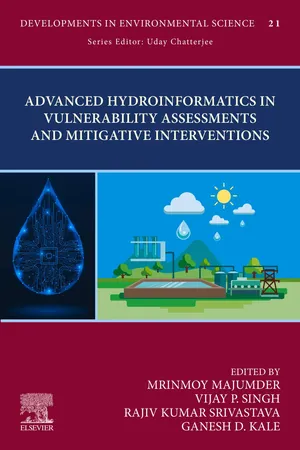
Advanced Hydroinformatics in Vulnerability Assessments and Mitigative Interventions
- 833 pages
- English
- ePUB (mobile friendly)
- Available on iOS & Android
eBook - ePub
Advanced Hydroinformatics in Vulnerability Assessments and Mitigative Interventions
About this book
Advanced Hydroinformatics in Vulnerability Assessments and Mitigative Interventions is a comprehensive guide that explores the role of hydroinformatics in managing peri-urban watersheds amidst challenges such as climate change and urbanization.Leveraging artificial intelligence, data science, and Internet of Things, this book presents innovative strategies for optimal management of natural resources. The book uniquely combines theory and case studies to illustrate the application of data science, AI, and other technologies in assessing vulnerabilities and developing mitigation strategies for peri-urban watersheds.Readers will find Advanced Hydroinformatics in Vulnerability Assessments and Mitigative Interventions an invaluable resource for understanding and applying hydroinformatics to address their water-related challenges.
- Provides real-world case studies demonstrating the application of AI, data science, and Internet of Things in watershed management
- Offers practical strategies for assessing vulnerabilities and crafting mitigative interventions in the face of water scarcity
- Unpacks the complex role of hydroinformatics in managing peri-urban watersheds, particularly under climate change and urbanization pressures
Information
Subtopic
Environmental ScienceIndex
Biological SciencesTable of contents
- Cover image
- Title page
- Table of Contents
- Developments in Environmental Science
- Contributors
- Foreword
- Preface
- Acknowledgment
- Chapter 1. Impact of manholes in flood simulation of microcatchments: An AHP—MCDM approach
- Chapter 2. Assessing the impacts of climate and urban dynamics on peri-urban watershed vulnerability
- Chapter 3. Minimization of virtual water of a peri-urban capital city in face of climate change: Case study of tea industry
- Chapter 4. Application of modified version of the first innovative approach for prioritization of blocks in the Barmer district
- Chapter 5. Location selection for rainwater harvesting plants with the help of GWA-based neural networks
- Chapter 6. Identification of groundwater blocks needing groundwater recharge and determination of causal factors affecting declining groundwater by using innovative approaches: A case study of Udaipur division
- Chapter 7. Impact of brick industry on surface water vulnerability analysis: A PROMETHEE-ELECTRE approach
- Chapter 8. Vulnerability analysis of peri-urban watershed with respect to climate change and urbanization
- Chapter 9. Assessment of groundwater potential zone mapping of Haora River Basin, Tripura, by MCDM and GIS
- Chapter 10. Impact of climate change on pollution content of periurban river—A polynomial neural network approach
- Chapter 11. Development of a spatial predictive model for estimation of flow rate in penstock networks
- Chapter 12. Wave powered desalination for delivering clean water to developing countries and island nations
- Chapter 13. Application of nature-based optimization techniques in optimizing water used in renewable energy
- Chapter 14. Minimization of energy use in surface water treatment plant
- Chapter 15. Performance optimization wave energy conversion system with the help of multicriteria decision techniques and nature-based algorithms
- Chapter 16. Development of indicator-based real-time penstock condition monitoring system by the application of GIS and cognitive tools
- Chapter 17. Selection of a suitable location for the installation of a wave energy converter in the Indian coastal zone: An MCDM and reliability analysis approach
- Chapter 18. Design and development of low-cost solar based domestic water filter
- Chapter 19. Impact of saline water intrusion on water conservation of a coastal zone in equatorial India
- Chapter 20. Flood mitigation in farmlands: Modeling and simulation techniques
- Chapter 21. Application of satellite remote sensing for flood prediction and management
- Chapter 22. Predictive hydroinformatics: Reducing flood risks through advanced modeling
- Chapter 23. Application of artificial intelligence in impact analysis of saline water intrusion on coastal wetlands
- Chapter 24. Impact of tsunami on island coasts: The most effected parameter approach
- Chapter 25. Impact of paper and pulp industry on Coastal Zone Vulnerabilities: Moth-flame, fire fly, and water cycle optimization approach
- Chapter 26. Impact of climate change on tropical coasts: An OPAAHP approach for coastal vulnerability assessment in India
- Chapter 27. Optimal resource allocation within peri-urban consumers of a coastal zone with the help of mine burst and glowworm optimization technique
- Chapter 28. Vulnerability analysis of tropical coastal zone under changed climate scenarios with the help of water cycle and poly-neural networks
- Chapter 29. Vulnerability analysis of a shallow coastal zone with respect to volcanic storms: A MERC—GWA approach
- Chapter 30. Monitoring graywater recycle potential of a wetland: A Group Method of Data Handling Approach
- Chapter 31. Data-driven strategies for reducing agricultural water footprint
- Chapter 32. WetMAN: an app to manage Wetland resources
- Chapter 33. Hydroinformatics-driven strategies for drought mitigation in agricultural systems
- Chapter 34. Vulnerability analysis of wetlands under changed climate scenarios with the help of water cycle and poly-neural networks
- Chapter 35. Application of particle swarm algorithm in vulnerability assessment of blue water management with respect to wetlands
- Chapter 36. Risk minimization of wetlands from climatic vulnerabilities by firefly and glowworm optimization
- Chapter 37. Application of water cycle algorithms and polynomial neural networks in Wetland vulnerability
- Chapter 38. Insightful of regional climate models in temperature dynamics under climate change scenarios for Junagadh district, Gujarat, India: A case study
- Chapter 39. Satellite remote sensing for flood prediction and management: A case study
- Index
Trusted by 375,005 students
Access to over 1.5 million titles for a fair monthly price.
Study more efficiently using our study tools.
Frequently asked questions
Yes, you can cancel anytime from the Subscription tab in your account settings on the Perlego website. Your subscription will stay active until the end of your current billing period. Learn how to cancel your subscription
No, books cannot be downloaded as external files, such as PDFs, for use outside of Perlego. However, you can download books within the Perlego app for offline reading on mobile or tablet. Learn how to download books offline
Perlego offers two plans: Essential and Complete
- Essential is ideal for learners and professionals who enjoy exploring a wide range of subjects. Access the Essential Library with 800,000+ trusted titles and best-sellers across business, personal growth, and the humanities. Includes unlimited reading time and Standard Read Aloud voice.
- Complete: Perfect for advanced learners and researchers needing full, unrestricted access. Unlock 1.5M+ books across hundreds of subjects, including academic and specialized titles. The Complete Plan also includes advanced features like Premium Read Aloud and Research Assistant.
We are an online textbook subscription service, where you can get access to an entire online library for less than the price of a single book per month. With over 1.5 million books across 990+ topics, we’ve got you covered! Learn about our mission
Look out for the read-aloud symbol on your next book to see if you can listen to it. The read-aloud tool reads text aloud for you, highlighting the text as it is being read. You can pause it, speed it up and slow it down. Learn more about Read Aloud
Yes! You can use the Perlego app on both iOS and Android devices to read anytime, anywhere — even offline. Perfect for commutes or when you’re on the go.
Please note we cannot support devices running on iOS 13 and Android 7 or earlier. Learn more about using the app
Please note we cannot support devices running on iOS 13 and Android 7 or earlier. Learn more about using the app
Yes, you can access Advanced Hydroinformatics in Vulnerability Assessments and Mitigative Interventions by Mrinmoy Majumder,V.P. Singh,Rajiv Kumar Srivastava,Ganesh D. Kale in PDF and/or ePUB format, as well as other popular books in Biological Sciences & Environmental Science. We have over 1.5 million books available in our catalogue for you to explore.