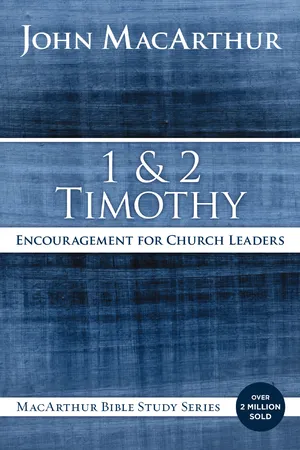
1 and 2 Timothy
eBook - ePub

1 and 2 Timothy

Encouragement for Church Leaders

  1. 128 pages
  2. English
  3. ePUB (mobile friendly)
  4. Available on iOS & Android
eBook - ePub

1 and 2 Timothy

Encouragement for Church Leaders

About this book

Pastor John MacArthur will take you through the two short letters to Timothy, passage by passage, so that you can better understand Paul's instructions to church leaders and the cultural context that makes these letters so relevant today.

Timothy was a close associate of Paul who was facing problems within the church that he was leading in Ephesus. In these personal letters, Paul gives practical pastoral instruction to his protégé, highlighting godliness and holy living to help Timothy fulfill his calling and effectively carry out his important tasks in the church.

Paul's gentle encouragement in these letters challenges Timothy to persevere in his faith—a faith that might have been weakening under the pressure of the church and the persecution of the world. Paul's godly counsel was helpful not only to Timothy, a first-century Christian leader, but is also helpful to each of us as believers today.

—ABOUT THE SERIES—

The MacArthur Bible Study series is designed to help you study the Word of God with guidance from widely respected pastor and author John MacArthur. Each guide provides intriguing examinations of the whole of Scripture by examining its parts and incorporates:

  • Extensive, but straight-forward commentary on the text.
  • Detailed observations on overriding themes, timelines, history, and context.
  • Word and phrase studies to help you unlock the broader meaning and apply it to your life.
  • Probing, interactive questions with plenty of space to write down your response and thoughts.

Frequently asked questions

Yes, you can cancel anytime from the Subscription tab in your account settings on the Perlego website. Your subscription will stay active until the end of your current billing period. Learn how to cancel your subscription.
At the moment all of our mobile-responsive ePub books are available to download via the app. Most of our PDFs are also available to download and we're working on making the final remaining ones downloadable now. Learn more here.
Perlego offers two plans: Essential and Complete
  • Essential is ideal for learners and professionals who enjoy exploring a wide range of subjects. Access the Essential Library with 800,000+ trusted titles and best-sellers across business, personal growth, and the humanities. Includes unlimited reading time and Standard Read Aloud voice.
  • Complete: Perfect for advanced learners and researchers needing full, unrestricted access. Unlock 1.4M+ books across hundreds of subjects, including academic and specialized titles. The Complete Plan also includes advanced features like Premium Read Aloud and Research Assistant.
Both plans are available with monthly, semester, or annual billing cycles.
We are an online textbook subscription service, where you can get access to an entire online library for less than the price of a single book per month. With over 1 million books across 1000+ topics, we’ve got you covered! Learn more here.
Look out for the read-aloud symbol on your next book to see if you can listen to it. The read-aloud tool reads text aloud for you, highlighting the text as it is being read. You can pause it, speed it up and slow it down. Learn more here.
Yes! You can use the Perlego app on both iOS or Android devices to read anytime, anywhere — even offline. Perfect for commutes or when you’re on the go.
Please note we cannot support devices running on iOS 13 and Android 7 or earlier. Learn more about using the app.
Yes, you can access 1 and 2 Timothy by John F. MacArthur in PDF and/or ePUB format, as well as other popular books in Theology & Religion & Biblical Studies. We have over one million books available in our catalogue for you to explore.

INTRODUCTION TO 1 TIMOTHY

This is the first of two inspired letters Paul wrote to his beloved son in the faith. Timothy received his name, which means “one who honors God,” from his mother (Eunice) and grandmother (Lois), devout Jews who became believers in the Lord Jesus Christ (2 Tim. 1:5). They taught Timothy the Old Testament Scriptures from his childhood (2 Tim. 3:15). His father was a Greek (Acts 16:1) who may have died before Timothy met Paul.
Timothy was from Lystra (Acts 16:1–3), a city in the Roman province of Galatia (part of modern Turkey). Paul led Timothy to Christ (1:2, 18; 1 Cor. 4:17; 2 Tim. 1:2), undoubtedly during his ministry in Lystra on his first missionary journey (Acts 14:6–23). When he revisited Lystra on his second missionary journey, Paul chose Timothy to accompany him (Acts 16:1–3). Although Timothy was very young (probably in his late teens or early twenties, since about fifteen years later Paul referred to him as a young man, 4:12), he had a reputation for godliness (Acts 16:2). Timothy was to be Paul’s disciple, friend, and co-laborer for the rest of the apostle’s life, ministering with him in Berea (Acts 17:14), Athens (Acts 17:15), and Corinth (Acts 18:5; 2 Cor. 1:19), and accompanying him on his trip to Jerusalem (Acts 20:4). He was with Paul in his first Roman imprisonment and went to Philippi (2:19–23) after Paul’s release. In addition, Paul frequently mentions Timothy in his epistles (Rom. 16:21; 2 Cor. 1:1; Phil. 1:1; Col. 1:1; 1 Thess. 1:1; 2 Thess. 1:1; Philem. 1). Paul often sent Timothy to churches as his representative (1 Cor. 4:17; 16:10; Phil. 2:19; 1 Thess. 3:2), and 1 Timothy finds him on another assignment, serving as pastor of the church at Ephesus (1:3). According to Hebrews 13:23, Timothy was imprisoned somewhere and released.

AUTHOR AND DATE

Many modernist critics delight in attacking the plain statements of Scripture and, for no good reason, deny that Paul wrote the Pastoral Epistles (1, 2 Tim., Titus). Ignoring the testimony of the letters themselves (1:1; 2 Tim. 1:1; Titus 1:1) and that of the early church (which is as strong for the Pastoral Epistles as for any of Paul’s epistles, except Romans and 1 Corinthians), these critics maintain that a devout follower of Paul wrote the Pastoral Epistles in the second century. As proof, they offer five lines of supposed evidence: (1) the historical references in the Pastoral Epistles cannot be harmonized with the chronology of Paul’s life given in Acts; (2) the false teaching described in the Pastoral Epistles is the fully developed Gnosticism of the second century; (3) the church organizational structure in the Pastoral Epistles is that of the second century and is too well developed for Paul’s day; (4) the Pastoral Epistles do not contain the great themes of Paul’s theology; and (5) the Greek vocabulary of the Pastoral Epistles contains many words not found in Paul’s other letters, nor in the rest of the New Testament.
While it is unnecessary to dignify such unwarranted attacks by unbelievers with an answer, occasionally such an answer does enlighten. Thus, in reply to the critics’ arguments, the following points are given: (1) This contention of historical incompatibility is valid only if Paul was never released from his Roman imprisonment mentioned in Acts. But he was released, since Acts does not record Paul’s execution, and Paul himself expected to be released (Phil. 1:19, 25–26; 2:24; Philem. 22). The historical events in the Pastoral Epistles do not fit into the chronology of Acts because they happened after the close of the Acts narrative, which ends with Paul’s first imprisonment in Rome. (2) While there are similarities between the heresy of the Pastoral Epistles and second-century Gnosticism, there are also important differences. Unlike second-century Gnosticism, the false teachers of the Pastoral Epistles were still within the church (see 1:3–7), and their teaching was based on Judaistic legalism (1:7; Titus 1:10, 14; 3:9). (3) The church organizational structure mentioned in the Pastoral Epistles is, in fact, consistent with that established by Paul (Acts 14:23; Phil. 1:1). (4) The Pastoral Epistles do mention the central themes of Paul’s theology, including the inspiration of Scripture (2 Tim. 3:15–17); election (2 Tim. 1:9; Titus 1:1–2); salvation (Titus 3:5–7); the deity of Christ (Titus 2:13); His mediatory work (1 Tim. 2:5); and substitutionary atonement (2:6). (5) The different subject matter in the Pastoral Epistles required a different vocabulary from that in Paul’s other epistles. Certainly a pastor today would use a different vocabulary in a personal letter to a fellow pastor than he would in a work of systematic theology.
The idea that a “pious forger” wrote the Pastoral Epistles faces several further difficulties: (1) The early church did not approve of such practices and surely would have exposed this as a ruse, if there had actually been one (see 2 Thess. 2:1–2; 3:17). (2) Why forge three letters that include similar material and no deviant doctrine? (3) If a counterfeit, why not invent an itinerary for Paul that would have harmonized with Acts? (4) Would a later, devoted follower of Paul have put the words of 1 Timothy 1:13, 15 into his master’s mouth? (5) Why would he include warnings against deceivers (2 Tim. 3:13; Titus 1:10), if he himself were one?
The evidence seems clear that Paul wrote 1 Timothy and Titus shortly after his release from his first Roman imprisonment (about AD 62–64), and then wrote 2 Timothy from prison during his second Roman imprisonment (about AD 66–67), shortly before his death.

BACKGROUND AND SETTING

After being released from his first Roman imprisonment (see Acts 28:30), Paul revisited several of the cities in which he had ministered, including Ephesus. Leaving Timothy behind there to deal with problems that had arisen in the Ephesian church, such as false doctrine (1:3–7; 4:1–3; 6:3–5), disorder in worship (2:1–15), the need for qualified leaders (3:1–14), and materialism (6:6–19), Paul went on to Macedonia, from where he wrote Timothy this letter to help him carry out his task in the church (see 3:14–15).

HISTORICAL AND THEOLOGICAL THEMES

First Timothy is a practical letter containing pastoral instruction from Paul to Timothy (see 3:14–15). Since Timothy was well versed in Paul’s theology, the apostle had no need to give him extensive doctrinal instruction. This epistle does, however, express many important theological truths, such as the proper function of the law (1:5–11), salvation (1:14–16; 2:4–6); the attributes of God (1:17); the Fall (2:13–14); the person of Christ (3:16; 6:15–16); election (6:12); and the second coming of Christ (6:14–15).

INTERPRETIVE CHALLENGES

Scholars disagree over the identity of the false teachers (1:3) and the genealogies (1:4) involved in their teaching. What it means to be “delivered to Satan” (1:20) has also been a source of debate. The letter contains key passages in the debate over the extent of the atonement (2:4–6; 4:10). Paul’s teaching on the role of women (2:9–15) has generated much discussion, particularly his declaration that they are not to assume leadership roles in the church (2:11–12). How women can be saved by bearing children (2:15) has also confused many. Whether the fact that an elder must be “the husband of one wife” excludes divorced or unmarried men has been disputed, as well as whether Paul refers to deacons’ wives or deaconesses (3:11). Those who believe Christians can lose their salvation cite 4:1 as support for their view. There is a question about the identity of the widows in 5:3–16—are they needy women ministered to by the church, or an order of older women ministering to the church? Does “double honor” accorded to elders who rule well (5:17–18) refer to respect or money? These will all be dealt with in the notes provided by the passages.

NOTES

[Your Response Here]
1

BEWARE OF FALSE DOCTRINE!
1 Timothy 1:1–20

DRAWING NEAR

Paul had a miraculous encounter with Christ that turned his life around. He calls himself an “insolent man” who had received God’s mercy and grace. What person do you know (or have heard about) who has an amazing “before-and-after” testimony of how God transformed his or her life? What about that person’s story encourages you?
[Your Response Here]
Why is it important to know what you believe, and why you believe it?
[Your Response Here]
As you begin this study, ask God to show you more about His mercy and grace.
[Your Response Here]

THE CONTEXT

In two brief verses that introduce the letter, the apostle Paul demonstrates his great concern for the church at Ephesus. His passion was the result of three years of ministry there. In order to help his young protégé battle the false teaching that was infiltrating the church, Paul threw all of his apostolic authority behind the young pastor. Not only that, Paul also prayed that God would give his beloved child in the faith the grace, mercy, and peace needed to navigate a difficult situation.
Despite its rich spiritual history, the Ephesian church was targeted by false teachers just as Paul had warned (Acts 20:29–30). Paul wrote this epistle to prepare Timothy for the onslaught of these enemies of the gospel. The opening charge in 1:3–11 sets the stage for all that will follow. Paul discusses four things that are true of false teachers: their doctrinal deviations, their mission, their motives, and their legacy.
Some scholars argue that Paul’s words in verses 12 through 17 are a parenthetical thought unrelated to the flow of thought in 1 Timothy. This is a weak argument, however, in light of Paul’s overall purpose. Paul’s intent was to warn his young associate of the dangers of the false teachers. Since they were teaching an erroneous view of the law, Paul purposed to show how a proper understanding of the law results in conviction of sin and an appreciation of grace. Here then is a contrast between the glory of the true gospel and the bankruptcy of false doctrine.

KEYS TO THE TEXT

Ephesus: Timothy was in the city of Ephesus, the capital of the Roman province of Asia (Asia Minor, modern Turkey). Located at the mouth of the Cayster River, on the east side of the Aegean Sea, Ephesus was perhaps best known for its magnificent temple of Artemis, or Diana, one of the seven wonders of the ancient world. It was also an important political, educational, and commercial center, ranking with Alexandria in Egypt and Antioch of Pisidia, in southern Asia Minor. The church here may have been started by Priscilla and Aquila, a gifted couple, who had been left in Ephesus by Paul on his second missionary journey (Acts 18:18–19). Later, Paul firmly established this fledgling church on his third missionary journey (Acts 19), and he pastored it for some three years. After Paul left, Timothy pastored the congregation for perhaps a year and a half.
The Law: The Mosaic law is in view here, not just law in general. Paul said that the would-be teachers wanted to impose circumcision and the keeping of Mosaic ceremonies on the church as necessary for salvation. These “Judaizers” plagued the early church, attempting to add to the gospel the legalistic requirements of the Old Testament. The law is good or useful because it reflects God’s holy will and righteous standard (Ps. 19:7; Rom. 7:12) and accomplishes its purpose in showing sinners their sin and their need for a Savior (Rom. 3:19; Gal. 3:24).

UNLEASHING THE TEXT

Read 1:1–20, noting the key words and definitions next to the passage.
1 Timothy 1:1–20 (NKJV)
1 Paul, an apostle of Jesus Christ, by the commandment of God our Savior and the Lord Jesus Christ, our hope,
apostle of Jesus Christ (v. 1)—“One who is sent with a commission.” An apostle was chosen and trained by Jesus Christ to proclaim His truth during the formative years of the church. Because Paul was not among the original Twelve, he needed to defend his apostleship (see 2 Cor. 12:11–12; Acts 1:2; 2:42; Eph. 2:20).
God our Savior (v. 1)—This is a title unique to the Pastoral Epistles (1 & 2 Tim., Titus) that has its roots in the Old Testament (Ps. 25:5; 27:9; Mic....

Table of contents

  1. Cover Page
  2. Title Page
  3. Copyright Page
  4. Ebook Instructions
  5. Contents
  6. Introduction to 1 Timothy
  7. 1. Beware of False Doctrine!: 1 Timothy 1:1–20
  8. 2. The Importance of Prayer: 1 Timothy 2:1–8
  9. 3. The Role of Women: 1 Timothy 2:9–15
  10. 4. Qualifications for Leadership: 1 Timothy 3:1–16
  11. 5. False Teaching versus Truth: 1 Timothy 4:1–16
  12. 6. Pastoral Responsibilities: 1 Timothy 5:1–6:2
  13. 7. The Man of God: 1 Timothy 6:3–21
  14. Introduction to 2 Timothy
  15. 8. Not Ashamed: 2 Timothy 1:1–18
  16. 9. Be Diligent: 2 Timothy 2:1–26
  17. 10. Equipped for Good Works: 2 Timothy 3:1–17
  18. 11. Preaching With Integrity: 2 Timothy 4:1–5
  19. 12. Last Words: 2 Timothy 4:6–22