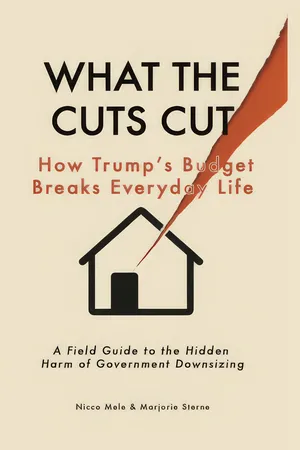
For generations, Americans have been told that government is the problem. But what if the programs being cut are the very things that make our lives safer, healthier, and more affordable?
What the Cuts Cut takes readers on a journey through everyday American life to reveal the often-invisible role government plays in protecting our homes, educating our children, keeping us healthy, feeding our families, preserving our parks, and supporting our economic security. Rather than focusing on budgets, bureaucracies, or partisan politics, the book asks a simple question: What happens to you when these programs disappear?
Through a series of accessible, real-world scenarios, the book explores how proposed cuts and policy changes could affect ordinary Americans. What happens if your child loses access to preschool, school lunches, or special education services? What if your local hospital closes, your college becomes unaffordable, or the next medical breakthrough is delayed because research funding disappears? What if disaster strikes and there is no one left to warn you, rescue you, or help you rebuild?
From the National Institutes of Health to the Department of Education, from FEMA and NOAA to SNAP and Medicaid, What the Cuts Cut explains how public investments shape our daily lives—often in ways we never notice until they are gone. Readers will discover how government programs help families buy homes, protect consumers from financial scams, keep food and water safe, support farmers, maintain public lands, and provide a safety net during life's most difficult moments.
Written in clear, conversational language and grounded in extensive research, the book translates complex policy debates into their human consequences. It challenges readers to look beyond political slogans and consider what government actually does—and what is at stake when those functions are reduced, privatized, or eliminated.
At its heart, What the Cuts Cut is a book about connection. It shows how the decisions made in Washington ripple through classrooms, hospitals, grocery stores, neighborhoods, and family budgets across the country. Most importantly, it reminds us that budgets are not just numbers on a spreadsheet. They are choices about the kind of country we want to live in—and who gets left behind when support disappears.