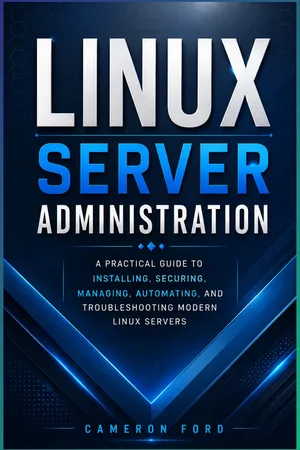
Linux Server Administration
eBook - ePub

Linux Server Administration

A Practical Guide to Installing, Securing, Managing, Automating, and Troubleshooting Modern Linux Servers

  1. English
  2. ePUB (mobile friendly)
  3. Available on iOS & Android
eBook - ePub

Linux Server Administration

A Practical Guide to Installing, Securing, Managing, Automating, and Troubleshooting Modern Linux Servers

About this book

### Book Description

Master the skills needed to confidently deploy, secure, manage, and maintain modern Linux servers.

Whether you're an aspiring system administrator, IT professional, DevOps engineer, or technology enthusiast, **Linux Server Administration** provides a practical, hands-on approach to mastering Linux server operations. Rather than focusing on theory alone, this book guides you through real-world administrative tasks using clear explanations, step-by-step examples, and essential command-line tools.

You'll learn how to install and configure Linux servers, manage users and permissions, administer storage and networking, deploy web and database services, strengthen server security, monitor system performance, automate routine administrative tasks with Bash scripting, and troubleshoot common server issues. You'll also explore configuration management with Ansible, container fundamentals with Docker, reliable backup and recovery strategies, and complete a production-ready server deployment project that ties everything together.

Inside this book, you'll discover how to:

* Install and configure Linux servers with confidence.
* Master essential Linux command-line administration.
* Manage users, permissions, processes, and services.
* Configure storage, file systems, and networking.
* Deploy Apache, Nginx, database, and file-sharing services.
* Secure Linux servers using SSH hardening, firewalls, and security best practices.
* Monitor performance, analyze logs, and optimize system resources.
* Automate administrative tasks with Bash scripting and Cron.
* Manage multiple servers using Ansible.
* Deploy and manage applications with Docker containers.
* Create dependable backup and disaster recovery plans.
* Troubleshoot common Linux server problems efficiently.
* Build and validate a production-ready Linux server from start to finish.

Designed for beginners and intermediate users alike, **Linux Server Administration** equips you with the practical knowledge and confidence to manage Linux servers in home labs, business environments, cloud platforms, and enterprise infrastructures. Whether you're preparing for a career in system administration or expanding your existing IT skills, this guide provides a solid foundation for real-world Linux server management.

Information

Publisher
Chiify
Year
2026
eBook ISBN
9798259608191

Table of contents

  1. Linux Server Administration
  2. Linux Server Administration
  3. A Practical Guide to Installing, Securing, Managing, Automating, and Troubleshooting Modern Linux Servers
  4. Chapter 1: Linux Server Fundamentals
  5. Chapter 2: Installing and Configuring a Linux Server
  6. Chapter 3: Mastering the Linux Command Line
  7. Chapter 4: Managing Users, Permissions, and Processes
  8. Chapter 5: Storage and File System Administration
  9. Chapter 6: Linux Networking and Remote Administration
  10. Chapter 7: Installing and Managing Software
  11. Chapter 8: Deploying Essential Server Services
  12. Chapter 9: Linux Server Security
  13. Chapter 10: Monitoring, Logging, and Performance Tuning
  14. Chapter 11: Backup, Recovery, and Disaster Preparedness
  15. Chapter 12: Automating Linux Server Administration
  16. Chapter 13: Configuration Management and Containers
  17. Chapter 14: Troubleshooting Linux Servers
  18. Chapter 15: Complete Production Linux Server Project
  19. Introduction
  20. Chapter 1: Linux Server Fundamentals
  21. Chapter 2: Installing and Configuring a Linux Server
  22. Preparing Installation Media
  23. Installing Ubuntu Server
  24. Initial System Configuration
  25. Updating the Operating System
  26. Configuring SSH
  27. Setting Hostnames
  28. Creating Administrative Users
  29. Basic Server Hardening
  30. Chapter 3: Mastering the Linux Command Line
  31. Navigating the File System
  32. Working with Files and Directories
  33. Viewing and Editing Files
  34. Searching for Files
  35. Pipes and Redirection
  36. Text Processing Utilities
  37. Command History
  38. Essential Administrative Commands
  39. Chapter 4: Managing Users, Permissions, and Processes
  40. Creating Users and Groups
  41. Password Policies
  42. File Ownership
  43. Linux Permissions
  44. Access Control Lists (ACLs)
  45. Managing Running Processes
  46. Managing Services with systemd
  47. Scheduling Tasks with Cron
  48. Chapter 5: Storage and File System Administration
  49. Linux Directory Structure
  50. Partitioning Disks
  51. File Systems
  52. Mounting Storage
  53. Managing Swap Space
  54. Logical Volume Management (LVM)
  55. RAID Basics
  56. Disk Usage Monitoring
  57. Chapter 6: Linux Networking and Remote Administration
  58. IP Address Configuration
  59. DNS Configuration
  60. Network Interfaces
  61. Routing Basics
  62. Network Troubleshooting
  63. SSH Administration
  64. Secure File Transfers
  65. Remote Server Management
  66. Chapter 7: Installing and Managing Software
  67. Package Management
  68. Software Repositories
  69. Installing Applications
  70. Updating Packages
  71. Removing Software
  72. Managing Dependencies
  73. Compiling from Source
  74. Keeping Systems Current
  75. Chapter 8: Deploying Essential Server Services
  76. Web Servers (Apache and Nginx)
  77. Database Servers
  78. File Sharing Services
  79. DNS Basics
  80. Reverse Proxy Configuration
  81. SSL Certificates
  82. Service Management
  83. Testing Deployments
  84. Security Principles
  85. User Security
  86. SSH Hardening
  87. Firewalls
  88. SELinux and AppArmor
  89. System Auditing
  90. Log Management
  91. Security Best Practices
  92. Chapter 10: Monitoring, Logging, and Performance Tuning
  93. System Monitoring
  94. Resource Utilization
  95. Journal Logs
  96. Log Rotation
  97. Performance Bottlenecks
  98. Memory Optimization
  99. Disk Performance
  100. Capacity Planning
  101. Chapter 11: Backup, Recovery, and Disaster Preparedness
  102. Backup Strategies
  103. Using rsync
  104. Creating Archives
  105. Snapshot Technologies
  106. Restoring Data
  107. Disaster Recovery Planning
  108. Backup Verification
  109. Recovery Best Practices
  110. Chapter 12: Automating Linux Server Administration
  111. Bash Scripting Fundamentals
  112. Variables and Functions
  113. Conditional Logic
  114. Loops
  115. Error Handling
  116. Automating Routine Tasks
  117. Scheduling Automation
  118. Script Best Practices
  119. Chapter 13: Configuration Management and Containers
  120. Infrastructure as Code
  121. Introduction to Ansible
  122. Writing Basic Playbooks
  123. Managing Multiple Servers
  124. Docker Fundamentals
  125. Container Networking
  126. Persistent Storage
  127. Container Security
  128. Chapter 14: Troubleshooting Linux Servers
  129. Boot Failures
  130. Network Problems
  131. Storage Issues
  132. Service Failures
  133. Package Problems
  134. Performance Issues
  135. Reading Logs Effectively
  136. Emergency Recovery Techniques
  137. Chapter 15: Complete Production Linux Server Project
  138. Planning the Deployment
  139. Installing the Server
  140. Configuring Storage
  141. Setting Up Networking
  142. Securing the System
  143. Deploying Web and Database Services
  144. Implementing Monitoring
  145. Configuring Automated Backups
  146. Automating Administration Tasks
  147. Performing Final Testing
  148. Production Readiness Checklist
  149. Lessons Learned and Next Steps
  150. About the Book
  151. Acknowledgments

Trusted by 375,005 students

Access to over 1.5 million titles for a fair monthly price.

Study more efficiently using our study tools.

Frequently asked questions

Yes, you can cancel anytime from the Subscription tab in your account settings on the Perlego website. Your subscription will stay active until the end of your current billing period. Learn how to cancel your subscription
No, books cannot be downloaded as external files, such as PDFs, for use outside of Perlego. However, you can download books within the Perlego app for offline reading on mobile or tablet. Learn how to download books offline
Perlego offers two plans: Essential and Complete
  • Essential is ideal for learners and professionals who enjoy exploring a wide range of subjects. Access the Essential Library with 800,000+ trusted titles and best-sellers across business, personal growth, and the humanities. Includes unlimited reading time and Standard Read Aloud voice.
  • Complete: Perfect for advanced learners and researchers needing full, unrestricted access. Unlock 1.5M+ books across hundreds of subjects, including academic and specialized titles. The Complete Plan also includes advanced features like Premium Read Aloud and Research Assistant.
Both plans are available with monthly, semester, or annual billing cycles.
We are an online textbook subscription service, where you can get access to an entire online library for less than the price of a single book per month. With over 1.5 million books across 990+ topics, we’ve got you covered! Learn about our mission
Look out for the read-aloud symbol on your next book to see if you can listen to it. The read-aloud tool reads text aloud for you, highlighting the text as it is being read. You can pause it, speed it up and slow it down. Learn more about Read Aloud
Yes! You can use the Perlego app on both iOS and Android devices to read anytime, anywhere — even offline. Perfect for commutes or when you’re on the go.
Please note we cannot support devices running on iOS 13 and Android 7 or earlier. Learn more about using the app
Yes, you can access Linux Server Administration by Cameron Ford in PDF and/or ePUB format, as well as other popular books in Computer Science & Programming Algorithms. We have over 1.5 million books available in our catalogue for you to explore.