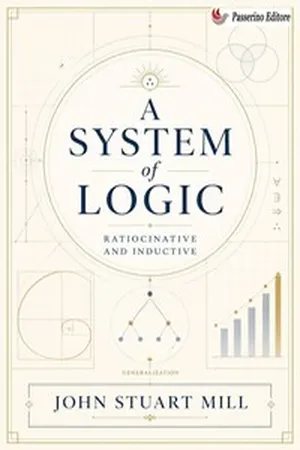
A landmark of nineteenth-century philosophy, A System of Logic, Ratiocinative and Inductive is John Stuart Mill’s ambitious attempt to define the principles of reasoning, evidence, and scientific inquiry.
First published in 1843, this monumental work explores the foundations of deductive and inductive logic, the methods by which knowledge is formed, and the rules that guide human understanding from observation to general truth. Mill examines language, propositions, syllogism, causation, probability, and the logic of the moral and social sciences, offering one of the most influential accounts of empirical reasoning in modern thought.
More than a technical treatise, A System of Logic is a powerful reflection on how the mind organizes experience, tests ideas, and distinguishes sound argument from illusion. Its influence reached far beyond philosophy, shaping debates in science, politics, economics, and social theory. Clear, rigorous, and intellectually ambitious, this classic remains essential reading for anyone interested in logic, epistemology, the philosophy of science, and the development of liberal and empirical thought.
John Stuart Mill (1806–1873) was an English philosopher, economist, and political thinker, widely regarded as one of the most influential liberal intellectuals of the nineteenth century. A leading advocate of individual liberty, representative government, women’s rights, and empirical reasoning, Mill made major contributions to logic, ethics, political philosophy, and economics. His best-known works include A System of Logic, On Liberty, Utilitarianism, The Subjection of Women, and Principles of Political Economy.
- English
- ePUB (mobile friendly)
- Available on iOS & Android
eBook - ePub
A System of Logic, Ratiocinative and Inductive
About this book
Information
Topic
PhilosophySubtopic
Logic in PhilosophyTable of contents
- Cover
- A System of Logic, Ratiocinative and Inductive
- Table of contents
- Preface To The First Edition
- Preface To The Third And Fourth Editions
- Introduction
- Book I. Of Names And Propositions
- I. Of The Necessity Of Commencing With An Analysis Of Language
- II. Of Names
- III. Of The Things Denoted By Names
- IV. Of Propositions
- V. Of The Import Of Propositions
- VI. Of Propositions Merely Verbal
- VII. Of The Nature Of Classification, And The Five Predicables
- VIII. Of Definition
- Book II. Of Reasoning
- I. Of Inference, Or Reasoning, In General
- II. Of Ratiocination, Or Syllogism
- III. Of The Functions And Logical Value Of The Syllogism
- IV. Of Trains Of Reasoning, And Deductive Sciences
- V. Of Demonstration, And Necessary Truths
- VI. The Same Subject Continued
- VII. Examination Of Some Opinions Opposed To The Preceding Doctrines
- Book III. Of Induction
- I. Preliminary Observations On Induction In General
- II. Of Inductions Improperly So Called
- III. Of The Ground Of Induction
- IV. Of Laws Of Nature
- V. Of The Law Of Universal Causation
- VI. On The Composition Of Causes
- VII. On Observation And Experiment
- VIII. Of The Four Methods Of Experimental Inquiry
- IX. Miscellaneous Examples Of The Four Methods
- X. Of Plurality Of Causes, And Of The Intermixture Of Effects
- XI. Of The Deductive Method
- XII. Of The Explanation Of Laws Of Nature
- XIII. Miscellaneous Examples Of The Explanation Of Laws Of Nature
- XIV. Of The Limits To The Explanation Of Laws Of Nature; And Of Hypotheses
- XV. Of Progressive Effects; And Of The Continued Action Of Causes
- XVI. Of Empirical Laws
- XVII. Of Chance And Its Elimination
- XVIII. Of The Calculation Of Chances
- XIX. Of The Extension Of Derivative Laws To Adjacent Cases
- XX. Of Analogy
- XXI. Of The Evidence Of The Law Of Universal Causation
- XXII. Of Uniformities Of Co-Existence Not Dependent On Causation
- XXIII. Of Approximate Generalizations, And Probable Evidence
- XXIV. Of The Remaining Laws Of Nature
- XXV. Of The Grounds Of Disbelief
- Book IV. Of Operations Subsidiary To Induction
- I. Of Observation And Description
- II. Of Abstraction, Or The Formation Of Conceptions
- III. Of Naming, As Subsidiary To Induction
- IV. Of The Requisites Of A Philosophical Language, And The Principles Of Definition
- V. On The Natural History Of The Variations In The Meaning Of Terms
- VI. The Principles Of A Philosophical Language Further Considered
- VII. Of Classification, As Subsidiary To Induction
- VIII. Of Classification By Series
- Book V. On Fallacies
- I. Of Fallacies In General
- II. Classification Of Fallacies
- III. Fallacies Of Simple Inspection; Or A Priori Fallacies
- IV. Fallacies Of Observation
- V. Fallacies Of Generalization
- VI. Fallacies Of Ratiocination
- VII. Fallacies Of Confusion
- Book VI. On The Logic Of The Moral Sciences
- I. Introductory Remarks
- II. Of Liberty And Necessity
- III. That There Is, Or May Be, A Science Of Human Nature
- IV. Of The Laws Of Mind
- V. Of Ethology, Or The Science Of The Formation Of Character
- VI. General Considerations On The Social Science
- VII. Of The Chemical, Or Experimental, Method In The Social Science
- VIII. Of The Geometrical, Or Abstract, Method
- IX. Of The Physical, Or Concrete Deductive, Method
- X. Of The Inverse Deductive, Or Historical, Method
- XI. Additional Elucidations Of The Science Of History
- XII. Of The Logic Of Practice, Or Art; Including Morality And Policy
Trusted by 375,005 students
Access to over 1.5 million titles for a fair monthly price.
Study more efficiently using our study tools.
Frequently asked questions
Yes, you can cancel anytime from the Subscription tab in your account settings on the Perlego website. Your subscription will stay active until the end of your current billing period. Learn how to cancel your subscription
No, books cannot be downloaded as external files, such as PDFs, for use outside of Perlego. However, you can download books within the Perlego app for offline reading on mobile or tablet. Learn how to download books offline
Perlego offers two plans: Essential and Complete
- Essential is ideal for learners and professionals who enjoy exploring a wide range of subjects. Access the Essential Library with 800,000+ trusted titles and best-sellers across business, personal growth, and the humanities. Includes unlimited reading time and Standard Read Aloud voice.
- Complete: Perfect for advanced learners and researchers needing full, unrestricted access. Unlock 1.5M+ books across hundreds of subjects, including academic and specialized titles. The Complete Plan also includes advanced features like Premium Read Aloud and Research Assistant.
We are an online textbook subscription service, where you can get access to an entire online library for less than the price of a single book per month. With over 1.5 million books across 990+ topics, we’ve got you covered! Learn about our mission
Look out for the read-aloud symbol on your next book to see if you can listen to it. The read-aloud tool reads text aloud for you, highlighting the text as it is being read. You can pause it, speed it up and slow it down. Learn more about Read Aloud
Yes! You can use the Perlego app on both iOS and Android devices to read anytime, anywhere — even offline. Perfect for commutes or when you’re on the go.
Please note we cannot support devices running on iOS 13 and Android 7 or earlier. Learn more about using the app
Please note we cannot support devices running on iOS 13 and Android 7 or earlier. Learn more about using the app
Yes, you can access A System of Logic, Ratiocinative and Inductive by John Stuart Mill in PDF and/or ePUB format, as well as other popular books in Philosophy & Logic in Philosophy. We have over 1.5 million books available in our catalogue for you to explore.