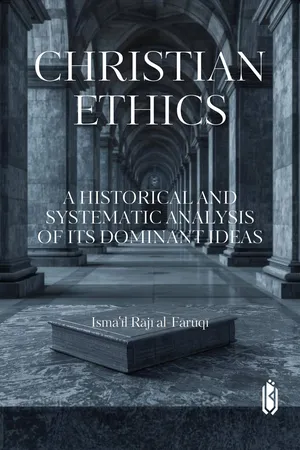
In 1959, a Palestinian Muslim scholar was invited into a Christian faculty of divinity — not as a curiosity, but as a critic. Two years of seminars, disputations, and close textual study followed. This book is what came of them.
Ismail Ragi al-Faruqi worked directly from the primary sources of Christian thought: the Hebrew prophets, the Synoptic Gospels, the letters of Paul, Augustine, the Reformers, and twentieth-century theologians from Karl Barth to Reinhold Niebuhr. Christian Ethics builds a single argument across two thousand years of material — that the ethical breakthrough achieved by Jesus of Nazareth, his rejection of Jewish racial particularism and his interiorization of the moral law, was steadily overtaken by a later theological tradition al-Faruqi names Christianism, organized around two governing ideas he terms peccatism and saviourism.
The book unfolds in two parts. The first isolates the ethic of Jesus against its Jewish background and traces its closest historical parallel — not in later Christian doctrine, but in the discipline of Sufism. The second follows the doctrine of man, sin, and salvation from the Hellenistic and patristic periods through the Reformation and into modern Protestant theology, weighing Augustine, Luther, Calvin, William Temple, Barth, and Niebuhr in turn.
Written during al-Faruqi's fellowship at the McGill University Faculty of Divinity under Dean Stanley Brice Frost, and prefaced by the Dutch missiologist Hendrik Kraemer shortly before Kraemer's death, Christian Ethics stands among the earliest sustained efforts by a Muslim scholar to engage Christian theology on its own historical and textual ground, using the methods of biblical criticism and comparative religion rather than classical polemic. Kraemer's own preface calls it a phenomenon in modern Muslim apologetic literature — a book born of conviction, yet addressed, deliberately, as an invitation to dialogue.
This edition restores al-Faruqi's argument, documentation, and full scholarly apparatus, returning an important primary text in Muslim-Christian intellectual history to print.
For readers of comparative religion, Islamic studies, and the history of Christian-Muslim dialogue, this is foundational material — a document of its moment and a still-active provocation to the theological conversation it set out to begin.