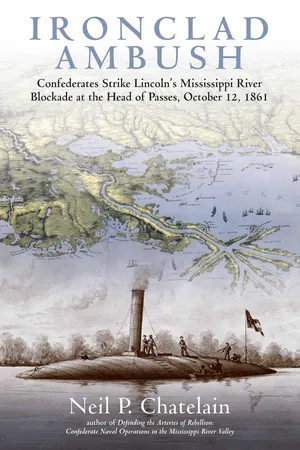
In early October 1861, United States warships entered the Head of Passes, where the Mississippi River’s multiple entrances converge into a single channel. The occupation simplified the blockade by enabling a handful of ships to seal off the “father of waters” and cut off supplies to New Orleans. Confederate Capt. George N. Hollins recognized the danger, assembled a makeshift flotilla, and launched a surprise attack on these enemy vessels. Award-winning historian Neil P. Chatelain’s Ironclad Ambush: Confederates Strike Lincoln’s Mississippi River Blockade at the Head of Passes, October 12, 1861, is the first book-length treatment of this pivotal naval action.
The Battle of the Head of Passes marked the Civil War’s first major fleet engagement. The Southern privateer ironclad ram Manassas smashed into USS Richmond, and as the Federals retreated toward the Gulf of Mexico, two blockaders ran aground and crews abandoned ship as Confederate gunboats closed in. The clash represented the Confederacy’s first major naval victory, the first use of an ironclad in North American waters, and the first direct challenge to President Lincoln’s blockade.
The action quickly became mired in confusion and conflicting accounts. Outdated technologies—sailing ships, fire rafts, and rams—collided with modern innovations like screw-propelled steamers, telegraph communications, and ironclads. The fog of war led officers and enlisted men to misinterpret orders, and many historians have misinterpreted the facts. Some commanders excelled and earned promotions, while others faltered, appeared drunk, or suffered breakdowns.
Lingering questions persist: Why did U.S. forces initially enter the Head of Passes? Why did Hollins seek to counter them? Which ships were involved? Why did two blockading crews abandon their vessels mid-battle? Why did the Confederates withdraw yet claim victory? Why does this seemingly minor and often overlooked engagement matter?
Chatelain’s Ironclad Ambush scrutinizes every previous account, firsthand archival material, and period newspapers to draw upon voices from all sides—including ship captains, junior officers, enlisted sailors, lighthouse keepers, and civilians across southeastern Louisiana. Like a detective, he unravels the complexities and contradictions of early Civil War coastal and riverine naval operations and places them within the context of the war. Everyone with an interest in the Civil War in general, and naval warfare in particular, will find this book invaluable.
eBook - PDF
Ironclad Ambush
Confederates Strike Lincoln's Mississippi River Blockade at the Head of Passes, October 12, 1861
- 257 pages
- English
- PDF
- Available on iOS & Android
eBook - PDF
Ironclad Ambush
Confederates Strike Lincoln's Mississippi River Blockade at the Head of Passes, October 12, 1861
About this book
Information
Subtopic
Military & Maritime HistoryIndex
HistoryTable of contents
- Cover
- TABLE OF CONTENTS
- ABBREVIATIONS
- Acknowledgments
- Preface
- Introduction
- Chapter One - Stevenson’s Proposal
- Chapter Two - New Orleans and the Genesis of Confederate Naval Activity
- Chapter Three - Establishing the Mississippi River Blockade
- Chapter Four - Tightening the Blockade
- Chapter Five - Converting Manassas
- Chapter Six - Occupying the Head of Passes
- Chapter Seven - An Ironclad and a Plan
- Chapter Eight - Night Ramming
- Chapter Nine - Hollins Advances, Pope Retreats
- Chapter Ten - Contesting Southwest Pass
- Chapter Eleven - A Comedy of Errors
- Chapter Twelve - Stuck in the Mud
- Chapter Thirteen - Hardships and Celebrations
- Chapter Fourteen - Effects and Implications
- Chapter Fifteen - Impacting the War
- Appendix - Vessels Mentioned
- Bibliography
- Index
- About the Author
Trusted by 375,005 students
Access to over 1.5 million titles for a fair monthly price.
Study more efficiently using our study tools.
Frequently asked questions
Yes, you can cancel anytime from the Subscription tab in your account settings on the Perlego website. Your subscription will stay active until the end of your current billing period. Learn how to cancel your subscription
No, books cannot be downloaded as external files, such as PDFs, for use outside of Perlego. However, you can download books within the Perlego app for offline reading on mobile or tablet. Learn how to download books offline
Perlego offers two plans: Essential and Complete
- Essential is ideal for learners and professionals who enjoy exploring a wide range of subjects. Access the Essential Library with 800,000+ trusted titles and best-sellers across business, personal growth, and the humanities. Includes unlimited reading time and Standard Read Aloud voice.
- Complete: Perfect for advanced learners and researchers needing full, unrestricted access. Unlock 1.5M+ books across hundreds of subjects, including academic and specialized titles. The Complete Plan also includes advanced features like Premium Read Aloud and Research Assistant.
We are an online textbook subscription service, where you can get access to an entire online library for less than the price of a single book per month. With over 1.5 million books across 990+ topics, we’ve got you covered! Learn about our mission
Look out for the read-aloud symbol on your next book to see if you can listen to it. The read-aloud tool reads text aloud for you, highlighting the text as it is being read. You can pause it, speed it up and slow it down. Learn more about Read Aloud
Yes! You can use the Perlego app on both iOS and Android devices to read anytime, anywhere — even offline. Perfect for commutes or when you’re on the go.
Please note we cannot support devices running on iOS 13 and Android 7 or earlier. Learn more about using the app
Please note we cannot support devices running on iOS 13 and Android 7 or earlier. Learn more about using the app
Yes, you can access Ironclad Ambush by Neil P. Chatelain,Neil P. Chatelain in PDF and/or ePUB format, as well as other popular books in History & Military & Maritime History. We have over 1.5 million books available in our catalogue for you to explore.