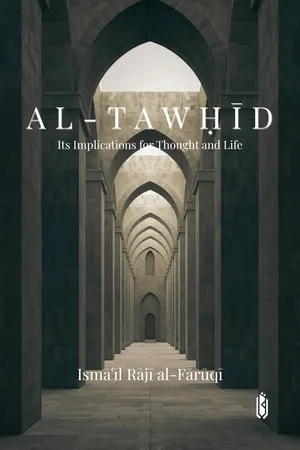
Isma'il Raji Al-Faruqi set out in this work to do something no other twentieth-century Muslim thinker had attempted with the same systematic rigor: trace a single doctrine, Al-Tawhid, through every major department of human thought and social life, from metaphysics and ethics to family, economics, politics, and art.
Al-Faruqi begins from the claim that Tawhid is not merely a statement about God's oneness but the organizing principle of reality itself, and that Islamic civilization's coherence, at its strongest, flowed directly from this single axiom. Across thirteen chapters he works outward from religious experience and epistemology into history, metaphysics, and ethics, before turning to the institutions through which Tawhid is meant to govern collective life: the family, the Ummah, political order, economic order, and international relations, closing with a substantial treatment of Islamic aesthetics and the art of Arabic calligraphy.
Written by a scholar trained in both Western philosophy, at Indiana University and Harvard, and the Islamic sciences at Al-Azhar University, and grounded in close engagement with the Qur'an, Hadith, and classical theology, the book moves between comparative religion, Greek and Christian philosophical categories, and the Islamic intellectual tradition, drawing sustained contrasts with Judaism, Christianity, and the philosophies of India along the way.
Composed as a work of instruction rather than abstract scholarship for its own sake, the book carries a reformist urgency throughout: Al-Faruqi wrote it in the conviction that the disunity and weakness of the modern Muslim world could be addressed only by returning to Tawhid as a lived, comprehensive worldview rather than a theological formula. Extensively documented, with 391 endnotes and a glossary of technical and foreign terms, the volume remains a standard reference for the study of the Islamic worldview.
A foundational text for students of Islamic philosophy, comparative religion, and Islamic studies, and for readers seeking a single, structured account of how the doctrine of divine unity extends into every sphere of Muslim thought and practice.