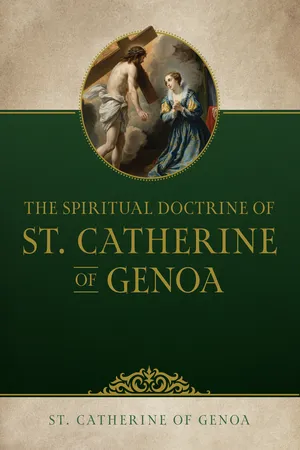
St. Catherine of Genoa was a noblewoman drawn from the vanities of the world into an extraordinary life of penance, hospital service, and mystical union with God. In this compelling account of her life and teachings, her confessor documents the fierce internal purification she endured as divine love systematically consumed her self-will. The text presents a vivid biographical portrait of her trials, spiritual insights, and renowned dialogues between the soul, the body, and self-love. This great saint's experiences culminated in a famous treatise on Purgatory, wherein she reveals that the suffering of holy souls consists in the agonizing delay of their union with Supreme Goodness. Let St. Catherine guide you, Dear Reader, into a deeper understanding of the absolute necessity of interior detachment, the subtle deceptions of self-love, and the consuming fire of divine charity that prepares the soul to see God face to face.
eBook - ePub
The Spiritual Doctrine of St. Catherine of Genoa
- English
- ePUB (mobile friendly)
- Available on iOS & Android
eBook - ePub
The Spiritual Doctrine of St. Catherine of Genoa
About this book
Information
Topic
Theology & ReligionSubtopic
Religious BiographiesTable of contents
- The Spiritual Doctrine of St. Catherine of Genoa
- Copyright
- Contents
- The Life and Doctrine of St. Catherine of Genoa
- Chapter I Of the parents and ancestors of the blessed Catherine, and how at eight years of age she began to do penance; her gift of prayer, and of her desire to enter into religion, and her marriage against her will.
- Chapter II She is wounded with divine love in the presence of her confessor.—Manifestations of the love of God and of her own offenses.—The Lord appears to her carrying His Cross, and she is taken up three degrees toward God.
- Chapter III How the desire was given to her to receive Holy Communion, and of its precious effects in her; of her sufferings when she did not receive, and how it seemed to her that she had lost faith, and walked by sight.
- Chapter IV How she was unable to take food during Lent and Advent, being sustained by the Blessed Sacrament.
- Chapter V Of her great penances and mortifications.
- Chapter VI How she was withdrawn by God from the use of her senses. —Of three rules given her by the Lord, and of certain words chosen from the Our Father and Hail Mary, and from the whole of the Holy Scripture.
- Chapter VII How even her humanity was affected by the burning fire of this love; how much she desired to die, and took delight in hearing Masses, bells, and offices for the dead.
- Chapter VIII How the Saint devoted herself to pious works, and served in a hospital.
- Chapter IX Of her wonderful knowledge of God and of herself.
- Chapter X How impossible it was for vainglory to enter the mind of this holy creature.—Of the light which hatred of self gave her, and of the value of our own actions.
- Chapter XI Of the revelation she had concerning purity of conscience, and of the opposition of sin to God.
- Chapter XII Of the great and solicitous care with which God operates in divers ways in order to attract the soul to Himself, so that He seems to be in a manner our servant.—Of the blindness of man.—Of the many ways in which he is deceived by his own self-will.
- Chapter XIII How she sees that the source of goodness is in God, and how creatures participate in it.
- Chapter XIV How she was entirely transformed in God, and hated to say me or mine.—What pride is.—Of the error of man who seeks for plenty and happiness on earth, where they cannot be found.—What a misfortune it is to be without love.
- Chapter XV How contrary to pure love is even the slightest imperfection.—Of the many means by which God ministers to our salvation.—At the point of death we shall esteem the opposition made to the divine inspirations as worse than Hell itself.
- Chapter XVI That she understood her own nothingness, and therefore would not speak about herself.—Of her great faith in God.—How willful and malicious we are in ourselves, and how necessary it is to abandon all to God.
- Chapter XVII In what manner God deals with one who corresponds with Him.—And how the saint abhorred spiritual delights, and how God cast around her the chain of pure love.
- Chapter XVIII How she did not desire love for God or in God, nor to have any medium between herself and God.—She could not see how love could be increased in her.—Of the peace of the soul transformed in God.
- Chapter XIX Of her earnest answer to a Friar Preacher who told her how much better he was prepared than herself for the divine love.—Nothing can hinder divine love, neither can it be deceived.—Also of its various conditions.
- Chapter XX That God does not wish man to serve Him through self-interest or through fear, but only through faith and love, and therefore He sweetly attracts his will.—The saint did not desire grace or mercy, but only justice.—That pure love fears nothing but sin.
- Chapter XXI How she was disposed toward God and toward her neighbor.—What pure and simple love is.
- Chapter XXII Of her vocation, which was like that of St. Paul.—That she was freed from suffering by her great love.—How terrible is man without grace.—How great is the stain of even one slight defect, and still more that of a sin.
- Chapter XXIII Of self-love and of divine love, and of their conditions.
- Chapter XXIV Concerning the three ways which God takes to purify the creature.
- Chapter XXV The manner in which the saint was medically treated for bodily infirmity, when her suffering was from spiritual fire, and of other accidents that befell her.
- Chapter XXVI Of the three things to which she could not consent, and of those which she could not refrain from desiring.
- Chapter XXVII Of the sweetness of the divine precepts, and the advantage of temporal adversity.
- Chapter XXVIII The process of annihilation of man in God illustrated by the figure of the eating of bread.—Of her interior and exterior.
- Chapter XXIX The saint urged to give an idea of her state.
- Chapter XXX Of her compunction for having desired death, every desire being an imperfection. —She relates her conversion to one of her spiritual children.
- Chapter XXXI How the saint left the whole care of herself to Love; and what means Love employed to purify her from her imperfections.
- Chapter XXXII How well regulated was the saint in all things.—Of the opposition of her spirit to humanity, and how humanity tormented her.
- Chapter XXXIII How an evil spirit, that had possession of one of her spiritual daughters, named her Catherine Serafina.
- Chapter XXXIV How God gave the saint a confessor in her extreme need who understood her and greatly consoled her.
- Chapter XXXV Treatment of the saint by her husband and how she obtained salvation of his soul from God, and also that of Sister Tommasa Fiesca, her companion.
- Chapter XXXVI How a person, hopelessly ill, was cured by the prayers of the saint.
- Chapter XXXVII Continuing an account of her extraordinary way of life, and her wonderful condition for some time before her death.
- Chapter XXXVIII How the sufferings she was to endure were revealed to her in spirit; and how dreadful they were to her humanity.—Seeing an image of the woman of Samaria, she asked of God that water.—Of a difference that arose between the spirit and humanity, and of other wonderful things.
- Chapter XXXIX How the spirit deprived her of her confessor, who concealed himself where he could witness her peace of mind in the midst of these tortures.—She had visions of angels.—Of the experiments tried by various physicians.—Of one who had come from England.—Of further divine operations.
- Chapter XL Of the many wonderful visions which the saint beheld in her last days.—Of her acute sufferings.—How she could taste nothing but the Blessed Sacrament, and suffered in herself the pains of the Passion of Our Lord.
- Chapter XLI In what manner, and at what time, she passed from this life to the Lord.—Many persons saw that blessed soul, under different forms, and in different ways, unite itself with God.—What happened to her confessor when he was celebrating the Mass of the Martyrs.
- Chapter XLII Of her burial, and how the body was preserved in the midst of great moisture and putrefaction.—How many prayers were granted by her intercession, and a person restored to health.—Of the order she gave to have her heart opened, which was not done.
- Spiritual Dialogue
- Chapter I The Soul and the Body propose to travel in company, and to take Self-Love for a third party.
- Chapter II The Soul and the Body take their turns, in which each enjoys itself according to its wishes and tastes.
- Chapter III How Self-Love blames both the Soul and the Body, and wishes to rule them himself.—The Soul complains, and the Body, adhering to Self-Love, demands what its needs require.
- Chapter IV The Soul, the Body, and Self-Love pursue their journey, during which the Soul cannot complete her whole week, and the Body encroaches upon it.—The Soul allows herself to be persuaded by Self-Love under pretext of the necessities of her two companions.—The Soul laments her condition and proposes not to take her turn again.
- Chapter V The Soul yields to the allurements of the Body and of Self-Love, and falls into the depths of sin.—Of the little satisfaction she takes in earthly things, and the trifles that are sufficient to content the Body.—Of the troubles of the Soul.
- Chapter VI How the Soul discourses further with Self-Love, proposing a new mode of action. —Of the nature of Self-Love.—Of the little required to satisfy the desires of the Body. —How the Soul falls into misery and despair.
- Chapter VII Of the light which God gave to the Soul to discover all her faults, and the state into which she had sunk.—Of her submission, confidence, and conversion.
- Chapter VIII Of many illuminations received by the Soul, and of the pure love of God.—Of conscience, and the remorse which God awakens in it.
- Chapter IX The Soul speaks to Self-Love and the Body of the truth she had seen, and tells them that she should be lost if she followed them.—She warns them of her purpose to do to them what they had designed to do to her, namely, to subject them to herself.—Of the disgust they felt at this.
- Chapter X Of the view which the Soul has of the goodness and providence of God.—Of her faults and imperfections.—Of her esteem of herself and hatred of her Humanity.
- Chapter XI How the Soul turns to God and perceives her own sinfulness, and also what she would have become had she continued her former course.—Almost in despair she bewails her offenses.—Of the confidence with which Our Lord inspires her, appearing to her spirit; and of the wound she receives.
- Chapter XII How God once more manifested to the Soul the love with which He had suffered for her.—She sees the malice of man and the benignity of the pure love of God.—Of the offering which she makes of herself to God, and of the wound she receives.—Of the five fountains of Jesus.—Of His constant and jealous watchfulness.
- Chapter XIII Of the instinct which led her to cast off every superfluous thing, and even those that appear necessary.—Of her instinct for prayer and her mortification.
- Chapter XIV Of the words that passed between the Spirit and Humanity. —Of the complaints made by Humanity against the fervor of the Spirit which she thought she could endure no longer.
- Chapter XV Humanity complains that the Spirit does not keep its promises and the Spirit defends itself against this charge.—Of the perils of spiritual delights under the semblance of good, and how they are more dangerous than bodily pleasures, which are evidently contrary to the Spirit.—Of the threats of the Spirit against its Humanity.
- Chapter XVI Humanity prays the Spirit to act justly and with equity, reminding her that she had been the first to sin and that the body had been merely the instrument.—The Spirit proves the contrary, and shows who has been the cause of their fall.—The Spirit demonstrates also the necessity of purification here, and that it is better to suffer for a thousand years in this world than one hour in Purgatory.
- Chapter XVII God pours into and diffuses throughout the soul a divine sweetness, whereat she complains, not desiring any proof of love.—God, notwithstanding, leaves her plunged in a sea of divine love.—He gives her, also, a vision of pure Love, and another of Self-Love and of her own evil inclinations.
- Chapter XVIII Humanity laments and asks for something to do.—The Spirit consents and enjoins upon it that it should be obedient in all things, stopping at nothing for any pleasure or displeasure that it might feel therein.—Of the rules he wishes it to observe: and of the prohibition he imposes upon it of forming any particular friendships.
- Chapter XIX Of the poverty in which the Spirit compelled Humanity to live.—How she was obliged to visit the poor and sick.—Of the suffering she found among them.—Of the oppression and interior distress which she experienced.
- Chapter XX Humanity having tried both exterior suffering and interior distress, the Spirit allows her to choose between them.
- Chapter XXI The Spirit brings Humanity to consent to take up her abode in a hospital, where she served the sick in the humblest manner, doing everything that she was ordered to do. —When she became accustomed to whatever she naturally most abhorred, she was made directress of the hospital, and was gifted with the prudence necessary for this office.—How the burning flame of love ever increased within her.
- Spiritual Dialogue
- Chapter I Of a new love which God poured into her heart, by which He drew her Spirit to Himself.—The Soul follows it, so that her powers are absorbed and lost in this love, and the Body, being subject to the Soul, becomes bewildered and changed from its natural condition.
- Chapter II In what manner God keeps the Soul occupied in His love.—Of the weakness of the body and of the support it receives from creatures.—Of the extreme sufferings of Humanity, which it bemoans without complaining, being interiorly conformed to the will of God.—And how Purgatory in this life is severe and sweet and full of mercy.
- Chapter III Humanity, thus menaced, desires to know the cause.—This is promised her.—God, while seeking men, draws them by different means and inspirations.—Of her continual sorrow. How, in her affliction, she calls upon God to relieve her by one ray of His love.—When she comes to understand the grace God has given her, she is pierced by a new dart of love.—Of her confession and contrition.
- Chapter IV God sends into that heart another ray of love, which, diffusing itself, fills the soul and revives the body.—There is nothing but exceeding love and joy, until this love, which is wholly from God, has completed its work.
- Chapter V The Soul asks concerning this love.—Our Lord in part answers her and discourses to her upon its greatness, nature, properties, causes, and effects.
- Chapter VI God reveals to the Soul that the body is to be a purgatory for her in this world.—How necessary it is that man should deny himself and become wholly lost in God.—Of the misery of man when he occupies himself with aught besides, since he has no time but the present to acquire a treasure of merit.
- Chapter VII The Soul, confirmed in virtue, begins to rest in her Lord.—God permits her to see that loving operation whereby, through His great goodness alone, He had liberated her.—The Soul, perceiving her own miseries, burns with a continual flame and is unable to speak or think of aught besides.
- Chapter VIII Our Lord makes known to the Soul that she had merited nothing, having employed in purifying herself the time which was given her to increase in grace and glory.—Also He shows her that without His help she could have done nothing.
- Chapter IX The Spirit, seeing the Soul brought to the gates of divine love, resolves to subject both Soul and Body to severe suffering.—He tells the Soul that he will separate himself from her, and that in order to recover her first purity, she must pass through many trials.
- Chapter X The Soul discovers that she must make satisfaction voluntarily, and it seems to her that she is abandoned by God.—She calls upon others for help.—How Humanity, by whom she had been threatened, is put to the proof.—Of the sufferings of the Body when deprived of communication with the Spirit.
- Chapter XI Of the brightness of eternal glory, and of the strength imparted to Humanity by a glimpse of it.—How God draws the Spirit to Himself, so that it may be wholly occupied in Him.—Of its sufferings.—What it is to live on earth while the Spirit is in Heaven, and through what sufferings one must pass in order to escape Purgatory.
- Spiritual Dialogue
- Chapter I The Soul inquires of God the reason of His great love for man, who is so opposed to Him; and also what is man, for whom He cares so much.
- Chapter II Exclamations of the Soul.—Our Lord demands the cause of her surprise, and questions her concerning her enjoyment in the company of spiritual persons, and of the pleasing conversations held with them.
- Chapter III The Soul discovers that what she had been doing, as if for God, proceeded truly from Self-Love.—She is filled with astonishment at the sight of pure love, and inquires concerning its nature.—Our Lord answers her that she could not understand it, and that He Himself, being love, can be comprehended only in His effects.
- Chapter IV That he whose heart is pure knows the love of God.—How that love works secretly, subtly, and without exterior occupation.—Some of its effects.—Exclamations of the Soul upon this love.—Of its properties.
- Chapter V Other effects of love.—What it accomplishes at its will.—The work is all its own. —Of works wrought through love, in love, and by love, with some explanation of them.
- Chapter VI The Soul asks various questions of Our Lord.—What the martyrs have suffered for this love.—That charity is the shortest and most secure road to salvation, and that without it the Soul would rather cast itself into a thousand hells than enter the presence of God.
- Chapter VII Our Lord questions the Soul concerning the love she feels and on what He has said to her.—The Soul responds according to her ability, but cannot express the intensity of her love.—She asks Our Lord how the loving Soul can live on earth, and concerning her condition.
- Chapter VIII Of the condition of the loving Soul.—How God delays imparting to her the knowledge of her defects, since she could not endure it.—She has no repose so long as she suspects the existence of any fault by which her Spirit is hindered of its satisfaction.
- Chapter IX Of the condition of the Body, and in what suffering Humanity found itself, living as though dead.—How God provided for it.—Of the joy experienced by the Soul in the interchange of love, and how she is left like one dead when deprived of it.
- Chapter X How the Soul, the heart, and the Spirit of this creature are devoid of form, and employed in an occupation which cannot be known by their means.—That the heart becomes the tabernacle of God, into which He infuses many graces and consolations, which produce admirable fruits.—That few creatures are led by this road.—Of the nudity of the Spirit and of its union with God.
- Chapter XI Of the secret means used by God for the purification of man.—Of the loving care He takes of him.—How He sweetly leads him by love, and does not allow him to work for his own advantage.—That true nakedness of spirit cannot be expressed by words.
- Chapter XII Exclamations of the Soul upon the hindrances which creatures offer to the love of God.—Of the secret operations of God in man, arousing and admonishing him with love.—The Soul inquires concerning this work, and desires to know what grace is, and what is the ray of love.
- Chapter XIII That love cannot be comprehended, and that the heart filled with it lives content.—Of the great mercy which God shows man in this life.—That His justice becomes apparent at the moment when the Soul leaves the body and passes to its destined place.—That the Soul can find repose in God only.
- Treatise on Purgatory
- Chapter I The state of souls in Purgatory.—They are exempt from all self-love.
- Chapter II The joy of souls in Purgatory.—The saint illustrates their ever-increasing vision of God.—The difficulty of speaking about their state.
- Chapter III Separation from God is the greatest pain of Purgatory.—In this, Purgatory differs from Hell.
- Chapter IV The difference between the state of the souls in Hell and that of those in Purgatory. —Reflections of the saint upon those who neglect their salvation.
- Chapter V Of the peace and joy which are found in Purgatory.
- Chapter VI A comparison to express with how great violence of love the souls in Purgatory desire to enjoy God.
- Chapter VII Of the marvelous wisdom of God in the creation of Purgatory and of Hell.
- Chapter VIII Of the necessity of Purgatory, and of its terrific character.
- Chapter IX How God and the soul reciprocally regard each other in Purgatory.—The saint confesses that she has no words to express these things.
- Chapter X How God makes use of Purgatory to complete the purification of the soul.—That she acquires therein a purity so great that if she were yet to remain after her purification she would cease to suffer.
- Chapter XI The desire of souls in Purgatory to be purified from every stain of sin.—The wisdom of God in veiling from them their defects.
- Chapter XII How joy and suffering are united in Purgatory.
- Chapter XIII The souls in Purgatory are not in a state to merit.—How they regard the suffrages offered for them in this world.
- Chapter XIV Of the submission of the souls in Purgatory to the will of God.
- Chapter XV Reproaches of the soul in Purgatory to persons in this world.
- Chapter XVI Showing that the sufferings of the souls in Purgatory do not prevent their peace and joy.
- Chapter XVII Which concludes with an application of all that has been said concerning the souls in Purgatory to what the saint experiences in her own soul.
- Endnotes
Trusted by 375,005 students
Access to over 1.5 million titles for a fair monthly price.
Study more efficiently using our study tools.
Frequently asked questions
Yes, you can cancel anytime from the Subscription tab in your account settings on the Perlego website. Your subscription will stay active until the end of your current billing period. Learn how to cancel your subscription
No, books cannot be downloaded as external files, such as PDFs, for use outside of Perlego. However, you can download books within the Perlego app for offline reading on mobile or tablet. Learn how to download books offline
Perlego offers two plans: Essential and Complete
- Essential is ideal for learners and professionals who enjoy exploring a wide range of subjects. Access the Essential Library with 800,000+ trusted titles and best-sellers across business, personal growth, and the humanities. Includes unlimited reading time and Standard Read Aloud voice.
- Complete: Perfect for advanced learners and researchers needing full, unrestricted access. Unlock 1.5M+ books across hundreds of subjects, including academic and specialized titles. The Complete Plan also includes advanced features like Premium Read Aloud and Research Assistant.
We are an online textbook subscription service, where you can get access to an entire online library for less than the price of a single book per month. With over 1.5 million books across 990+ topics, we’ve got you covered! Learn about our mission
Look out for the read-aloud symbol on your next book to see if you can listen to it. The read-aloud tool reads text aloud for you, highlighting the text as it is being read. You can pause it, speed it up and slow it down. Learn more about Read Aloud
Yes! You can use the Perlego app on both iOS and Android devices to read anytime, anywhere — even offline. Perfect for commutes or when you’re on the go.
Please note we cannot support devices running on iOS 13 and Android 7 or earlier. Learn more about using the app
Please note we cannot support devices running on iOS 13 and Android 7 or earlier. Learn more about using the app
Yes, you can access The Spiritual Doctrine of St. Catherine of Genoa by Don Cattaneo Marabotto,Catherine St. Catherine in PDF and/or ePUB format, as well as other popular books in Theology & Religion & Religious Biographies. We have over 1.5 million books available in our catalogue for you to explore.