eBook - ePub
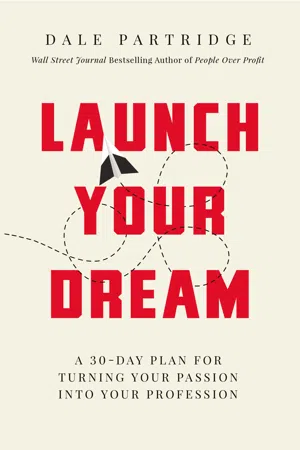
Launch Your Dream
A 30-Day Plan for Turning Your Passion into Your Profession
- 224 pages
- English
- ePUB (mobile friendly)
- Available on iOS & Android
eBook - ePub
About this book
Though his highly acclaimed Startup Camp program, bestselling author and serial entrepreneur Dale Partridge has helped thousands of people find unimaginable freedom and financial success by assisting them in launching new startup businesses. And now, in Launch Your Dream, he has distilled the essence of that course into a hyper-practical, 30-day journey for readers looking to join these other entrepreneurs in following their dreams and achieving unimaginable freedom and financial security. This invaluable and comprehensive resource will teach readers how to:• Hone their ideas• Build an audience• Construct an online presence• Master social media• Craft a beautiful brand• Create experiences that keep customers from even considering competitors• And does this in 30 days!Whether you are an experienced CEO, a budding entrepreneur, a stay-at-home mom, or a freelancer just looking to make some money on the side, Launch Your Dream provides the easy-to-follow steps necessary to finding the freedom you've been looking for.
Information
Subtopic
Business generaleIndex
BusinessDream Well
DAY 5
An Irresistible Idea
Estimated Reading Time: 10 Minutes
Entrepreneurs are more than just a growing part of the American economy. They are now a significant part of American folklore. We often hear stories about Steve Jobs at Apple or Mark Zuckerberg at Facebook and assume that a critical part of being a successful entrepreneur is youthfulness. But according to recent research, the average age of a successful entrepreneur in high-growth industries such as aerospace and health care is forty. Twice as many successful entrepreneurs are over the age of fifty as compared to those under the age of twenty-five.1 The determining factor in a starter’s success isn’t age; it often depends on the strength of their ideas.
If you’ve picked up this book and read this far, you probably have an idea for a service or product that you believe has marketplace value. I hate to be the bearer of bad news, but your idea may suck. Lots of entrepreneurs have bad ideas. But the best ones will continue to search until they replace a bad idea with a good one or find a better version of the bad idea.
But that raises a question: how does an entrepreneur know if an idea is good or bad? Some assume that the value of an idea is in the eye of the beholder, and when it comes to the details of your idea, that may be true. If an entrepreneur came to me with a new type of soda, I wouldn’t be interested. I don’t like soda, and I don’t drink it. But just because I don’t consider it a good idea for me doesn’t mean it is inherently bad.
The true value of an idea, however, is not a matter of taste. This is actually one of the worst ways to judge an idea’s merits. The reason for this is “confirmation bias,” or the human tendency to filter facts according to what we hope is true. As Richard Watson of Fast Company wrote, “If someone has an idea that they believe in, then any fact that supports the idea will be quickly seized upon, whereas any fact that questions it will be instantly dismissed.”2
Entrepreneurs need objective measures by which to judge their business ideas. In my experience, the best ideas have four characteristics that enable success, like the four legs that support a stool.
They Solve a Problem
Often, entrepreneurs create a product that is a solution in search of a problem. The best start-ups, however, are built on problem solving. As bestselling author Seth Godin says, “Don’t find customers for your products, find products for your customers.” As long as consumers have problems, they will always search for solutions and you will always have a business. Your ideas are only as strong as the problems they solve.
Of course, problems are like people. There are big ones and tiny ones, quiet ones and noisy ones. How do you know if your idea seeks to solve a worthy one? The best problems to solve are built around three elements:
1. Necessity: Search for problems that people need to solve. That will make your good or service a “must-have,” not a “nice-to-have.” Ideas that solve deep-seated issues have more potential than luxury products that tackle fringe problems.
2. Pain: The more pain the problem causes, the more powerful the solution will be. If your idea can relieve significant pain in the life of your customer, you’ll find quick buy-in and create lifelong fans. If a problem causes physical, emotional, even financial pain, it is a good one to solve.
3. Urgency: If there is a time component involved, the power of your idea can be amplified. A new kind of chemotherapy that can cure a lethal form of cancer is a more lucrative product than a new form of ibuprofen that is more sensitive on the stomach. The latter isn’t nearly as urgent as the former.
They Scratch Your Own Itch
This leg of the stool is related to the last point. You need to make sure that both the idea—and the problem it seeks to solve—are important to you personally. Working to solve someone else’s problem is never the best choice. Don’t start a baby clothing company if you don’t have children. Don’t start a tour guide service for mountain climbers if you’re afraid of heights. You have a better outlook and a greater chance of success if you align your personal interests and life with your business ideas.
As Brian Hamilton, chairman of Sageworks, said:
There are entrepreneurs who can start businesses in industries they don’t care about—buy for a dollar, sell for two. These people exist; I just haven’t seen any successful ones. On average, I think you’ll find that most successful business owners were (and are) passionate about the original idea behind their companies. The best entrepreneurs are like a musician who has a song and must sing it.3
Likewise, make sure the idea fits with your lifestyle. If you can’t afford it, it’s probably not your idea. And if you don’t enjoy it, it probably isn’t your idea. Filmmaking icon Walt Disney may have said it best: “We don’t make movies to make money. We make money to make more movies.”
They Are Timed Right
At least one person had a vision for Netflix, a company that has helped dismantle the cable industry in America. At least one person had a vision for Airbnb, a company that has rocked the traditional hotel industry in America. At least one person had a vision for Uber, a company that has sent the public transportation industry in America scrambling. The ideas behind all three corporations have been wildly lucrative and have spawned a cottage industry of knockoffs. But one important thing they all have in common is timing.
A great idea launched at an inopportune time is a bad idea. Imagine if you had an idea for a revolutionary brick-and-mortar travel agency or a new and improved pay-phone booth. In the early 1990s these may have been good ideas, but today anyone will tell you that they are bad ideas. The only thing that’s different is the timing.
Timing is about more than just time. It’s not just when your idea occurs, but what is happening in the world, in your industry, and in the marketplace. Brandon Watts, a renowned publicist who has represented scores of start-ups, said:
[Good] timing isn’t about launching in either this or that quarter. Rather, it’s about the much broader condition of the industry and culture as a whole—something that can’t usually be controlled by business leaders and in many ways can’t even be defined. For entrepreneurs, it can be hard to accept that something so mysterious can make or break their companies, especially when there are so many other factors already working against a startup’s success. Yet it’s the reality all of them face.4
They Are Scalable
A bad idea is one that allows you to make money only if you have more time, so it is wholly dependent on you. Why? Because that kind of idea has a ceiling. Even the hardest-working entrepreneurs ultimately run out of time. And when they do, they’ll grow frustrated and burned-out trying to grow their business when growth is no longer possible. The best idea is one that can be scaled so that the entrepreneur can make more money while investing less time.
In the end, putting your energy behind the best idea possible only increases your chance of success. It doesn’t guarantee success. You’ll also need to be a passionate entrepreneur with a killer work ethic and a boatload of patience. An idea can be good, but only you can make it irresistible.
COMPLETE DAY #5
REMEMBER
“The value of an idea lies in the using of it.”
—Thomas A. Edison
ASK
If you stated the problem you’re trying to solve in one sentence, what would that be?
BELIEVE
My ideas are only as strong as the problems they solve.
DO
Rate how your idea measures on each of the following criteria, on a scale of 1 to 5:
The problem I’m solving is a necessity. ———...
Table of contents
- Dedication
- Contents
- 0 You Were Made for This
- Get Ready
- Dream Well
- Make ’Em Feel It
- Win Their Hearts
- Be Pixel Perfect
- Build the Box
- Launch Loud
- Sell the Story
- Hack to Huge
- Keep Them Captivated
- Beat the Barriers
- + Having It All
- Acknowledgments
- Notes
- About the Author
Trusted by 375,005 students
Access to over 1.5 million titles for a fair monthly price.
Study more efficiently using our study tools.
Frequently asked questions
Yes, you can cancel anytime from the Subscription tab in your account settings on the Perlego website. Your subscription will stay active until the end of your current billing period. Learn how to cancel your subscription
No, books cannot be downloaded as external files, such as PDFs, for use outside of Perlego. However, you can download books within the Perlego app for offline reading on mobile or tablet. Learn how to download books offline
Perlego offers two plans: Essential and Complete
- Essential is ideal for learners and professionals who enjoy exploring a wide range of subjects. Access the Essential Library with 800,000+ trusted titles and best-sellers across business, personal growth, and the humanities. Includes unlimited reading time and Standard Read Aloud voice.
- Complete: Perfect for advanced learners and researchers needing full, unrestricted access. Unlock 1.5M+ books across hundreds of subjects, including academic and specialized titles. The Complete Plan also includes advanced features like Premium Read Aloud and Research Assistant.
We are an online textbook subscription service, where you can get access to an entire online library for less than the price of a single book per month. With over 1.5 million books across 990+ topics, we’ve got you covered! Learn about our mission
Look out for the read-aloud symbol on your next book to see if you can listen to it. The read-aloud tool reads text aloud for you, highlighting the text as it is being read. You can pause it, speed it up and slow it down. Learn more about Read Aloud
Yes! You can use the Perlego app on both iOS and Android devices to read anytime, anywhere — even offline. Perfect for commutes or when you’re on the go.
Please note we cannot support devices running on iOS 13 and Android 7 or earlier. Learn more about using the app
Please note we cannot support devices running on iOS 13 and Android 7 or earlier. Learn more about using the app
Yes, you can access Launch Your Dream by Dale Partridge in PDF and/or ePUB format, as well as other popular books in Business & Business generale. We have over 1.5 million books available in our catalogue for you to explore.