eBook - ePub
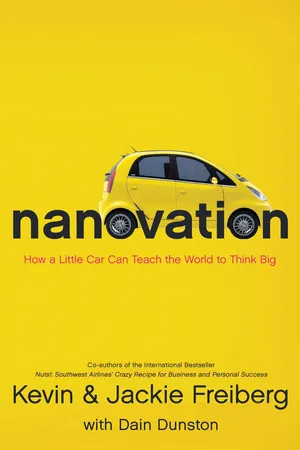
Nanovation
How a Little Car Can Teach the World to Think Big and Act Bold
- 560 pages
- English
- ePUB (mobile friendly)
- Available on iOS & Android
eBook - ePub
Nanovation
How a Little Car Can Teach the World to Think Big and Act Bold
About this book
The Nano car disrupted an entire industry and changed the game in India forever. But this inspiring book is more than the story of one ingenious invention. Nanovation explains how revolutionary business thinking and product design can have profound effects on companies, industries, and the world. Discover the thought processes that bred innovation, the leadership that overcame adversity, the risks that were necessary to avoid failure, and how all of these efforts resulted in success beyond customers' wildest expectations. This book will inspire you to contest management dogma, taken-for-granted assumptions, and updated systems--asking instead the tough questions of "What if?" and "Why not?" The process may even motivate you to overcome the toughest roadblocks in your career, the limitations of your business, and the biggest challenges facing your industry, In India, entire families?too poor to afford a car?crowd onto a single motor scooter every day to brave the tangled traffic of the streets. One evening, Tata Motor's then–venerable chairman Ratan Tata witnessed something on those rain-soaked streets that horrified him: an overloaded scooter lost traction in a busy intersection and sent several members of a family tumbling across the pavement. In that moment, the dream of Nanovation took root--and Ratan Tata perused it undeterred. When budget constraints, design restrictions, the rising costs of materials, and political agitation threatened to derail the project, Team Nano pressed on. This is the story of how they overcame insurmountable odds to create one of the greatest innovations in the auto industry.Do you have the eyes, the ears, and the hands to be a Nanovator? Endorsed by CEOs of high-profile, worldwide companies spanning many different industries, Nanovation encourages big ideas and even bigger action plans so that you, too, can make your mark.
Information
Topic
Personal DevelopmentSubtopic
Automobile Industry
Part One
The Nano Story
The Nano Story
1
I think that’s when the whole thing started in my mind, looking at what is now a pretty familiar sight in India, an entire family traveling on a scooter with three or four family members.
RATAN TATA, CEO, TATA GROUP
RATAN TATA, CEO, TATA GROUP
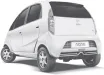
The story of the Tata Nano is one of radical innovation in the service of a cause. The cause was to reach out to those emerging from the bottom of the pyramid and offer them a safe and dignified alternative to the current, death-defying practice of putting an entire family on a scooter. The radical innovation was to take up to 50 percent of the cost out of manufacturing a small family car; to make a car that offered most of the functionality of a modern small car, like the popular Honda Civic or Volkswagen Golf, for a fraction of the price.
2
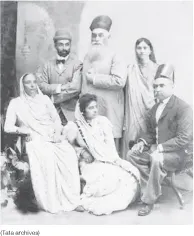
Looking back, it’s easy to forget how quixotic and impossible the challenge seemed at the time. Had it not been for the immense respect business leaders, the press, and the people of India have for Ratan Tata, the laughter would have been louder. Part of that respect stems from the fact that Tata and the company he leads have a long history of doing the right things for their customers, for their investors, and for the world.
This is the story of a small team that took on a big challenge, and, by doing so, made business history.
ONE
Nanovation Begins with Noticing
Nanovation Begins with Noticing
3
Apparently, there is nothing that cannot happen today.
MARK TWAIN
MARK TWAIN
Let’s set the scene with a look at life (and death) on the roads of India. If you want the ultimate definition of pandemonium, you’ll find it in the words Indian traffic. Traveling in India is not for the faint of heart. No wimps, no whiners.
Particularly in the cities, traffic can be more than heavy—it can be nuts! Signs over the streets beg drivers to stay in their lanes (Lane Driving Is Sane Driving!), but no one pays attention. Pedestrians and bicycles are everywhere.
Open-sided autorickshaws—three-wheel scooters that serve either as taxis or as delivery trucks—belch smoke and fumes as they inch forward like a sea of black-and-yellow beetles clawing for forward progress. Two-wheel scooters weave through the traffic carrying families or delivering lunch or anything else you can imagine. A camel pulls a flatbed wagon. A sacred white Brahma bull stops in the middle of an intersection to take it all in.
4
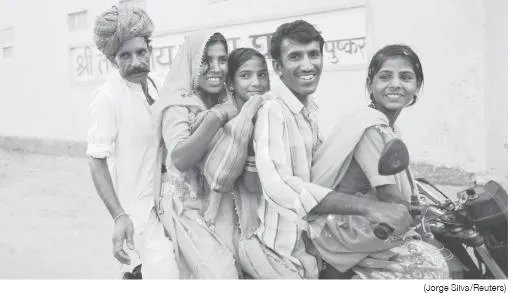
Amid the chaos, horns blare. Honking is acceptable and encouraged. In fact, many overloaded trucks paint “horn please” on the back of their vehicles because they cannot see you passing on either side. It’s one near miss after another in a dangerous sea of coordinated disorder that generally follows the laws of hydrodynamics. And in many places, all of this happens with toddlers and young children playing—literally—just inches away from all the mayhem.
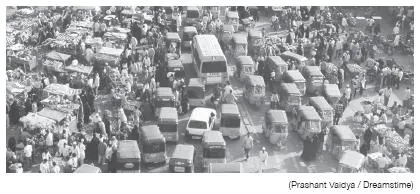
Indians have mastered the art of turning a two-lane street into five lanes of snarling traffic. Traveling in India is not for the faint of heart.
India has been working hard to build its infrastructure, strangled by decades of neglect, yet most roads are in rough shape. To say that they are congested is a major understatement. Traffic in the cities frequently comes to a standstill, and traffic on the highways often slows to fifteen or twenty miles per hour. And fortunately they’re not going any faster.
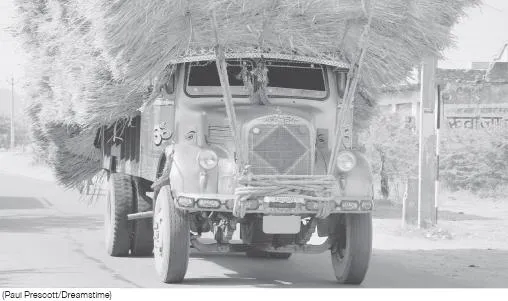
Crazy? Unstoppable? Or both? You decide. An overloaded truck in the agricultural region of Rajasthan.
5
India’s minister of Road Transport and Highways, Kamal Nath, recognizes the severity of this problem. In his keynote address at the annual convention of the Society of Indian Automobile Manufacturers in 2009 he said, “We had the decade of IT in India. We must make this the decade of infrastructure. You build the vehicles; I will build the roads.”
In the present decade, India will make a quantum leap from building one to ten miles of new roads per day using the best technology and latest methods from around the globe.
Against this backdrop, imagine riding a scooter in the rain. In India, when the rains hit, all the oil and grease accumulated from the dry season is flushed to the surface of the road, making driving conditions treacherous. It’s not a good time to be driving, and it’s an even worse time to be on a scooter or motorbike. It’s uncomfortable. Undignified. And dangerous.
6
And that’s where our story begins.
THE FAMILY ON A SCOOTER
In Bangalore during the monsoons of 2002, it has been raining all day, making it hard to get on with your life. The rain subsides for the moment; you stick your head out the window and ask yourself, Can we make it? You decide to go for it, so you push the family scooter to the street and climb on—mother and father, with one child clutched between the two of you, and one child standing between your legs.
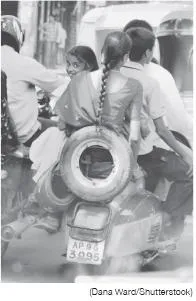
Counting heads reveals a typical family of four on a scooter.
These people are not crazy. They’re just unstoppable.
Like most of your friends, you are among millions of young, educated Indian families making do with what you can afford. You are doing better than any generation of Indians before you, working hard to give your children a better life. As you pull into traffic, everybody hangs on. Since most of the traffic in India is open vehicles—two-wheel and three-wheel scooters—people tend to wait for a rainstorm to end if they can. Frequently that just isn’t possible. So you ride next to many who have obviously been drenched by the rain. They are wet, their passengers are wet, it’s hard to see, the streets are congested, and the traffic is loud. It’s no fun to ride a scooter in pouring rain. And it’s not much more fun to ride it right after the rain, when cars and trucks splash through puddles and the spray from their tires hits you in the face.
7
YOUR WORST NIGHTMARE IS NO DREAM
You approach an intersection where you need to make a turn. You see up ahead that traffic has opened and people are increasing their speed. If you can just thread the needle and get by the Mercedes immediately in front of you, this narrow window might allow you to make it to your meeting before the rain starts again.
Suddenly your back wheel slides. Panic strikes, and a surge of adrenaline floods your veins. Your worst nightmare is unfolding right before your eyes.
You lose control, and the scooter goes down. No helmets. No leather. No protection.
You’ve seen this happen before but never thought it would happen to you. This time no one is seriously injured. As you collect your shaken family, you are incredibly thankful, yet ever more hopeful. The incident has intensified your dream of owning a safe, more dignified form of transportation, one that will get your family out of the rain.
This is not a hypothetical family. They are very real and so was their crash.
Someone had to ask,
“What if?”
“What if?”
Now, consider the story through the eyes of Ratan Naval Tata, the chairman of the Tata Group. On this same dark and dreary afternoon, Ratan steps into his car, knowing how dangerous the roads will be. But he has no way of knowing the magnitude of what is about to unfold.
“Please drive carefully,” he tells the driver. “The roads will be slippery.” The driver nods as he pulls away from the curb. A few minutes later, as Mr. Tata’s car approaches an intersection, the family on the scooter passes it.
8
What if we could give these people safe transportation they could afford?
“I think that’s when the whole thing started in my mind,”
Ratan told us, “looking at what is now a pretty familiar sight in India, an entire family traveling on a scooter with three or four family members.” He points them out to his driver. “Watch those people. In this rain, they could slip.”
His driver responds.
“Be careful; slow down,” Mr. Tata says again as they enter an intersection behind the scooter.
And then it happens. “I had no sooner said the words when he lost control and went slipping down on the pavement, the scooter sliding one way and the family members tumbling in all directions.”
As he steps from his car to help, Mr. Tata knows it could have been much worse: “If we had been going faster, there would have been no way to keep from running over them. The family was all over the road and could have been under the car. I thought, This is really bad. And I thought, Now add nighttime to this. Add a little speed. Add a little bit of lack of control, and you have a really dangerous mode of transport.”
They offered what help they could and then got back in the car and drove on. As they did, Ratan Tata knew he’d just been given a wake-up call that something had to be done.
Someone had to ask, “What if?”
A DREAM BORN OF COMPASSION
“Where observation is concerned, chance favors only the prepared mind.”
Louis Pasteur
Louis Pasteur
Most people would leave the scene of the accident feeling sad and sorry, but few would be in a position to take meaningful action. As Louis Pasteur said, speaking of his ability to recognize patterns and connections that other scientists missed, when, by long thought and study, your mind is prepared to see opportunity, you’re more likely to have a breakthrough.
9
And this was not the first time Ratan Tata had thought about how to get Indian families off scooters and into something safer. In fact, he’d mentioned it in speeches and talked about it with his peers. As chairman of the Tata Group, which owns and manages Tata Motors, he had a car company at his command. He had the means and opportunity to act, and now, his heart pumping from the excitement, he had a motive.
Immediately his mind went to work. He couldn’t shut the idea down; it played again and ...
Table of contents
- Cover Page
- Title Page
- Copyright Page
- Dedication
- Contents
- Prologue
- Part One: The Nano Story
- Part Two: Defining Nanovation
- Part Three: Finding What’s Next! The Eight Rules of Nanovation
- Part Four: The Nanovation Effect
- Acknowledgments
- About the Authors
- Index
Trusted by 375,005 students
Access to over 1.5 million titles for a fair monthly price.
Study more efficiently using our study tools.
Frequently asked questions
Yes, you can cancel anytime from the Subscription tab in your account settings on the Perlego website. Your subscription will stay active until the end of your current billing period. Learn how to cancel your subscription
No, books cannot be downloaded as external files, such as PDFs, for use outside of Perlego. However, you can download books within the Perlego app for offline reading on mobile or tablet. Learn how to download books offline
Perlego offers two plans: Essential and Complete
- Essential is ideal for learners and professionals who enjoy exploring a wide range of subjects. Access the Essential Library with 800,000+ trusted titles and best-sellers across business, personal growth, and the humanities. Includes unlimited reading time and Standard Read Aloud voice.
- Complete: Perfect for advanced learners and researchers needing full, unrestricted access. Unlock 1.5M+ books across hundreds of subjects, including academic and specialized titles. The Complete Plan also includes advanced features like Premium Read Aloud and Research Assistant.
We are an online textbook subscription service, where you can get access to an entire online library for less than the price of a single book per month. With over 1.5 million books across 990+ topics, we’ve got you covered! Learn about our mission
Look out for the read-aloud symbol on your next book to see if you can listen to it. The read-aloud tool reads text aloud for you, highlighting the text as it is being read. You can pause it, speed it up and slow it down. Learn more about Read Aloud
Yes! You can use the Perlego app on both iOS and Android devices to read anytime, anywhere — even offline. Perfect for commutes or when you’re on the go.
Please note we cannot support devices running on iOS 13 and Android 7 or earlier. Learn more about using the app
Please note we cannot support devices running on iOS 13 and Android 7 or earlier. Learn more about using the app
Yes, you can access Nanovation by Kevin Freiberg,Jackie Freiberg,Dain Dunston in PDF and/or ePUB format, as well as other popular books in Personal Development & Automobile Industry. We have over 1.5 million books available in our catalogue for you to explore.