An international group of esteemed scholars examines how religio-ethnonationalist power is communicatively produced, normalized, and resisted through discourse.
This edited volume moves beyond conceptions of democratic decline as a purely institutional or electoral phenomenon to advance our understanding of how religion, nationalism, and media power intersect in struggles over democracy. Foregrounding the communicative processes through which affective narratives of exclusion, tradition, and morality are mobilized to legitimate authoritarian power, contributors demonstrate how discourse is simultaneously leveraged as both a mechanism of domination and a site of contestation as it shapes memory, identity, citizenship, and political belonging.
Engaging interdisciplinary conversations across global contexts including North Macedonia, Malaysia, Nigeria, and the United States, contributors highlight not only how discursive tactics of amnesia, amnesty, and cleansing are utilized to sustain religio-ethnonationalist hierarchies but also how discursive resistance can be embraced to reveal the uneven conditions from which resistance emerges. By centering communication as a site of democratic struggle, this volume offers a conceptual framework for identifying how democratic backsliding is (re)produced and challenged, ultimately emphasizing the ethical and political stakes of memory, identity, and power in shaping the future of democracy.
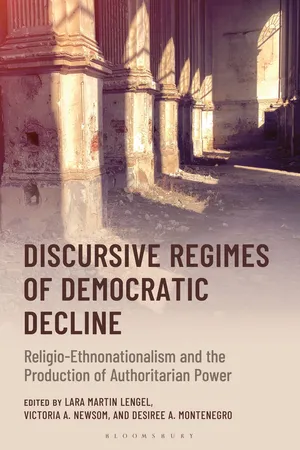
eBook - ePub
Discursive Regimes of Democratic Decline
Religio-Ethnonationalism and the Production of Authoritarian Power
- 351 pages
- English
- ePUB (mobile friendly)
- Available on iOS & Android
eBook - ePub
Discursive Regimes of Democratic Decline
Religio-Ethnonationalism and the Production of Authoritarian Power
About this book
Information
Table of contents
- Cover
- Half-Title
- Series
- Dedication
- Title
- Contents
- Foreword
- Acknowledgments
- Introduction: Discursive Regimes in the Age of Religio-Ethnonationalisms, Authoritarianisms, and Resistance
- Part I Discursive Amnesia and Religio-Ethnonationalisms
- 1 Theorizing Discursive Amnesia and Religio-Ethnonationalisms
- 2 Contested Histories and Ethnonationalism: Colonial Knowledge, Historical Mythmaking, and the Rise of Hindutva in India
- 3 Invoking an Unhealed Past: Trauma, Memory, and Biafra Resurgence, 1999–2023
- 4 Faith, Nation, and Nature: Religious Environmentalism and the Politics of Belonging in the Global South
- Part II Discursive Amnesty in Response to Religio-Ethnonationalisms
- 5 Theorizing Discursive Amnesty and Religio-Ethnonationalisms
- 6 Discursive Amnesia, Discursive Amnesty, Religio-Ethnonationalism, and Imperialistic Missions
- 7 “We Need to Pray for Our Country”: Virtue Signaling and Christian Nationalist Sympathy in White Evangelical Culture
- 8 Discursive Amnesty and the Performance of Democracy in North Macedonia
- Part III Discursive Cleansing as Religio-Ethnonationalism
- 9 Theorizing Discursive Cleansing and Religio-Ethnonationalisms
- 10 The Rise of Antisemitism and Political Extremist Ideology
- 11 The Pedagogy of Forgetting: How Christian Nationalist Curricula Produces Discursive Cleansing
- 12 Contextual Democracy Beyond Binary Opposites: Dialogical Islam and the Post-Essentialist Turn
- Part IV Discursive Resistance to Religio-Ethnonationalisms
- 13 Theorizing Discursive Resistance to Religio-Ethnonationalisms
- 14 Creating a Shared Identity: Innovative Indigenous and Civil Society Resistance to Cypriot Ethnonationalism
- 15 Yogic Resistance: Swami Vivekananda and the Rhetoric of Transcendence
- 16 Ethnoreligious Nationalism: Advancing or Impeding Women’s Rights?
- 17 Neo-Nazi Celebration and Fascist Critique: Radical Religio-Ethnonationalism and Resistance in Mainstream Balkan Rock
- Conclusion: Identity, Resistance, and Democratization in the Age of Ethnonationalisms
- Index
- About the Editors and Contributors
- Copyright
Trusted by 375,005 students
Access to over 1.5 million titles for a fair monthly price.
Study more efficiently using our study tools.
Frequently asked questions
Yes, you can cancel anytime from the Subscription tab in your account settings on the Perlego website. Your subscription will stay active until the end of your current billing period. Learn how to cancel your subscription
No, books cannot be downloaded as external files, such as PDFs, for use outside of Perlego. However, you can download books within the Perlego app for offline reading on mobile or tablet. Learn how to download books offline
We are an online textbook subscription service, where you can get access to an entire online library for less than the price of a single book per month. With over 1.5 million books across 990+ topics, we’ve got you covered! Learn about our mission
Look out for the read-aloud symbol on your next book to see if you can listen to it. The read-aloud tool reads text aloud for you, highlighting the text as it is being read. You can pause it, speed it up and slow it down. Learn more about Read Aloud
Yes! You can use the Perlego app on both iOS and Android devices to read anytime, anywhere — even offline. Perfect for commutes or when you’re on the go.
Please note we cannot support devices running on iOS 13 and Android 7 or earlier. Learn more about using the app
Please note we cannot support devices running on iOS 13 and Android 7 or earlier. Learn more about using the app
Yes, you can access Discursive Regimes of Democratic Decline by Lara Martin Lengel,Victoria A. Newsom,Desiree A. Montenegro in PDF and/or ePUB format, as well as other popular books in Languages & Linguistics & Communication Studies. We have over 1.5 million books available in our catalogue for you to explore.