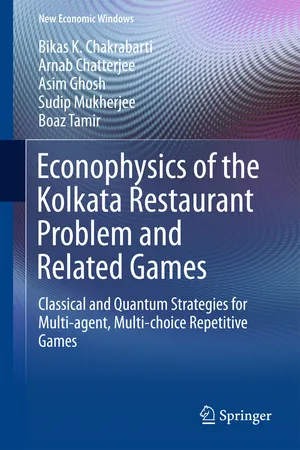
This book provides the first comprehensive introduction to multi-agent, multi-choice repetitive games, such as the Kolkata Restaurant Problem and the Minority Game. It explains how the tangible formulations of these games, using stochastic strategies developed by statistical physicists employing both classical and quantum physics, have led to very efficient solutions to the problems posed. Further, it includes sufficient introductory notes on information-processing strategies employing both classical statistical physics and quantum mechanics. Games of this nature, in which agents are presented with choices, from among which their goal is to make the minority choice, offer effective means of modeling herd behavior and market dynamics and are highly relevant to assessing systemic risk. Accordingly, this book will be of interest to economists, physicists, and computer scientists alike.
eBook - PDF
Econophysics of the Kolkata Restaurant Problem and Related Games
Classical and Quantum Strategies for Multi-agent, Multi-choice Repetitive Games
- 212 pages
- English
- PDF
- Available on iOS & Android
eBook - PDF
Econophysics of the Kolkata Restaurant Problem and Related Games
Classical and Quantum Strategies for Multi-agent, Multi-choice Repetitive Games
About this book
Information
Table of contents
- Preface
- Acknowledgements
- Contents
- 1 Introduction
- 2 Kolkata Paise Restaurant Problem
- 3 Phase Transition in the Kolkata Paise Restaurant Problem
- 4 Zipf's Law from Kolkata Paise Restaurant Problem
- 5 Minority Game and Kolkata Paise Restaurant Problem
- 6 From Classical Games, the Kokata Paise Restuarant Game, to Quantum Games
- 7 Some Recent Developments: A Brief Discussion
- Appendix A Statistical Physics: A Brief Introduction
- A.1 Introduction
- A.2 Specification of Macro and Microstates
- A.3 Statistical Ensembles
- A.4 Different Ensembles in Thermodynamic Systems
- A.4.1 Microcanonical Ensemble (N, V, E)
- A.4.2 Canonical Ensemble (N,V,T)
- A.4.3 Grand Canonical Ensemble (μ,V,T)
- A.5 Statistical Definitions of Thermodynamic Quantities
- A.5.1 Fluid System
- A.5.2 Magnetic System
- A.6 Fluctuation and Macroscopic Quantites
- A.7 Phase Transitions
- A.8 Critical Phenomena
- A.8.1 Fluctuation and Correlation
- A.8.2 Critical Exponents and Universality
- A.9 Nonequilibrium Phase Transitions
- A.9.1 Absorbing-State Phase Transitions
- A.9.2 Other Classes of Absorbing Phase Transitions
- A.10 Self-organized Criticality
- A.10.1 Height Type Sandpile Models
- Appendix B Quantum Mechanics: A Brief Introduction
- Appendix C Game Theory (Classical): A Brief Introduction
- C.1 Introduction
- C.2 Nash Equilibrium
- C.3 The Kolkata Restaurant Problem: The One Shot Version
- C.4 Sub-game Perfect Nash Equilibrium
- C.4.1 Finite Horizon Repeated Games
- C.4.2 Infinite Horizon Repeated Games
- C.5 The Kolkata Restaurant Problem as an Infinitely Repeated Game
- C.6 Cooperative Games
- C.6.1 The Core
- C.6.2 The Shapley Value
- C.7 Conclusion
- Appendix D Minority Game: An Overview and Recent Results
- D.1 To be in the Minority is Beneficial
- D.2 BIMG
- D.3 DIMG
- D.4 Rational Solution: Trapping State and the Co-action Concept
- D.5 Experiments
- D.6 Concluding Remarks
- Appendix E Extending KPR Problem to Dynamic Matching in Mobility Markets
- E.1 Introduction
- E.2 Assumptions
- E.3 Strategies
- E.4 Preliminary Results
- Appendix F A Brief Discussion on Econophysics
- F.1 Introduction
- F.2 Econophysics of Financial Market
- F.2.1 Stylized Facts
- F.2.2 Statistics of Order Books
- F.2.3 Correlation in Financial Market
- F.3 Econophysics of Income and Wealth Distribution
- F.3.1 Data Analysis of the Income and Wealth Distribution
- F.3.2 Models of the Income and Wealth Distribution
- F.4 Summary and Discussion
- Appendix References
- Index
Trusted by 375,005 students
Access to over 1.5 million titles for a fair monthly price.
Study more efficiently using our study tools.
Frequently asked questions
Yes, you can cancel anytime from the Subscription tab in your account settings on the Perlego website. Your subscription will stay active until the end of your current billing period. Learn how to cancel your subscription
No, books cannot be downloaded as external files, such as PDFs, for use outside of Perlego. However, you can download books within the Perlego app for offline reading on mobile or tablet. Learn how to download books offline
Perlego offers two plans: Essential and Complete
- Essential is ideal for learners and professionals who enjoy exploring a wide range of subjects. Access the Essential Library with 800,000+ trusted titles and best-sellers across business, personal growth, and the humanities. Includes unlimited reading time and Standard Read Aloud voice.
- Complete: Perfect for advanced learners and researchers needing full, unrestricted access. Unlock 1.5M+ books across hundreds of subjects, including academic and specialized titles. The Complete Plan also includes advanced features like Premium Read Aloud and Research Assistant.
We are an online textbook subscription service, where you can get access to an entire online library for less than the price of a single book per month. With over 1.5 million books across 990+ topics, we’ve got you covered! Learn about our mission
Look out for the read-aloud symbol on your next book to see if you can listen to it. The read-aloud tool reads text aloud for you, highlighting the text as it is being read. You can pause it, speed it up and slow it down. Learn more about Read Aloud
Yes! You can use the Perlego app on both iOS and Android devices to read anytime, anywhere — even offline. Perfect for commutes or when you’re on the go.
Please note we cannot support devices running on iOS 13 and Android 7 or earlier. Learn more about using the app
Please note we cannot support devices running on iOS 13 and Android 7 or earlier. Learn more about using the app
Yes, you can access Econophysics of the Kolkata Restaurant Problem and Related Games by Bikas K. Chakrabarti,Arnab Chatterjee,Asim Ghosh,Sudip Mukherjee,Boaz Tamir in PDF and/or ePUB format, as well as other popular books in Economics & Econometrics. We have over 1.5 million books available in our catalogue for you to explore.