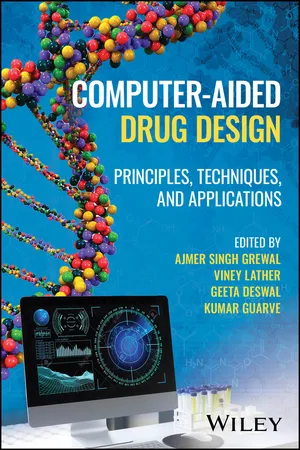
Computer-Aided Drug Design
eBook - ePub

Computer-Aided Drug Design

Principles, Techniques, and Applications

  1. English
  2. ePUB (mobile friendly)
  3. Available on iOS & Android
eBook - ePub

Computer-Aided Drug Design

Principles, Techniques, and Applications

About this book

Integrate QSAR, molecular docking, AI, and nanotechnology into drug design

Computational approaches now drive critical decisions at every stage of drug discovery and development. Computer-Aided Drug Design: Principles, Techniques, and Applications provides an in-depth treatment of CADD methodologies, from QSAR and molecular docking to pharmacophore mapping and virtual screening. Written by Ajmer Singh Grewal, a pharmaceutical chemistry researcher with nearly 13 years of experience, each chapter links theoretical foundations directly to real-world drug design applications.

Computer-Aided Drug Design covers molecular and quantum mechanics, energy minimization, ADMET prediction, de novo drug design, and homology modeling. The book integrates artificial intelligence, machine learning, and nanotechnology into its treatment of contemporary drug discovery workflows. Case studies demonstrate practical use of computational tools, connecting technique-level detail to tangible outcomes in anticancer, anti-diabetic, anti-inflammatory, and Alzheimer's therapeutic research programs.

Readers will also find:

  • Detailed coverage of QSAR modeling, molecular docking protocols, and pharmacophore mapping with step-by-step computational methodologies for each technique
  • Integration of artificial intelligence and machine learning approaches into structure-based and ligand-based drug design workflows
  • Practical guidance on ADMET prediction tools and their application to optimizing drug candidate selectivity and efficacy
  • Real-world case studies linking computational modeling to therapeutic outcomes across multiple disease areas including oncology and neurodegeneration
  • Coverage of de novo drug design, homology modeling, and virtual screening techniques with current computational tools and software platforms

Designed for pharmaceutical scientists, computational chemists, bioinformatics and cheminformatics professionals, and advanced postgraduate students, this reference connects foundational CADD principles with current AI-driven and nanotechnology-enhanced approaches. It serves as a practical resource for researchers and drug developers seeking to apply computational methods across the drug discovery pipeline.

Information

Publisher
Wiley
Year
2026
Print ISBN
9781394371082
eBook ISBN
9781394371099

Table of contents

  1. Cover
  2. Table of Contents
  3. Title Page
  4. Copyright
  5. About the Editors
  6. List of Contributors
  7. Preface
  8. Chapter 1: Introduction to Computer-aided Drug Design
  9. Chapter 2: Quantitative Structure–Activity Relationships (QSARs): Principles and Applications
  10. Chapter 3: Molecular Mechanics and Quantum Mechanics in Drug Design and Energy Minimization
  11. Chapter 4: Molecular Docking in Drug Discovery: Techniques and Applications
  12. Chapter 5: Computational Approaches to Drug–Receptor Binding Analysis
  13. Chapter 6: Decoding Drug Discovery: Pharmacophore Mapping and Ligand-based Design
  14. Chapter 7: Homology Modeling, AI-based Protein Structure Prediction, and 3D Protein Modeling
  15. Chapter 8: In Silico Pharmacology: Computational Techniques and Applications in Drug Design
  16. Chapter 9: Computational Methods for Predicting ADMET Properties: Tools and Strategies to Minimize Late-stage Drug Failures
  17. Chapter 10: In Silico Drug Design and Virtual Screening Techniques
  18. Chapter 11: De Novo Drug Design: From Fragment-based to AI-driven Approaches
  19. Chapter 12: Artificial Intelligence in Computer-aided Drug Design
  20. Chapter 13: Computational Chemistry and Drug Discovery: Intersection of AI, QSAR, and Molecular Modeling
  21. Chapter 14: CADD in Drug Discovery: From Molecular Modeling to AI-powered Insights
  22. Chapter 15: From Target to Candidate: A Stepwise Guide to Modern Computational Drug Discovery
  23. Chapter 16: Case Studies: Successful Drug Discovery Using CADD
  24. Chapter 17: Practical Guide to Computational Drug Discovery: Tools, Databases, and Workflows
  25. Chapter 18: Future Innovations in CADD: AI, Quantum Computing, and Beyond
  26. Index
  27. End User License Agreement

Trusted by 375,005 students

Access to over 1.5 million titles for a fair monthly price.

Study more efficiently using our study tools.

Frequently asked questions

Yes, you can cancel anytime from the Subscription tab in your account settings on the Perlego website. Your subscription will stay active until the end of your current billing period. Learn how to cancel your subscription
No, books cannot be downloaded as external files, such as PDFs, for use outside of Perlego. However, you can download books within the Perlego app for offline reading on mobile or tablet. Learn how to download books offline
We are an online textbook subscription service, where you can get access to an entire online library for less than the price of a single book per month. With over 1.5 million books across 990+ topics, we’ve got you covered! Learn about our mission
Look out for the read-aloud symbol on your next book to see if you can listen to it. The read-aloud tool reads text aloud for you, highlighting the text as it is being read. You can pause it, speed it up and slow it down. Learn more about Read Aloud
Yes! You can use the Perlego app on both iOS and Android devices to read anytime, anywhere — even offline. Perfect for commutes or when you’re on the go.
Please note we cannot support devices running on iOS 13 and Android 7 or earlier. Learn more about using the app
Yes, you can access Computer-Aided Drug Design by Ajmer Singh Grewal,Viney Lather,Geeta Deswal,Kumar Guarve in PDF and/or ePUB format, as well as other popular books in Physical Sciences & Organic Chemistry. We have over 1.5 million books available in our catalogue for you to explore.