![]()
S
Sackcloth
Sackcloth is a coarse fabric typically woven from the dark hair of a goat or, less frequently, from the stiff hair of a camel (Rev. 6:12). In contrast to the textiles woven from wool or flax, the darker sackcloth was coarser in texture and similar to the tightly woven burlap of today. It was very durable but not very attractive. Because sackcloth could take a great deal of abuse and was also very breathable, it became the ideal fabric for tents. These same qualities made sackcloth the fabric of choice for sacks used for carrying grain and toting provisions when traveling (Gen. 42:25; Josh. 9:4). Sackcloth was not particularly soft to sit or sleep on, but it was better than a rock; thus the tireless watch of Rizpah over the bodies of Saul’s sons and grandsons was slightly softened by her use of a sackcloth bedroll (2 Sam. 21:10).
Clothing was typically sewn from wool or linen fabric, yet the most frequent mention of sackcloth in the Bible is a reference to people wearing sackcloth clothing. The donning of this unique apparel was a cultural signal announcing to other mortals, to the Lord, or to both that the wearer was in some form of distress. Individuals mourning the loss of a family member put on such clothing during the time of their grieving (Gen. 37:34; Joel 1:8; Amos 8:10). When the opposition’s general, Abner, defected to the side of David, he was murdered in cold blood. David called on all his people to show respect for this fallen warrior by putting on sackcloth as they walked in mourning before his body (2 Sam. 3:31). Dressing in sackcloth could also symbolize that one was powerless to respond to his or her circumstances. As the Aramean army faced defeat, they declared their submission to Ahab by dressing in this fabric (1 Kings 20:32). Joram expressed his powerless frustration by wearing such a garment when the citizens of his besieged Samaria resorted to cannibalism (2 Kings 6:30). And this is how people dressed when they were faced by the threat of an overwhelming enemy (Isa. 15:3). When people dressed in this clothing of distress, the expectation was that others would not only recognize their emotional state but also treat them in a more kindly fashion. David was appalled when his dressing in sackcloth did not afford him this expected courtesy: “When I put on sackcloth, people make sport of me” (Ps. 69:11).
The message of distress sent by wearing sackcloth was also one that could be directed at the Lord. Faithful leaders like Hezekiah, David, and Mordecai dressed in sackcloth when facing circumstances that were well beyond their control. In each case the distress illustrated in their attire was attended by a call for help from their powerful and merciful God (2 Kings 19:1–2; 1 Chron. 21:16; Esth. 4:1 — 4). As Job expressed frustration over his circumstances, he acknowledged his powerless position in the way he dressed: “I have sewed sackcloth over my skin and buried my brow in the dust” (Job 16:15).
People dressed in sackcloth as a signal to others that they were in deep distress.
Gary Ombler © Dorling Kindersley
A crisis of conscience could also lead to the wearing of sackcloth. When the burning reality of sin seared the conscience, penitence filled the heart. A change of heart was signaled by a change in clothing to garments made of sackcloth. Even the heart of wicked King Ahab was subject to moments of spiritual unrest. Faced with the horrific details of Elijah’s condemnation, “he tore his clothes, put on sackcloth and fasted. He lay in sackcloth and went around meekly” (1 Kings 21:27). God recognized and honored that penitence in Ahab, just as he did the repentant hearts he found in Nineveh. Jonah had declared an end to this wicked city, and the city responded quickly, hoping that the Lord might relent. Everyone from the greatest to the least dressed in sackcloth, including the king, who ordered that not only the people dress in garments of repentance but the animals as well (Jonah 3:5 — 8). The attire of repentance is what Jesus longed to see but failed to see in the cities where he did the majority of his miracles, Korazin and Bethsaida (Matt. 11:21; Luke 10:13). The connection of sackcloth to repentance may also explain why this kind of clothing was typically worn by the prophets (Isa. 20:2; Rev. 11:3). The coarse garments of Elijah and John the Baptist not only linked the ministry of these two men, but it may also be a symbol of the message they regularly carried to God’s people, the call to repent (2 Kings 1:8; Matt. 3:4).
The call to put on sackcloth thus became the equivalent of the call to repent. This is particularly evident in the language of Isaiah and Jeremiah. “Tremble, you complacent women; shudder, you daughters who feel secure! Strip off your clothes, put sackcloth around your waists” (Isa. 32:11; cf. 22:12; 58:5). “So put on sackcloth, lament and wail, for the fierce anger of the LORD has not turned away from us” (Jer. 4:8; cf. 6:26; Joel 1:13).
Only one thing can bring comfort to the conscience in distress — the message of forgiveness from the Lord. Once again a change in clothing marks the moment when the pain of sin is replaced by the peace of forgiveness: “You turned my wailing into dancing; you removed my sackcloth and clothed me with joy” (Ps. 30:11).
Salt
Salt along the shore of the Dead Sea.
© www.istockphoto.com
For those living in the Promised Land, salt was available locally and used in many facets of day-to-day living. Although the art of extracting salt from seawater via evaporation was known, this time-and labor-intensive method of harvesting salt would not have been necessary for those living so close to the Dead Sea (also known as the Salt Sea). In the Dead Sea basin, naturally occurring salt could be mined or gathered and then transported throughout Israel for both domestic and industrial use. Of course the salt that made its way into the homes was not like the table salt of today. The ancients would not have recognized the small white grains of nearly pure sodium chloride found in our salt shakers; their salt came to them in chunks that were a mixture of the tasty sodium chloride and other impurities that either lacked taste or carried a bitter taste.
Five cultural uses of salt are either directly mentioned or alluded to in the Bible. First, our bodies require salt to maintain the appropriate balance of water; too much or too little salt can cause health problems. This is particularly the case for those living in a warm, dry climate, because salt plays a critical role in fostering the perspiration that keeps the body cool. Like the ancients, we crave salt in our food because we need a certain amount of salt in our diet (Job 6:6). Second, salt was used to preserve meat, which bacteria could quickly degrade in a culture without refrigeration. The salting of meat inhibits the growth of bacteria by removing the watery environment it needs to survive. The salt that was harvested along the Dead Sea was transported north to Magdala (Tarichaea) where it was used to preserve fish caught in the Sea of Galilee. A third use of salt was associated with the birth of a child. On the day a child was born, he or she was washed and rubbed with salt (Ezek. 16:4). The reason for this practice is unmentioned and has been assigned both medical and religious motivations. Fourth, salt was mixed with manure (Luke 14:34 — 35), as it is today by rural Palestinians. In a land with precious little lumber, the residents have a long history of burning dried manure as fuel for cooking and heating. The addition of the salt is thought to produce a fuel that burns at a higher temperature than manure alone. Finally, salt was also employed as a weapon of war in various ancient Near Eastern cultures. When a city was defeated and the conquerors had no plans to occupy the city, their efforts to make such a place a permanent ruin included damaging the agricultural fields around it. One way to do so was to spread salt on the arable land to compromise its ability to produce food. Without arable fields nearby, a city was less likely to be resettled (Judg. 9:45).
Three connotations associated with salt lie behind the symbolic use of salt in biblical culture and Bible communication. First, because salt is used as a preservative, it is symbolically linked to things that will last a long time. For instance, the Bible authors speak of the “salt of the covenant” (Lev. 2:13; Num. 18:19; 2 Chron. 13:5). Those in the ancient Near East who were entering into an agreement would eat a meal that included heavily salted food as a way of stating that their agreement with one another was one destined to endure. Thus a salt covenant was one meant to be “everlasting” (Num. 18:19). This application of salt may well lie behind the frequent use of salt in the worship system designed by the Lord for Israel. Salt was used to make the special incense for the tabernacle and temple and was also used for virtually every sacrifice (Ex. 30:35; Lev. 2:13; Ezek. 43:24). This repeated use of salt may well be yet another way to link the regular worship of Israel with their covenant with the Lord. The link between covenant and salt may also provide the best explanation for Elisha’s use of salt in healing the spring at Jericho (2 Kings 2:20 — 21).
Second, the connotation of ruin or desolation is associated with salt. Like a city that has been made unlivable, so the Lord can act against a person or a place to bring either to ruin. Lot’s wife became one with the decimated landscape around Sodom and Gomorrah when she hesitated to leave the life she had known. “She became a pillar of salt” (Gen. 19:26). As an invading army might ruin the arable land, so God promised that those who challenged him would pay with the devastation of their land. The language is often reminiscent of what happened to Sodom and Gomorrah: “The whole land will be a burning waste of salt and sulfur — nothing planted, nothing sprouting, no vegetation growing on it” (Deut. 29:23; cf. Ps. 107:34; Jer. 48:9; Zeph. 2:9).
Finally, the role of salt in making food more palatable is used as a metaphor for righteous living, particularly in the language of Jesus (Matt. 5:13; Mark 9:49–50; Luke 14:34). “Salt” is good, but it is possible for salt to lose its saltiness. The chunk of salt a family struck to break free grains of pure salt lasted just so long before it produced more byproduct than pure salt, and once the chunk of salt reached that point, there was no turning back. It was not good for anything — not even for use with the manure. Therefore Jesus encourages us to “have salt in yourselves, and be at peace with each other” (Mark 9:50). Picking up where Jesus left off, Paul writes, “Let your conversation be always full of grace, seasoned with salt, so that you may know how to answer everyone” (Col. 4:6).
Salt Sea. See Dead Sea.
Samaria (City of)
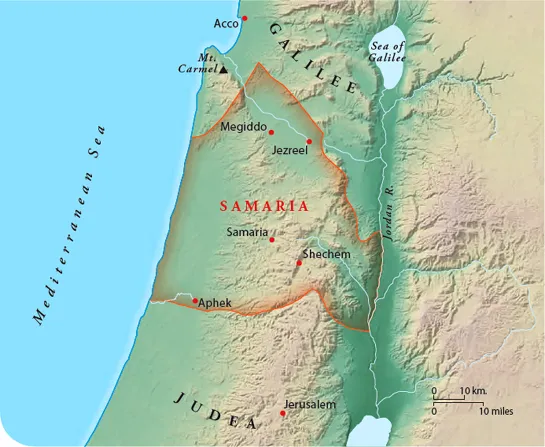
The Old Testament city of Samaria was built on a prominent hill approximately twenty-five miles inland from the Mediterranean Sea and forty miles north of Jerusalem. Given the advantages the site promised, an important city was destined for this location. The hill on which Samaria sat rose some three hundred feet above the surrounding valleys, providing its residents with a degree of natural security from attack. A short walk down that hill brought one into a large basin filled with farm fields capable of producing an abundance of food. Samaria was also favored by its position alongside natural travel corridors that provided access to the interior of the country and to the world via connections to the Jezreel Valley and Phoenicia, Israel’s strong international trading partner.
The hill that once belonged to Shemer became the capital city of the northern kingdom in the ninth century BC during the tenure of King Omri (1 Kings 16:24). In the fifty years prior to this, the capital of the northern kingdom had moved three times, but once Omri purchased this hill and founded Samaria here, it remained the capital of the northern kingdom for 150 years. Starting in the days of Omri and continuing through the rule of his son Ahab, Samaria became a showplace. It was surrounded by casemate walls twenty to thirty feet thick and contained a large palace and administrative complex with architecture that rivaled the buildings of Solomon in Jerusalem. All indications from the Bible, ancient Near Eastern history, and the archaeological record suggest that Samaria enjoyed a healthy economy, reflected in its expensive imports and high living (1 Kings 22:39; Amos 6:4).
But this rosy picture of life in the capital city of the northern kingdom is not the one painted most frequently by the biblical authors. There are bright moments, mostly connected with the ministry of Elisha (2 Kings 2:25; 5:3; 6:19–20). Yet it is the darker moments and negative publicity that overwhelm the Bible reader, leaving Samaria enveloped in negative connotations. The majority of the time, it is a city given over to pagan worship, social abuses, and shaky leadership. King Ahab built a temple to Baal in this city, erected an Asherah pole, and supported a large number of Baal priests who led worship there (1 Kings 16:32–33; 18:19). By all appearances, Baal worship had become the state religion of the northern kingdom: “Among the prophets of Samaria I saw this repulsive thing: They prophesied by Baal and led my people Israel astray” (Jer. 23:13). And when Jehu finally brought an end to this Baal worship facility (2 Kings 10:18–28), lingering connections to Asherah and calf worship continued (2 Kings 10:31; 13:6; 14:23–24; et al.). Separated from the love of the Lord, the love for one another quickly grew cold, leading to the abuse of the poor, sexual abuse, gluttony, and corruption in the legal system (Amos 2:6–8; 3:9–10; 4:1; 5:10–13; 6:4–6). And when the prophets called Samaria to repentance, their preaching was met with an unhealthy dose of misplaced pride and arrogance (Isa. 9:9). Where were the leaders of God’s people in all this, the kings who were to keep their subjects connected to the Lord and make justice known in the streets? They took the lead in the debauchery, at least as long as they were in office, which in the closing days of Israel was not every long. As the morality of the capital city eroded, we see palace intrigue increasing and the time spent in office diminishing until the Lord had had enough, allowing the city to fall in 722 BC (2 Kings 17:1–6). It happened as Hosea had foretold: “Samaria and its king will float away like a twig on the surface of the waters” (Hos. 10:7). Pagan worship, social decay, and unstable and ungodly leadership clung to the capital city and permanently damaged the connotations associated with it.
Samaria.
The deserved reputation of Samaria subsequently became a tool in the hands of the prophets who were directing their words of correction toward Jerusalem. They urged the kings and capital of the southern kingdom to learn the lesson that Samaria had not. The measuring line that was used to evaluate and subsequently condemn the capital of the north was now being stretched to measure the righteousness of those in the south (2 Kings 21:13). As the Lord did so, he asked the poignant and penetrating question, “Shall I not deal with Jerusalem and her images as I dealt with Samaria and her idols?” (Isa. 10:11).
Samaria also became personified in the language of the prophets. Hosea addressed the city as if it were the culprit: “Throw out your calf-idol, O Samaria! My anger burns against them. How long will they be incapable of purity?” (Hos. 8:5). But it is Ezekiel who portrays the city of Samaria as a young woman, the sister of Jerusalem (Ezek. 16; 23). In this extended analogy, Jerusalem, the younger sister, is contrasted with Samaria, the older sister. The older sister, named Oholah, had regularly engaged in prostitution with other pagan kingdoms, filling herself with their idols. In the end Oholah was not favored but destroyed by her lovers (Ezek. 23:5–8). “They stripped her naked, took away her sons and daughters and killed her with the sword. She became a byword among women, and punishment was inflicted on her” (v. 10). Jerusalem had gone the unfortunate way of her sister and so would find herself meeting the same fate as her sister city to the north (vv. 32–35).
Sandal
Sandals, the ordinary footwear of Bible times, consisted of a leather or fiber sole attached to the moving foot of the owner by a leather thong. An ordinary pair of sandals must not have been particularly expensive, because Abram lists a sandal strap as the least valuable item in the pile of booty he had taken from the kings who had captured his nephew, Lot (Gen. 14:23). With sandals available at a reasonable price, ordinary men and women could afford to wear them every day when they were working outdoors or traveling (Ex. 12:11; Acts 12:8). Of course some sandals were destined to be more expensive than others, noteworthy for the way they graced one’s foot and for the high-quality material used in making them (Song 7:1; Ezek. 16:10).
The role of the sandal in society was much more complex than this simple footwear might suggest. The biblical authors mention sandals rhetorically either because they conform to social expectation or defy it. For example, there was every expectation that sandals that had been in service for a time would wear out. This expectation was used by the Gibeonites who displayed worn sandals to support their claim that they had come a great distance (Josh. 9:5, 13). But sandals did not wear out when God intervened. As an example of the Lord’s care, Moses reminded God’s people that the Lord had kept their sandals from wearing out despite being worn for forty years in the wilderness (Deut. 29:5). In an ominous echo, Isaiah warned rebellious Israel that God would permit distant nations to invade their land. Tireless soldiers were on the march unhindered by as much as a broken sandal thong (Isa. 5:27). Because sandals would wear out, those embarking on a longer trip might take along an extra pa...