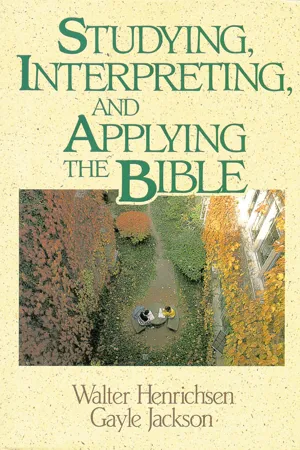
Studying, Interpreting, and Applying the Bible combines into one volume the popular trilogy by Walter Henrichsen and Gayle Jackson: - A Layman's Guide to Studying the Bible - A Layman's Guide to Interpreting the Bible - A Layman's Guide to Applying the Bible This book will help students as well as ministers, young people and old alike, as they learn to study Scripture more easily and conveniently. The chapters on studying the Bible help the beginning or experienced Bible student mine God's Word for its riches through verse analysis, chapter analysis, the overview of a book, the study of a topic, and the study of Bible characters (including charts, diagrams, and other helpful illustrations). The unit on interpreting the Bible explains Bible interpretation based on grammar, history, and theology. The section on applying the Bible moves beyond study to life applications, enabling a person to - be motivated to make personal application - move beyond a "to do" list to an internal desire to obey - consider the risks involved in obeying - use specific application principles
- 336 pages
- English
- ePUB (mobile friendly)
- Available on iOS & Android
eBook - ePub
Studying, Interpreting, and Applying the Bible
About this book
Information
Topic
Theology & ReligionSubtopic
Christian TheologySECTION II
Improving Skills Bible Study Your
7
Improvement Is for Everyone
Section II will help you improve the skills that you have already learned and launch you into developing your own methods of doing Bible study. Before you use the methods suggested here, however, make sure you are familiar with the methods described in Section I of this book. After you have done the Bible studies described there for some time, using those methods, refer to this part.
The contents of this section will help you go into greater depth into the four major essentials or parts of Bible study—observation, interpretation, correlation, and application. As you begin to sense the need for some additional help in a particular part of your Bible study, or want some new ideas, refer to the appropriate part.
This section will teach you new concepts of Bible study as well as new methods. Take sufficient time to understand any new concepts thoroughly. You will want to employ these in any of the methods you use, i.e., analytical, synthetic, topical, etc.
The suggestions in this section are only a sampling of the hundreds that are available. Use your own creativity to develop new methods, but before you do, take time to learn the methods presented. True creativity follows structure.
8
Observation: The Role of a Detective
OBSERVATION
The recording of what may be seen in a selected method of Bible study.
Webster’s New Collegiate Dictionary defines observation as the “act of recognizing and noting a fact or occurrence”; it means to be mentally aware of what one sees. The purpose of observation in Bible study is to saturate yourself with the content of the passage of Scripture, to become as familiar as possible with all that the biblical writer is saying and implying.
Accuracy is important in observation. Not everything you read will be of equal value in ascertaining the meaning of the passage. So you will have to learn to discern what is important and what is not. Practice and concentration are the two ingredients that will sharpen your expertise.
Jesus’ last words of instruction to His disciples were to prepare them for the time when He would no longer be physically with them. He assured them that “the Counselor, the Holy Spirit, whom the Father will send in my name, will teach you all things and will remind you of everything I have said to you” (John 14:26). A little later on in the same conversation He said, “But when He, the Spirit of truth, comes, He will guide you into all truth” (John 16:13).
A prayerful dependence on the Holy Spirit is key to all aspects of Bible study, and especially to observation. Diligence, openness, dependence, an eagerness to learn—all these must characterize the student as he begins digging in the Word.
How do you begin observing? Where do you start? Take a piece of paper (8½” × 11” will do fine) and begin to record all you see. No item or idea is insignificant. Write it down so your mind can free itself to look for new things. The following suggestions are not necessarily given in the order of their importance. You will want to pick and choose from them depending on your level of proficiency and the type of material you are studying. Some suggestions will be more applicable to a character study, for example, than to an analytic study.
Have the Right Mental Attitude
You have already learned that a basic requirement for making good observations is a prayerful dependence on the Holy Spirit. As you have worked on making good observations, you have probably become aware that more is required than just that attitude. Five more requirements are necessary as well.
1. Observation requires an act of the will. You must have the will and the desire to be aware of what is in the biblical text, then to perceive and recognize what is there. You must have the determination to know and to learn. For example, when you meet people for the first time, do you remember their names? If not, it is likely that you have not purposed in your mind that you are going to learn their names. Learning begins with an act of the will—you must want to learn.
2. Observation requires a persistence to know. Learning is never easy. It requires diligence and discipline. You cannot have an effective disciple without him or her being a disciplined person. One of the keys in persisting in your personal Bible study is to see that the results are really worth the effort and the work that you have put into it. Take time to reflect on the results that have taken place in your life over the past six months because you have been doing Bible study faithfully.
3. Observation requires patience. In a day when you have instant communication, instant everything, there is a tendency to want an instant education. True learning, however, takes a great deal of time. You cannot take shortcuts in the learning process. The so-called short cuts are in fact only short circuits; they lead to ineffective results. In personal Bible study as well as in everything else in the Christian life, the process is as important as the product.
4. Observation requires diligent recording. As you look over the observations you recorded in some of your previous Bible studies, you will probably notice that there are some that you have completely f...
Table of contents
- Cover Page
- Title Page
- Copyright Page
- Contents
- Section I: How to Study the Bible
- Section II: Improving Your Bible Study Skills
- Section III: How to Interpret the Bible
- Section IV: Improving Your Interpretation Skills
- Section V: The Principles of Application
Trusted by 375,005 students
Access to over 1.5 million titles for a fair monthly price.
Study more efficiently using our study tools.
Frequently asked questions
Yes, you can cancel anytime from the Subscription tab in your account settings on the Perlego website. Your subscription will stay active until the end of your current billing period. Learn how to cancel your subscription
No, books cannot be downloaded as external files, such as PDFs, for use outside of Perlego. However, you can download books within the Perlego app for offline reading on mobile or tablet. Learn how to download books offline
Perlego offers two plans: Essential and Complete
- Essential is ideal for learners and professionals who enjoy exploring a wide range of subjects. Access the Essential Library with 800,000+ trusted titles and best-sellers across business, personal growth, and the humanities. Includes unlimited reading time and Standard Read Aloud voice.
- Complete: Perfect for advanced learners and researchers needing full, unrestricted access. Unlock 1.5M+ books across hundreds of subjects, including academic and specialized titles. The Complete Plan also includes advanced features like Premium Read Aloud and Research Assistant.
We are an online textbook subscription service, where you can get access to an entire online library for less than the price of a single book per month. With over 1.5 million books across 990+ topics, we’ve got you covered! Learn about our mission
Look out for the read-aloud symbol on your next book to see if you can listen to it. The read-aloud tool reads text aloud for you, highlighting the text as it is being read. You can pause it, speed it up and slow it down. Learn more about Read Aloud
Yes! You can use the Perlego app on both iOS and Android devices to read anytime, anywhere — even offline. Perfect for commutes or when you’re on the go.
Please note we cannot support devices running on iOS 13 and Android 7 or earlier. Learn more about using the app
Please note we cannot support devices running on iOS 13 and Android 7 or earlier. Learn more about using the app
Yes, you can access Studying, Interpreting, and Applying the Bible by Walter A. Henrichsen,Gayle Jackson in PDF and/or ePUB format, as well as other popular books in Theology & Religion & Christian Theology. We have over 1.5 million books available in our catalogue for you to explore.