eBook - ePub
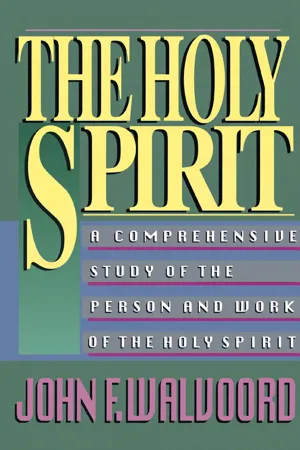
The Holy Spirit
A Comprehensive Study of the Person and Work of the Holy Spirit
- 312 pages
- English
- ePUB (mobile friendly)
- Available on iOS & Android
eBook - ePub
About this book
This eBook on the Holy Spirit is the outgrowth of lectures on the topic given in Dr. Walvoord's classes at Dallas Theological Seminary. Over the years, this book has aroused considerable interest and gone through 23 printings in hardcover before prompting this new paperback edition. The Holy Spirit is an extensive treatment of the entire doctrine of pneumatology, using some 1500 Scripture citations, and is designed for theological students and pastors as well as for laypeople desiring to get a complete presentation of the third person of the Trinity who indwells all Christians.
Information
Topic
Theology & ReligionSubtopic
Christian TheologyPart One
THE PERSON OF THE HOLY SPIRIT
CHAPTER I
THE PERSONALITY OF THE HOLY SPIRIT
IT IS A fundamental revelation of Scripture that the Holy Spirit is a person in the same sense that God the Father is a person and the Lord Jesus Christ is a person. The Holy Spirit is presented in Scripture as having the same essential deity as the Father and the Son and is to be worshipped and adored, loved and obeyed in the same way as God. To regard the Holy Spirit in any other way is to make one guilty of blasphemy and unbelief. We tread therefore on most holy ground in thinking of the Holy Spirit of God and the truth involved is most sacred and precious.
The personality of the Holy Spirit has been subject to denial and neglect through the centuries of the Christian church and is seldom understood by twentieth-century Christians. The heretic Arius who stirred up a rebellion against the Scriptural teaching concerning the person of Christ and the person of the Holy Spirit denied the eternity of Christ and the personality of the Holy Spirit. For him the Holy Spirit was only the “exerted energy of God” manifested in the created world.1 While his view was repudiated at the Nicene Council in 325, it foreshadowed the defection from Scriptural teaching which was to follow. Socinius and his followers in the sixteenth century held that the Holy Spirit was merely the eternally proceeding energy of God.2 This laid the foundation for modern Unitarianism. Variations in the doctrine of the Holy Spirit have been many through the centuries, but in the main the great body of conservative and orthodox Christians have regarded the Holy Spirit as a Person according to the revelation given in the Scriptures.
I. HIS ATTRIBUTES AFFIRM PERSONALITY
Every aspect of the doctrine of the Holy Spirit contributes to His personality, but a study of His attributes in themselves demonstrates the truth of His personality beyond question. Personality is commonly defined as containing the essential elements of intellect, sensibility, and will.3 All of these elements can be found in the Holy Spirit. His intelligence is manifest in all His mighty works. It is expressly claimed for the Holy Spirit, “The Spirit searcheth all things, yea, the deep things of God. For who among men knoweth the things of a man, save the spirit of man which is in him? even so the things of God none knoweth, save the Spirit of God” (1 Cor. 2:10-11). He is the Spirit of wisdom (Eph. 1:17) and the Spirit of wisdom and understanding, the Spirit of counsel and might, the Spirit of knowledge and of the fear of Jehovah (Isa. 11:2). His sensibility is revealed in that the Spirit can be grieved by sin (Eph. 4:30). His will is shown in the sovereign bestowal of spiritual gifts on men which is accomplished “as he will” (1 Cor. 12:11). Sustaining these essential elements of personality is the whole broad doctrine of the deity of the Holy Spirit. If God possesses personality, and the Holy Spirit is a person of the Trinity, it follows that He has personality. A denial of His personality is a denial of the doctrine of the Trinity.
II. HIS WORKS AFFIRM PERSONALITY
The most tangible and conclusive evidence for the personality of the Holy Spirit is found in His works. The very character of His works makes it impossible to interpret the Scriptures properly without assuming His personality. In view of the discussion of His works in detail which follow, it is necessary only to mention illustrations here. All the works of the Holy Spirit are such that personality is required. His work in creation (Gen. 1:2), empowering (Zech. 4:6), teaching (John 16:13), guidance (Isa. 48:16; Rom. 8:14), comforting (John 14:26), prayer (Rom. 8:26), convincing the world of sin, righteousness, and judgment (John 16:8), restraint of sin (Gen. 6:3; Isa. 59:19; 2 Thess. 2:7), and His commands (Acts 8:29; 13:2; 16:7) make it evident that the Holy Spirit is a true person. A mere influence or emanation does not create, empower, teach, guide, pray, or command. In the history of the church, opponents of the personality of the Holy Spirit have found it necessary also to deny the inspiration and accuracy of the Word of God in order to sustain their teaching.
III. USE OF PERSONAL PRONOUNS AFFIRMS PERSONALITY
In normal discourse, personal pronouns such as I, thou, he, they are used of persons. While personification occurs in literature frequently, it is always quite apparent and does not leave the meaning in doubt. Personal pronouns are used of the Holy Spirit in such a way that personality is affirmed. In the New Testament the Greek word pneuma is neuter and would normally take a neuter pronoun. In several instances, however, the masculine pronouns are found (John 15:26; 16:13-14). The only explanation for the masculine is that the pronouns refer to a person. Relative pronouns are used in the same way in Ephesians 1:13-14. These indirect evidences confirm that the Holy Spirit is commonly regarded as a person in the Scripture. As Charles Hodge states: “He is introduced as a person so often, not merely in poetic or excited discourse, but in simple narrative, and in didactic instructions; and his personality is sustained by so many collateral proofs, that to explain the use of the personal pronouns in relation to Him on the principle of personification, is to do violence to all the rules of interpretation.“4
IV. THE HOLY SPIRIT THE PERSONAL OBJECT OF FAITH
Christians who have an intelligent comprehension of the truth regard the Holy Spirit as an object of their faith. This is done unconsciously rather than deliberately, their relation to the Spirit drawing out this response. According to the Scriptures it is possible to sin against the Holy Spirit (Isa. 63:10), grieve Him (Eph. 4:30), reverence Him (Ps. 51:11), and obey Him (Acts 10:19-21). It is impossible in the light of these Scriptures to regard the Holy Spirit intelligently without viewing Him as the personal object of faith. This is further confirmed by the baptismal formula in Matthew 28:19 where the Holy Spirit is associated on an equal basis with the Father and the Son, whose personality is generally accepted. Likewise the apostolic benediction of 2 Corinthians 13:14 indicates an equality of personality of the Trinity.
The only tenable position for those who accept the revelation of Scripture is to believe in the full-orbed personality of the Holy Spirit. This certainly has been the position of orthodox Christians from the beginning. As Charles Hodge expresses it, “The personality of the Spirit has been the faith of the Church from the beginning. It has few opponents in the chaotic period of theology; and in modern times has been denied by none but Socinians, Arians. and Sabellians.“5
CHAPTER II
THE DEITY OF THE HOLY SPIRIT
THE DEITY of the Holy Spirit has been a cardinal doctrine of the Christian faith from the beginning. The Arian controversy in the fourth century of the Christian era settled for all time the orthodox doctrine on both the personality and the deity of the Spirit. Arius, who held that the Holy Spirit was a created being, though he originally adhered to the personality of the Spirit later denied both His personality and His deity. His views were denounced by his contemporaries, and Arius was branded a heretic. From that day to this, orthodox Christianity has affirmed the deity and personality of the Spirit. As Hodge expresses it, “Since the fourth century his true divinity has never been denied by those who admit his personality.“1
In the sacred Scriptures, the evidence for the deity of the Holy Spirit is superabundant. In general the doctrine is supported by the names and titles of the Holy Spirit, His identification and association with God, His procession and relation to the holy Trinity, His divine attributes, and His many divine works. These combine to confirm and enhance the significant contribution of each to the whole and harmonize in a great symphony of Scriptural testimony.
I. THE TITLES OF THE HOLY SPIRIT
An examination of the Scriptural revelation on the Holy Spirit will indicate that He is nowhere assigned a formal name, such as we have for the Second Person, the Lord Jesus Christ, but is rather given descriptive titles, of which the most common in Scripture and in ordinary usage is the Holy Spirit. As His person is pure spirit, to which no material is essential, He is revealed in the Scriptures as the Spirit. The descriptive adjective holy is used to distinguish Him from other spirits which are creatures.
A study of the references to the Holy Spirit by various titles in Scripture will reveal some significant facts. The basic words in the original are also used in reference to entities other than the Holy Spirit. In the Old Testament, however, ruach is used over one hundred times for the Holy Spirit. The matter of interpretation enters into the problem. Cummings lists eighty-six references to the Holy Spirit in the Old Testament.2 The American Standard Version of the Bible by means of initial capital letters indicates considerably more than this. In any case, the instances are numerous and well scattered throughout the Old Testament. Cummings notes that the Pentateuch has fourteen references, none in Leviticus, that Isaiah has thirteen and Ezekiel fifteen, and that the references are scattered throughout twenty-two of the thirty-nine books of the Old Testament.3 The concise summary of Cummings on the significance of these references may well be quoted:
“It is impossible to say that the passages increase in number, or in clearness, with any special characteristic of the books of Scripture. They seem to bear no special relation to chronology, as they appear chiefly in Isaiah (750 B.C), in Ezekiel (590 B.C), and in the books of Moses. Nor can we trace any relation to the comparative spirituality of the books, though Isaiah stands so high in the list; for whereas Ezekiel stands first, the Judges has seven, Psalms has only six, Deuteronomy only one, and 2 Chronicles four. But it is possible to discern that each of the inspired writers has caught some special aspect of the Holy Spirit’s person or work, which is reiterated in his pages. In Ezekiel, for instance, it is the action of the Holy Spirit in transporting the prophet bodily to the places where he is needed, which accounts for six of the passages out of fifteen. In Judges it is the in-breathing of courage or strength which is alluded to in every one of the seven passages. In Exodus it is as the Spirit of wisdom that He is specially—and exclusively—regarded. It is His office as the Giver of prophetic inspiration which is most constantly spoken of in the books of Samuel and the Chronicles. In Isaiah, and in the Psalms, the twofold teaching concerning Him is His connection with the Messiah on the one hand, and what may be called His personal qualities, such as being grieved, or vexed, by ingratitude or rebellion, on the other.“4
In the New Testament, the references to the Holy Spirit are even more numerous. The New Testament word for the Spirit, pneuma, is found in two hundred and sixty-one passages, according to Cummings, scattered throughout all the major New Testament books.5 To quote Cummings, “The Gospels contain fifty-six passages; the Acts of the Apostles, fifty-seven; St. Paul’s Epistles, one hundred and thirteen; and the other books, thirty-six.“6 From these facts, it may be clearly seen that there is consistent reference to the Holy Spirit from Genesis 1:2 to Revelation 22:17, and the inference is plain that a constant ministry of the Holy Spirit is maintained suitable for each dispensation. The titles of the Holy Spirit as commonly translated are subject to significant classification which furnishes an interesting background for the doctrine.
Titles of the Holy Spirit revealing His relationships. Of the many titles and variations in reference to the Holy Spirit, sixteen reveal His relationship to the other Persons of the Trinity. Eleven titles are found relating the Holy Spirit to the Father: (1) Spirit of God (Gen. 1:2; Matt. 3:16); (2) Spirit of the Lord (Luke 4:18); Spirit of Our God (1 Cor. 6:11); (4) His Spirit (Num. 11:29); (5) Spirit of Jehovah (Judg. 3:10); (6) Thy Spirit (Ps. 139:7); (7) Spirit of the Lord God (Isa. 61:1); (8) Spirit of your Father (Matt. 10:20); (9) Spirit of the Living God (2 Cor. 3:3); (10) My Spirit (Gen. 6:3); (11) Spirit of Him (Rom. 8:11).
Five titles are found relating the Holy Spirit to the Son: (1) Spirit of Christ (Rom. 8:9; 1 Pet. 1:11); (2) Spirit of Jesus Christ (Phil. 1:19); (3) Spirit of Jesus (Acts 16:7); (4) Spirit of His Son (Gal. 4:6); (5) Spirit of the Lord (Acts 5:9; 8:39). In some of these instances it is not clear whether the reference is to the Spirit from Christ, the Holy Spirit, or the Spirit of Christ Himself. The Greek form is the same. Most of them are probably references to the Holy Spirit.
While there is some distinction in meaning in the various titles, the chief significance is to bring out the relationship of the Holy Spirit as the Third Person of the Trinity, all affirming His deity and procession.
Titles of the Holy Spirit revealing His attributes. Abundant revelation is given in the titles of the Holy Spirit to disclose His attributes. At least seventeen of His titles indicate the divine attributes of His Person. (1) The unity of the Spirit is revealed in the title, One Spirit (Eph. 4:4). (2) Perfection is the implication of the title, Seven Spirits (Rev. 1:4; 3:1). (3) The identity of the Holy Spirit and the Essence of the Trinity is affirmed in the title, the Lord the Spirit (2 Cor. 3:18). (4) The eternity of the Spirit is seen in the title, Eternal Spirit (Heb. 9:14). (5) Spirit of Glory connotes His glory as being the same as the Father and the Son (1 Pet. 4:14). (6) Spirit of Life affirms the eternal life of the Spirit (Rom. 8:2). Three titles affirm the holiness of the Spirit: (7) Spirit of Holiness (Rom. 1:4), a possible reference to the holy human spirit of Christ; (8) Holy Spirit or Holy Ghost (Ps. 51:11; Matt. 1:20; Luke 11:13), the most formal title of the Spirit and most frequently used; (9) Holy One (1 John 2:20).
Five of the titles of the Holy Spirit refer to some extent to Him as the author of revelation and wisdom: (10) Spirit of Wisdom (Ex. 28:3; Eph. 1:17); (11) Spirit of Wisdom and Understanding (Isa. 11:2); (12) Spirit of Counsel and Might (Isa. 11:2); (13) Spirit of Knowledge and of the Fear of the Lord (Isa. 11:2); (14) Spirit of Truth (John 14:17). The transcendence of the Spirit is indicated (15) in the title, Free Spirit (Ps. 51:12). The attribute of grace is found in two titles, (16) Spirit of Grace (Heb. 10:29), and (17) Spirit of Grace and Supplication (Zech. 12:10).
Titles of the Holy Spirit revealing His works. Many of the titles referred to as indicating His attributes also connote His works. In the discussion of the titles revealing His attributes, it may be noticed that the Spirit of Glory (1 Pet. 4:14) engages in a work to bring the saints to glory. The Spirit of Life (Rom. 8:2) is the agent of regeneration. The Spirit of Holiness (Rom. 1:4), the Holy Spirit (Matt. 1:20), and Holy One (1 John 2:20) is our sanctifier. The Spirit of Wisdom (Eph. 1:17), the Spirit of Wisdom and Understanding, the Spirit of Counsel and Might, the Spirit of Knowledge and of the Fear of the Lord (Isa. 11:2) speak of the several ministries of God in teaching, guiding and strengthening the saint. The Spirit of Truth (John 14:17) has a similar idea. The Spirit as one who manifests grace is revealed in the titles, Spirit of Grace (Heb. 10:29), and the Spirit of Grace and Supplication (Zech. 12:10).
In addition to these, two other titles are given the Holy Spirit, affirming His works. (1) The Spirit of Adoption (Rom. 8:15) has reference to His revelation of our adoption as sons. (2) The Spirit of Faith (2 Cor. 4:13), while perhaps impersonal, and in this case not referring to the Holy Spirit ...
Table of contents
- Cover Page
- Title Page
- Table of Contents
- PREFACE
- Part One THE PERSON OF THE HOLY SPIRIT
- Part Two THE HOLY SPIRIT IN THE OLD TESTAMENT
- PART THREE THE HOLY SPIRIT IN RELATION TO CHRIST
- PART FOUR THE WORK OF THE HOLY SPIRIT IN SALVATION
- PART FIVE THE WORK OF THE HOLY SPIRIT IN THE BELIEVER
- PART SIX ESCHATOLOGY OF THE HOLY SPIRIT
- PART SEVEN HISTORY
- APPENDIX THE HOLY SPIRIT IN CONTEMPORARY THEOLOGY
- BIBLIOGRAPHY
- Acknowledgments
- Copyright
- About the Publisher
- Share Your Thoughts
Trusted by 375,005 students
Access to over 1.5 million titles for a fair monthly price.
Study more efficiently using our study tools.
Frequently asked questions
Yes, you can cancel anytime from the Subscription tab in your account settings on the Perlego website. Your subscription will stay active until the end of your current billing period. Learn how to cancel your subscription
No, books cannot be downloaded as external files, such as PDFs, for use outside of Perlego. However, you can download books within the Perlego app for offline reading on mobile or tablet. Learn how to download books offline
Perlego offers two plans: Essential and Complete
- Essential is ideal for learners and professionals who enjoy exploring a wide range of subjects. Access the Essential Library with 800,000+ trusted titles and best-sellers across business, personal growth, and the humanities. Includes unlimited reading time and Standard Read Aloud voice.
- Complete: Perfect for advanced learners and researchers needing full, unrestricted access. Unlock 1.5M+ books across hundreds of subjects, including academic and specialized titles. The Complete Plan also includes advanced features like Premium Read Aloud and Research Assistant.
We are an online textbook subscription service, where you can get access to an entire online library for less than the price of a single book per month. With over 1.5 million books across 990+ topics, we’ve got you covered! Learn about our mission
Look out for the read-aloud symbol on your next book to see if you can listen to it. The read-aloud tool reads text aloud for you, highlighting the text as it is being read. You can pause it, speed it up and slow it down. Learn more about Read Aloud
Yes! You can use the Perlego app on both iOS and Android devices to read anytime, anywhere — even offline. Perfect for commutes or when you’re on the go.
Please note we cannot support devices running on iOS 13 and Android 7 or earlier. Learn more about using the app
Please note we cannot support devices running on iOS 13 and Android 7 or earlier. Learn more about using the app
Yes, you can access The Holy Spirit by John F. Walvoord in PDF and/or ePUB format, as well as other popular books in Theology & Religion & Christian Theology. We have over 1.5 million books available in our catalogue for you to explore.