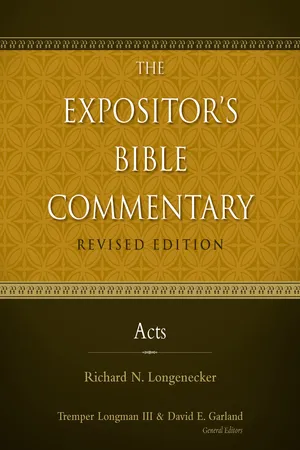
Continuing a Gold Medallion Award-winning legacy, this completely revised edition of The Expositor’s Bible Commentary series puts world-class biblical scholarship in your hands. Based on the original twelve-volume set that has become a staple in college and seminary libraries and pastors’ studies worldwide, this new thirteen-volume edition marshals the most current evangelical scholarship and resources. The thoroughly revised features consist of: • Comprehensive introductions • Short and precise bibliographies • Detailed outlines • Insightful expositions of passages and verses • Overviews of sections of Scripture to illuminate the big picture • Occasional reflections to give more detail on important issues • Notes on textual questions and special problems, placed close to the texts in question • Transliterations and translations of Hebrew and Greek words, enabling readers to understand even the more technical notes • A balanced and respectful approach toward marked differences of opinion
- 432 pages
- English
- ePUB (mobile friendly)
- Available on iOS & Android
eBook - ePub
About this book
Information
Subtopic
Bibelkritik & -auslegungText and Exposition
I. RESUMPTIVE PREFACE (1:1–5)
OVERVIEW
The prologue to Luke’s two volumes is really Luke 1:1–4. Here, however, Luke begins his second volume with what may be called a “resumptive preface” that (1) links together the two volumes and (2) anticipates the features he wants to stress as being constitutive for the Christian mission.
1In my former book, Theophilus, I wrote about all that Jesus began to do and to teach 2until the day he was taken up to heaven, after giving instructions through the Holy Spirit to the apostles he had chosen. 3After his suffering, he showed himself to these men and gave many convincing proofs that he was alive. He appeared to them over a period of forty days and spoke about the kingdom of God. 4On one occasion, while he was eating with them, he gave them this command: “Do not leave Jerusalem, but wait for the gift my Father promised, which you have heard me speak about. 5For John baptized with water, but in a few days you will be baptized with the Holy Spirit.”
COMMENTARY
1 Luke calls his gospel “my former book” (ton prōton logon). The Greek article ton specifies an antecedent writing, and the suffix of the verb translated “I wrote” (epoiēsamēn, GK 4472) calls for the possessive “my.” The word logos (GK 3364), usually translated “word” or “message” in the NT, is used here in the technical sense of a section of a work that covers more than one papyrus roll. The occurrence of the adjective prōtos (“first”; NIV, “former”), rather than its comparative proteros (“former,” GK 4728), need not imply that Luke intended his gospel to be the first in a series of three or more treatises, as Theodor Zahn and William M. Ramsay have supposed. While the classical usage of proteros as “former,” as contrasted with “latter,” is maintained by Josephus in the preface to Book 2 of his Against Apion—and also appears in the Pauline letters (cf. Gal 4:13; Eph 4:22; 1Ti 1:13)—Luke never uses proteros, which was rare in the nonliterary papyri of the day. Just as today we use “first” for “former” even when speaking about only two things, Luke should probably be understood as using prōtos as a comparative (cf. Ac 7:12) and without any implication that his work was intended to go beyond the two volumes.
The appearance of the article “the” (ho) with the name “Jesus” (Iēsous, GK 2652)—which is the first occurrence of “Jesus” in Acts and so, according to Greek standards, would not call for an article—probably stems from the original union of Luke’s two volumes and thus functions to bring to the reader’s mind the content of his gospel. The scribes of codices B and D, which are the only two manuscripts of Acts that omit the article, probably chose to omit it since (1) in their time the third gospel and Acts were treated as separate compositions, and (2) the first occurrence of a name or proper noun in a Greek writing did not require an article.
Luke says that the subject of his first volume is “all that Jesus began to do and to teach” up to his ascension. Throughout his two volumes Luke uses “all” (pas) as a general expression, which the context in each case must define. So we cannot assume he meant his gospel to be any more exhaustive than his Acts. In a number of places in the NT the terms “all” (pas/pantes) and “many” (polloi) are used interchangeably (e.g., Mk 1:32–34 // Mt 8:16; Mk 10:45 // Mt 20:28 [cf. 1Ti 2:6]; Mk 3:10 // Mt 12:15; Ro 5:12–21), with the context determining the precise nuance.
“To do” (poieō, GK 4472) and “to teach” (didaskō, GK 1438) describe the nature of the third gospel, combining as it does Mark’s narrative about what Jesus did and material from the “Sayings” source or “Q” (Quelle, which means “source” in German) about what Jesus taught. The verb “began” (ērxato, GK 806), while used as something of a redundant auxiliary verb elsewhere in Acts (cf. 2:4; 11:4, 15; 18:26; 24:2; 27:35), probably appears here for emphasis, much as it does in 11:15. As such, it serves to highlight Luke’s intent to show in Acts what Jesus continued to do and to teach through his church, just as in his gospel he had previously presented “all that Jesus began to do and to teach.”
Acts, like the third gospel, is addressed to Theophilus, who is called “most excellent Theophilus” (kratiste Theophile) in Luke 1:3. The adjective kratistos (GK 3196) is used elsewhere in Acts when addressing the Roman governors Felix and Festus (cf. 23:26; 24:3; 26:25). This has suggested to some that the word should be seen as an honorific title for a highly placed Roman official. But it was often also used as a form of polite address, which is probably how Luke used it of Theophilus. Origen (AD 185–254), and many others after him, treated the name Theophilus etymologically (i.e., theos + philos = “Friend of God” or “Loved by God”) and so have understood “Theophilus” as a symbolic designation for an anonymous person or a class of people. Such a supposition is precarious. Theophilus occurs as a proper name at least three centuries before Luke, and the practice of dedicating books to distinguished persons was common in his day.
2 The Greek of v.2 is awkward, chiefly because of the unnatural separation of “he was taken up” (anelēmphthē, GK 377) at the end of the verse from “until the day” (achri hēs hēmeras, GK 2465) at its beginning, and because it separates “[whom] he had chosen” (hous exelexato, GK 1721) from “the apostles” (tois apostolois, GK 693). But the awkwardness was evidently intentional. Through such a word order Luke has, in effect, highlighted four important introductory matters in his first two chapters and signaled his priorities throughout the rest of his presentation in Acts.
By placing the adverbial participle enteilamenos (“after giving instructions,” GK 1948) up front in the sentence, Luke lays emphasis on Jesus’ mandate to witness. The instructions he has in mind are undoubtedly those already set out in Luke 24:48–49 as the climax of Jesus’ earthly teaching: “You are witnesses of these things. I am going to send you what my Father has promised; but stay in the city until you have been clothed with power from on high.” In slightly revised form, Luke quotes these instructions in Acts 1:4–5 and develops them in 1:6–8 as the theme of Acts. Apparently Luke also wanted to show through the word order of v.2 that (1) Jesus’ mandate to witness (2) was given to the apostles, (3) who acted through the power of the Holy Spirit, (4) whose coming was a direct result of our Lord’s ascension. Each of these four factors—the mandate to witness, the apostles, the Holy Spirit, and the ascended Lord—is a major emphasis that runs throughout Acts, and each receives special attention in chs. 1 and 2.
3 Having stated the relation of his present volume to its predecessor and shown his interest in the four factors named above—which, as will be noted, comprise the constitutive elements of the Christian mission—Luke turns back to the time before Jesus’ ascension. He will reiterate and expand certain features in Jesus’ ministry that are crucial to the advance of the gospel as presented in Acts. In view of v.2, this is slightly redundant. But Luke wants to be very explicit. Like the confessional material and Paul’s comments in 1 Corinthians 15:5–7, Luke’s emphasis is on the living Christ, who “after his suffering … showed himself … alive” and demonstrated his resurrection by “many convincing proofs.” The expression “many convincing proofs” doubtless has in mind such things as the events of Luke 24:13–52. “Over a period of forty days” implies that during that time the risen Lord showed himself at intervals, not continuously. When he did so, he “spoke about the kingdom of God.”
The theme of “the kingdom of God” (hē basileia [GK 993] tou theou) is a common one in the OT and NT. It refers primarily to God’s sovereign rule in human life and the affairs of history, and secondarily to the realm where that rule takes place. God’s sovereignty is universal (cf. Ps 103:19). But it was specially manifested in the life of the nation Israel and among Jesus’ disciples; it is expressed progressively in the church and through the lives of Christians; and it will be fully revealed throughout eternity. In the Gospels the kingdom is presented as having been inaugurated in time and space by Jesus’ presence and ministry (cf. Mk 1:15: “The time has come…. The kingdom of God is near. Repent and believe the good news!”—with the expression “the kingdom of heaven” being Matthew’s reverential form of the same idea adapted to Jewish sensibilities). In Acts “the kingdom of God” usually appears as a convenient way of summarizing the content of the earliest Christian preaching (cf. 8:12; 19:8; 20:25; 28:23, 31). And in this proclamation by the early Christians Jesus is explicitly identified as the subject (cf. 8:12; 28:23, 31).
We may infer that Jesus’ teaching during those “forty days” dealt, in essence, with (1) the validation and nature of his messiahship, (2) the interpretation of the OT from the perspective of his resurrection, and (3) the responsibility of his disciples to bear witness to what had happened among them in fulfillment of Israel’s hope. This is what Luke 24:25–27, 44–49 reveal as the content of Jesus’ post-resurrection teaching, and this is what Acts elaborates in what follows.
4 In vv.4–5 Luke parallels his emphasis on the living Christ by stressing the coming and baptism of the Holy Spirit as being essential to the advance of the gospel. Luke gives us an individualized scene (so NIV’s inserted connective, “on one occasion”) of Jesus and his disciples eating together at the time when he commanded them not to leave Jerusalem but to wait for the coming of the Holy Spirit, who had been promised by God the Father and spoken of by Jesus. The command not to leave Jerusalem is a repetition of the one in Luke 24:49, with Hierosolyma (GK 2642), the hellenized name for Jerusalem, being used. This breaks the usual pattern in Acts, where Ierousalēm (GK 2647) appears exclusively in chs. 1–7 (cf. 1:8, 12, 19; 2:5, 14; 4:5, 16; 5:16, 28; 6:7) and is always on the lips of those whose native tongue was Aramaic. “The gift my Father promised” also repeats Luke 24:49 and is defined in v.5: “You will be baptized with the Holy Spirit.” It is a promise Jesus made on behalf of the Father. Its tradition has been incorporated in John’s gospel (cf. Jn 14:16–21, 26; 15:26–27; 16:7–15).
5 The statement “you will be baptized with the Holy Spirit” appears to come from Mark 1:8, with parallels in Matthew 3:11 and Luke 3:16 (which add “and with fire”), where it is part of John the Baptist’s message. One might take v.5 as an explanatory comment on Luke’s part, but its parallel in Acts 11:16, where it is given as a statement of Jesus, suggests that here too it should be understood as a word of Jesus. It may be that the transferal of the logion (“saying”) from the Baptist to the lips of Jesus occurred in the early church before Luke wrote Acts. But this seems doubtful, for the saying is commonly attributed to John the Baptist in the synoptic tradition (including Luke’s gospel). The ascription of the statement to Jesus, therefore, is probably Luke’s own doing. This need not be considered strange, particularly for an author who can quote the same logion of Jesus in two such diverse forms and in two so closely connected passages as Luke 24:49 and Acts 1:4.
The Spirit is the dynamo of all that Luke presents regarding God’s working in and through his church. As in Luke’s first volume, so in his second volume: there are only a few places in Acts where the Spirit’s activity and influence are not in some way evident. “Thus,” as Fitzmyer, 193, aptly reminds us, “Acts presents the sequel to the Jesus-story of the Lucan Gospel and stresses the continuity between what was begun in the earthly ministry of Jesus and the Christian chur...
Table of contents
- Cover
- Title Page
- Copyright Page
- Contents
- Contributors
- Preface
- Abbreviations
- Acts
- Introduction
- I. RESUMPTIVE PREFACE (1:1–5)
- II. INTRODUCTION: THE CONSTITUTIVE EVENTS OF THE CHRISTIAN MISSION (1:6–2:41)
- III. PART I: THE CHRISTIAN MISSION TO THE JEWISH WORLD (2:42–12:24)
- IV. PART II: THE CHRISTIAN MISSION TO THE GENTILE WORLD (12:25–28:31)
Trusted by 375,005 students
Access to over 1.5 million titles for a fair monthly price.
Study more efficiently using our study tools.
Frequently asked questions
Yes, you can cancel anytime from the Subscription tab in your account settings on the Perlego website. Your subscription will stay active until the end of your current billing period. Learn how to cancel your subscription
No, books cannot be downloaded as external files, such as PDFs, for use outside of Perlego. However, you can download books within the Perlego app for offline reading on mobile or tablet. Learn how to download books offline
Perlego offers two plans: Essential and Complete
- Essential is ideal for learners and professionals who enjoy exploring a wide range of subjects. Access the Essential Library with 800,000+ trusted titles and best-sellers across business, personal growth, and the humanities. Includes unlimited reading time and Standard Read Aloud voice.
- Complete: Perfect for advanced learners and researchers needing full, unrestricted access. Unlock 1.5M+ books across hundreds of subjects, including academic and specialized titles. The Complete Plan also includes advanced features like Premium Read Aloud and Research Assistant.
We are an online textbook subscription service, where you can get access to an entire online library for less than the price of a single book per month. With over 1.5 million books across 990+ topics, we’ve got you covered! Learn about our mission
Look out for the read-aloud symbol on your next book to see if you can listen to it. The read-aloud tool reads text aloud for you, highlighting the text as it is being read. You can pause it, speed it up and slow it down. Learn more about Read Aloud
Yes! You can use the Perlego app on both iOS and Android devices to read anytime, anywhere — even offline. Perfect for commutes or when you’re on the go.
Please note we cannot support devices running on iOS 13 and Android 7 or earlier. Learn more about using the app
Please note we cannot support devices running on iOS 13 and Android 7 or earlier. Learn more about using the app
Yes, you can access Acts by Richard N. Longenecker, Tremper Longman III,David E. Garland in PDF and/or ePUB format. We have over 1.5 million books available in our catalogue for you to explore.