Neural approaches have traditionally excelled at perceptual tasks like pattern recognition, whereas symbolic frameworks have offered powerful methods for knowledge representation, logical inference, and interpretability, but the current AI landscape is increasingly defined by hybrid systems that blend these complementary paradigms. This is particularly relevant in the context of knowledge graphs (KGs), which serve as a bridge between symbolic logic and the subsymbolic world of deep learning.
The Handbook on Neurosymbolic AI and Knowledge Graphs deals with state-of-the-art neurosymbolic and KG-based AI, reflecting an ecosystem in which large language models, deep neural networks, and symbolic representations converge. It illustrates the progress that has been made, while also revealing emerging challenges in trustworthiness, interpretability, and scalability.
The first four chapters are on the foundations of neural and symbolic AI. In the following chapters the authors explore the nuances of KG representation and embeddings, moving on to KG construction, integration, and quality, and covering challenges such as entity alignment, canonicalization, fusion, and the critical aspect of uncertainty management. Offering solutions that seamlessly combine symbolic logic with deep learning pipelines, the handbook deals with question answering, program synthesis, and dynamic KG methods, before moving on to the need to ensure transparency, accountability, and trust in systems operating on increasingly complex data. The final chapters demonstrate problem solving across news analytics, literary studies, life sciences, food computing, social media, and more.
This work offers a comprehensive overview of these intersecting fields and will be of interest to researchers and developers looking for a practical guide to building AI systems that are robust, transparent, and ethically grounded.
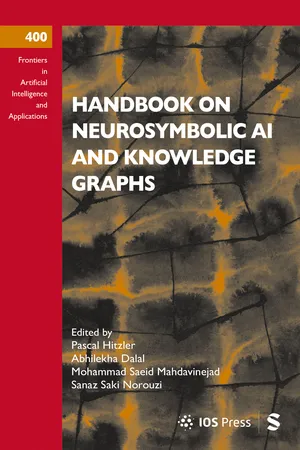
eBook - ePub
Handbook on Neurosymbolic AI and Knowledge Graphs
- 1,108 pages
- English
- ePUB (mobile friendly)
- Available on iOS & Android
eBook - ePub
Handbook on Neurosymbolic AI and Knowledge Graphs
About this book
Information
Table of contents
- Cover
- Half Title
- Series
- Title Page
- Copyright Page
- Preface
- Contents
- Part I. Foundations of Neural and Symbolic AI
- Primer on Deep Learning Models
- How the (Tensor-) Brain Uses Embeddings and Embodiment to Encode Senses and Symbols
- Logical Expressiveness of Graph Neural Networks on Knowledge Graphs
- Few-Shot Learning on Graphs
- Part II. Knowledge Graph Representation and Embeddings
- Vector Space Transformations to Uncover Knowledge Graphs in Neural Language Models
- How to Embed Large but Incomplete Knowledge Graphs in the Culture Heritage Sector: Lessons Learned from Odeuropa
- What Do Knowledge Graph Embeddings Learn to Represent?
- Instance Retrieval for Class Expression Learning Using SPARQL
- Geometric Relational Embeddings: Progress and Prospects
- Knowledge Internalized in LLMs
- Part III. Knowledge Graph Construction, Integration, and Quality
- Unsupervised Entity Alignment of Knowledge Graphs
- Neuro-Symbolic Techniques in Open Knowledge Graph Canonicalization
- Knowledge Fusion
- From Certainty to Uncertainty in Knowledge: Exploring Modeling, Extraction, Representation, and Applications
- Trustworthy Knowledge Graphs: Practices and Approaches
- Open Research Knowledge Graph: A Large-Scale Neuro-Symbolic Knowledge Organization System
- Ontology Population Using LLMs
- Part IV. Neurosymbolic Reasoning and Hybrid Architectures
- Knowledge Graph-Based Reasoning in Large Language Models
- Knowledge Graph Question Answering and Large Language Models
- Neurosymbolic Program Synthesis
- Neuro-Symbolic Relation Extraction
- Neurosymbolic Methods for Dynamic Knowledge Graphs
- Neurosymbolic Methods for Rule Mining
- Neuro-Symbolic Query Optimization in Knowledge Graphs
- Visual Transfer Learning Using Knowledge Graphs
- Neurosymbolic Visual Reasoning with Scene Graphs and Multimodal LLMs
- Enhancing Foundation Model-Based Reasoning with Neuro-Symbolic Cognitive Methods
- Knowledge Enhanced Neural Networks
- Part V. Explainable and Interpretable AI
- Empowering Mechanistic Interpretability of Deep Neural Networks with Knowledge Graphs
- Expressive Power of Monotonic Graph Neural Networks via Datalog
- Individual CNN Hidden-Layer Neurons Are Good Concept Encoders
- Knowledge-Augmented Explainable and Interpretable Learning for Anomaly Detection and Diagnosis
- Part VI. Interdisciplinary Perspectives and Real-World Applications
- Knowledge-Based News Event Analysis and Forecasting
- SmartBook: AI-Assisted Situation Report Generation for Intelligence Analysts
- Analysing Objectives of Auxiliary Inputs in Semantic Web Machine Learning Systems
- Neuro-Symbolic AI in Life Sciences
- Enriching Large Language Models with Knowledge Graphs for Computational Literary Studies
- Mutual Understanding Between People and Systems via Neurosymbolic AI and Knowledge Graphs
- Neurosymbolic Methods for Food Computing
- Capturing the Semantics of Internet Memes
- Neurosymbolic AI for Healthcare
- Subject Index
- Author Index
Trusted by 375,005 students
Access to over 1.5 million titles for a fair monthly price.
Study more efficiently using our study tools.
Frequently asked questions
Yes, you can cancel anytime from the Subscription tab in your account settings on the Perlego website. Your subscription will stay active until the end of your current billing period. Learn how to cancel your subscription
No, books cannot be downloaded as external files, such as PDFs, for use outside of Perlego. However, you can download books within the Perlego app for offline reading on mobile or tablet. Learn how to download books offline
We are an online textbook subscription service, where you can get access to an entire online library for less than the price of a single book per month. With over 1.5 million books across 990+ topics, we’ve got you covered! Learn about our mission
Look out for the read-aloud symbol on your next book to see if you can listen to it. The read-aloud tool reads text aloud for you, highlighting the text as it is being read. You can pause it, speed it up and slow it down. Learn more about Read Aloud
Yes! You can use the Perlego app on both iOS and Android devices to read anytime, anywhere — even offline. Perfect for commutes or when you’re on the go.
Please note we cannot support devices running on iOS 13 and Android 7 or earlier. Learn more about using the app
Please note we cannot support devices running on iOS 13 and Android 7 or earlier. Learn more about using the app
Yes, you can access Handbook on Neurosymbolic AI and Knowledge Graphs by Pascal Hitzler,Abhilekha Dalal,Mohammad Saeid Mahdavinejad,Sanaz Saki Norouzi in PDF and/or ePUB format, as well as other popular books in Computer Science & Artificial Intelligence (AI) & Semantics. We have over 1.5 million books available in our catalogue for you to explore.