eBook - ePub
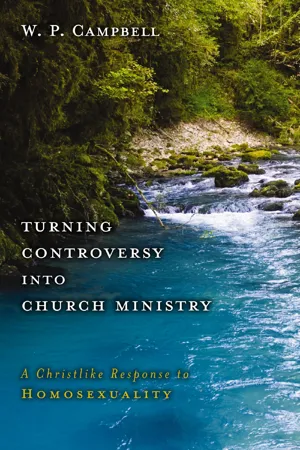
Turning Controversy into Church Ministry
A Christlike Response to Homosexuality
- 240 pages
- English
- ePUB (mobile friendly)
- Available on iOS & Android
eBook - ePub
About this book
One of the most volatile issues facing the Western Church is also one of the least discussed: homosexuality. Many pastors, church members, and congregations have become tired of the debate surrounding this topic but do not really understand the issues. Pulling away from this controversy doesn't seem to help; it keeps cropping up.Ninety percent of pastors are aware of members or visitors to their churches who struggle with homosexual tendencies, and the same percentage of churchgoers know a relative or friend who wrestles with this concern. The media, school systems, and nearly every sector of society will challenge Christians to give a reasoned response to the escalating gay agenda. For twenty-five years W. P. Campbell has studied and debated this topic as it relates to Christ's Church. He has come to the conclusion that it will not go away in our generation, but it can be coaxed to find its proper place in any congregation when it is tackled with a firm but loving grip. Homosexuality in the Church is a guidebook to help Christians and whole congregations do just that. It faces the heart of the controversy with the love and compassion of Christ and turns it into effective ministry.Framed by the most significant biblical passages related to homosexuality and supported by science, psychology and sociology, each of the five parts of the book unfold a unique aspect of God's person and purpose. As our Creator, he has made us to be whole; as our King he has provided laws and guidelines to help us remain that way; as our Redeemer, his power can save us from sin; as our Guide, his light will guide us out; as our Strength, he will make our ministry effective.As a resource for the church today, this book will: • Provide readers with a comprehensive overview of the biblical data about homosexuality • Inform readers about current scientific, psychological, and cultural findings related to same-sex practice • Teach readers Christ-like responses to gay rights activists in the Church and help them to know how to avoid extreme stances about homosexuals and the Church that result in alienating others or in supporting sexual sin • Offer guidelines and tools to church leaders for mobilizing a congregation to study this topic and to engage in ministry to recovering homosexuals
Information
Topic
Theology & ReligionSubtopic
Christian MinistryPart 1
ANALYSIS: YOUR CHURCH, CHRIST’S BODY
Chapter 1
THE FEET
Where Your Church Stands
Examine yourselves to see whether you are in the faith; test yourselves. Do you not realize that Christ Jesus is in you—unless, of course, you fail the test?—2 Corinthians 13:5
I wasn’t paying attention to the white-water rafting guide as I threw an inner tube out of the large raft and jumped into the frothing water—but my brother was. Listening carefully to the guide’s warnings about the upcoming section of Oregon’s Rogue River called “Coffeepot,” my brother stared helplessly as I floated ahead of the raft into the bubbling waters described by the guide as violent undercurrents that have been known to suck people down into the depths, into the river’s chest, wedged between its immovable ribs with no way out. My brother pointed in dismay, unable to speak as I disappeared under the agitated surface of the water.
I remember the experience of shock when I was pulled down, inner tube and all, and then flipped upside down. I gripped my float for dear life for what seemed an eternity as the watery currents tugged and tore at me, beckoning me into the black unknown. If my dug-in fingernails had slipped from the tube, I would have been sucked into the vortex of death. Finally, the draw slackened and my tube bobbed to the surface. I gasped, sucked in air, paddled to the side of the now quiet river, and climbed onto the rocks. My chest ached as I told myself that I would never forget to be thankful for the next breath or for the next heartbeat. I stood, rejoicing that my feet were on solid ground.
Now, years later, I find a chilling parallel between this incident and the forces that are pummeling the Western church like mighty currents and threatening to pull pastors, congregations, and entire denominations into swirling darkness. Rapid changes in societal values have swept over the church in a torrent that has many pastors holding on for the ride, or holding their breath and looking for a way of escape. Could this be why 80 percent of pastors would find another job if they were able, and 85 percent of pastors’ wives are depressed?1 It is vital that we identify the currents that are coming against the church if we hope to navigate our congregations to safe ground and settle them as outposts of recovery for the needy, the hurting, the drowning people we are called to reach.
Currents That Overwhelm
When I pastored a church in Maryland, I frequently drove to Harpers Ferry, West Virginia, for leadership retreats. Every time I drove into that historic town, I peered into the rippling waters where the Potomac and Shenandoah Rivers merge. Often a serene setting, the lower part of Harpers Ferry has sometimes felt the wrath of these converging rivers.
Local legend has it that Robert Harper, a Philadelphia businessman who settled in the area in the early eighteenth century, was driven out of his cabin by invading water in 1748. Rather than leave the area, he turned disappointment into opportunity and established a ferry across the Potomac in 1761. Thus Harpers Ferry became a vital crossing point for westward-moving settlers seeking new lands in the Shenandoah Valley and beyond. George Washington was captivated by the potential of a town that sat quietly where the mountains break and where a ferry provided passage. The president arranged to have one of our country’s two arsenals located there. From that day forward, history records more than a dozen deluges in Harpers Ferry. By highlighting a few devastating floods at key points in history, we can draw a parallel with the raging political, economic, and theological currents that threaten to submerge the church today.
The Flood of 1870—Politics
In 1870, floodwaters massed upriver from Harpers Ferry and rushed upon the town like two converging trains, catching the residents unaware and sweeping away homes and businesses. Forty-two people died because they were not prepared for the rapidly rising rivers. This flood came on the heels of the Civil War, which had already left the town nearly destitute. From the Sunday evening of October 16, 1859, when abolitionist John Brown and his twenty-one-man army of liberation had seized the town armory and its one hundred thousand weapons, to the day the Federals returned to Harpers Ferry after the Battle of Antietam, the town was submerged by conflicting political currents. Subject to forces outside its control, the town changed hands eight times between 1861 and 1865. Like two vast rivers, different viewpoints from the North and South regarding slavery converged on Harpers Ferry, and the town barely survived, reaching near ghost-town status.
The church of our day, like Harpers Ferry, sits exposed and vulnerable to the mighty rivers of competing interests that fuel our national politics. With regard to gay rights, for example, we can think of the Stonewall riots in 1969, the removal of homosexuality from the American Psychiatric Association’s list of disorders in 1973, the Anita Bryant campaign in 1977, Jerry Falwell’s founding of the Moral Majority in 1979, the media’s overstated claims about the supposedly gay brain in the early 1990s, California’s Proposition 8 in 2008, and the emergence of hate crime legislation and state approvals for same-sex marriage in 2009. These are but a few historic watermarks reminding us of the growing strength of two churning political rivers, for and against gay rights, which now converge on the church.
The Flood of 1942—Economics
In 1942, the Potomac and Shenandoah rivers overwhelmed residents of Lower Town Harpers Ferry once again, this time with an all-time-high flood level of 33.8 feet. There is never a good time for a flood, but this intrusion by nature was especially difficult for the town economy as the Great Depression was just coming to an end.
Analysts will forever debate how invisible forces surprised and then devastated the economies of the Western world to create a depression that lasted more than ten years. In fact, the debate has taken on fresh interest in our day, as our national economy is experiencing gyrations that cause financial gurus to draw comparisons with the financial woes of the Great Depression. Every sector of our economy has felt the force of the economic downturn that began in late 2008, and rival political parties have been quick to cast blame on each other. Christian ministries and churches cannot avoid being swept into converging forces of public irresponsibility and government policies that have ransacked our nation and have sent anxiety rippling into businesses, churches, and homes.
Economics is a hidden force behind the political currents that hammer the church across our land. Regarding the gay rights agenda, for example, funding sources for and against the November 2008 Proposition 8 ballot in California to ban same-sex marriage contributed more than $83 million from all fifty states and from twenty foreign countries. It was the most substantially funded campaign on a state ballot ever. The financing behind this single ballot surpassed every campaign in the country outside the U.S. presidential contest.
It is said that economics drives politics, and politics guides the masses. Yet there is a current deeper than either economics or politics that Christians must contend with. This mighty force flows undetected, yet it has the power to unite or to divide and devastate God’s people. This force is the combined pressure of divergent theologies.
The Flood of 1996—Theology
Only in 1996 did two floods in the lower part of Harpers Ferry bring the water over the 29.8-feet-high watermark in a single year. One of the floods, in January of that year, owed its existence to the blizzard of 1996, followed by torrential rainfall. The second watery invasion came on the heels of the angry Hurricane Fran. Twice the historic town that draws some two million tourists annually was deluged by two swollen rivers.
In the same year, 1996, my denomination, the Presbyterian Church (USA), was so conflicted by pressures from both sides of the theological debate about homosexuality that its national body felt the need to place a statement confirming the traditional viewpoint on marriage in its constitutional document, the Book of Order. That statement, once a high waterline, has been submerged in controversy ever since. Other mainline denominations were likewise inundated in the 1990s with the progressive push for homosexual unions and ordination on one side, and resistance and reactions from conservatives on the other. These streams of thought have risen with fury since the 1990s and are now threatening nearly every Christian church and denomination.
The Two Theological Rivers
There are two strong currents in the Scriptures that were never meant to be separated: grace and truth. When they have become divided throughout history, the church has always suffered. Older terms such as fundamentalist-modernist and newer labels such as progressive-traditional reflect these currents but cannot be used to measure or understand them.
The theological flows of the Old Testament, which highlights the law—the truth of God—and the New Testament, which features the grace shown in Jesus Christ, are two parts of one whole. They create an interconnecting pattern throughout the Bible. The Old Testament is about more than the law of God. The Ten Commandments were given through grace, through a God who loved the Israelites as his “treasured possession” among all the peoples, “a kingdom of priests and a holy nation” (Exodus 19:5-6). The tabernacle, accompanied by rules and regulations for worship, was an intricately painted portrait of the grace that invites us, through the sacrifice of Christ, into the very presence of God (Exodus 35-40; Hebrews 10:1-25).
The New Testament is about more than the grace of God. Jesus, in the New Testament, upheld the standards of God’s law. He said that “not the smallest letter, not the least stroke of a pen, will by any means disappear from the Law until everything is accomplished” (Matthew 5:18). He who came to save us will return to judge those who refuse to believe.
Law and grace flow together throughout the Bible—but have not always done so within the church. In the 1920s and ’30s, the influx of liberal theologies from Germany, spurred on by new literary approaches for understanding Scripture, provoked stark reactions from conservative theologians. Hence the fundamentalist-modernist controversy began, creating splits in seminaries and denominations. The battle was not fully settled theologically but rechan-neled into manageable currents through church policies (polity).
The effort to divert theological arguments rather than resolve them is but a temporary solution. Today the same two rivers, grace and truth, have risen to flood stage and are raging with destructive force. Many Christian denominations are attempting once again to hold themselves together through polity and procedures but have been unwilling to find the more difficult and lasting solution, which is to bring the two rivers into one. Grace and truth were never meant to be separated. Biblical standards and relevant cultural witness are partners. Evangelism and social action work best when working together. Great movements of renewal throughout history have brought the streams of truth and grace together to create mighty movements of God. This was the case in American history, for example, during three great awakenings (1730-1755; 1790-1840; 1850-1900). May it happen again today.
Examining Grace
The Greek word for grace, charis, means “unmerited favor.” It is food offered to the homeless person who has just cursed you. It is forgiveness extended toward the boss who cut your hours in half. It is love shown to the teenager or spouse who berated you, the kindness offered to the fellow church member who soiled your name in gossip, and the hug of welcome to the drug addict who stepped into your church for the first time. God’s grace, however, is not weak toward injustice, deception, compromised character, and shortcut spirituality. With tenacity and resilience, biblical grace challenges us to grow, to better ourselves, to climb toward the highest rung of godly living.
Those who strip the truth away from grace create a perversion of God’s person and plan for humanity. We live in an age of reckless sexuality. Our truthless grace has handed the car keys to teenagers, along with a map to the interstate of sexual experimentation. Nearly half (46 percent) of all fifteen- to nineteen-year-olds in the United States have had sex at least once, and by the age of nineteen, seven in ten teens have engaged in sexual intercourse.2 Grace with no anchor of truth ignores the high rate of divorce among Christians in our country and is untroubled that the rate of cohabitation rose by a thousand percent between 1960 and 2000.3 It may even turn a blind eye to the one in four girls and one in six boys who are sexually abused before the age of eighteen, because it has no basis for setting standards for human sexuality or behavior.4
Examining Truth
Truth lived in Christ’s way, the kind of truth we are called to embrace and proclaim as Christ-followers, has few gray edges. It is clear and straight about God’s commandments and God’s priorities. It shamelessly names what is right and wrong and does not hide the consequences for obedience and disobedience. It does not cheat on taxes or accept the benefits of a clerk’s error in a grocery store. Truth refuses to cover up the weakness of governmental policies or of a pastor’s theology. It confronts ethical violations on the job and verbal abuse at home. It will not be bent by majority opinion or bribed with an offer for a better position. Those who live by truth engage in the ongoing challenge of applying God’s unchanging standards to our ever-changing society.
Truth devoid of grace, however, is a poison-tipped dagger. It speaks words that wound and promotes acts that kill spirit and hope. It is loveless, merciless, compassionless, and clueless about how to help others improve. Rather than heal wounds, it opens them; rather than allowing time for change, it stifles growth; rather than offering help, it slams the door in the face of human need. It turns opportunity into despondency, and praise for a person’s hard work into a list of failures. Truth without grace creates a formal, pious, self-righteous legalism.
Caught in the Wash
There are very few churches or Christians who actually ride their theological rafts in only one river. The extremes of narrow truth and isolated grace are difficult to maintain in the real world. Fred Phelps of Westboro Baptist Church in Topeka, Kansas, who makes it a practice to carry picket signs to the funerals of homosexuals to announce their certain entrance into hell, does not have a big following.5 Nor has the World Naked Bike Ride movement enjoyed broad denominational endorsement.6 Most of us, avoiding the unabated flow of the extremes, attempt to plant ourselves in the middle, only to be victims of the backwaters and unexpected floods. The battle over homosexuality in the church has been raging for several decades, and we have built our rafts and lifeboats as we continue to gather for Sunday worship as though nothing has happened. We avoid teachings about sexual addiction among heterosexuals, or words like gay and lesbian from the pulpit, while many of our members are slipping off of the rafts and sinking. We lift our chins high and pull our rafts together for comfort, not noticing the sounds of those who are alternately going under and coming up, gasping for air because of their conflicted sexuality. Too ashamed to hold out their hands for help, they sink once again.
Many of us feel it is not proper to discuss such issues in or around the church. Those w...
Table of contents
- Cover Page
- Title Page
- Table of Contents
- Preface
- Introduction: Putting Christ Back into “Christian”
- Part 1 ANALYSIS: YOUR CHURCH, CHRIST’S BODY
- Part 2 APPROACH: OVERCOMING CONTROVERSY
- Part 3 ACTION: BUILDING MINISTRY
- Conclusion The Big Picture
- Questions for Personal or Group Reflection
- Additional Ministry Resources
- Notes
- Acknowledgments
- Copyright
- About the Publisher
- Share Your Thoughts
Trusted by 375,005 students
Access to over 1.5 million titles for a fair monthly price.
Study more efficiently using our study tools.
Frequently asked questions
Yes, you can cancel anytime from the Subscription tab in your account settings on the Perlego website. Your subscription will stay active until the end of your current billing period. Learn how to cancel your subscription
No, books cannot be downloaded as external files, such as PDFs, for use outside of Perlego. However, you can download books within the Perlego app for offline reading on mobile or tablet. Learn how to download books offline
Perlego offers two plans: Essential and Complete
- Essential is ideal for learners and professionals who enjoy exploring a wide range of subjects. Access the Essential Library with 800,000+ trusted titles and best-sellers across business, personal growth, and the humanities. Includes unlimited reading time and Standard Read Aloud voice.
- Complete: Perfect for advanced learners and researchers needing full, unrestricted access. Unlock 1.5M+ books across hundreds of subjects, including academic and specialized titles. The Complete Plan also includes advanced features like Premium Read Aloud and Research Assistant.
We are an online textbook subscription service, where you can get access to an entire online library for less than the price of a single book per month. With over 1.5 million books across 990+ topics, we’ve got you covered! Learn about our mission
Look out for the read-aloud symbol on your next book to see if you can listen to it. The read-aloud tool reads text aloud for you, highlighting the text as it is being read. You can pause it, speed it up and slow it down. Learn more about Read Aloud
Yes! You can use the Perlego app on both iOS and Android devices to read anytime, anywhere — even offline. Perfect for commutes or when you’re on the go.
Please note we cannot support devices running on iOS 13 and Android 7 or earlier. Learn more about using the app
Please note we cannot support devices running on iOS 13 and Android 7 or earlier. Learn more about using the app
Yes, you can access Turning Controversy into Church Ministry by William P. Campbell in PDF and/or ePUB format, as well as other popular books in Theology & Religion & Christian Ministry. We have over 1.5 million books available in our catalogue for you to explore.