- 208 pages
- English
- ePUB (mobile friendly)
- Available on iOS & Android
eBook - ePub
About this book
Less is more. And more is better. This is the new equation for church development, a new equation with eternal results.Rejecting the "bigger is better" model of the complex, corporate megachurch, church innovator Dave Browning embraced deliberate simplicity. The result was Christ the King Community Church, International (CTK), an expanding multisite community church that Outreach magazine named among America's Fastest Growing Churches and America's Most Innovative Churches. Members of the CTK network in a number of cities, countries, and continents are empowered for maximum impact by Browning's "less is more" approach. In Deliberate Simplicity, Browning discusses the six elements of this streamlined model:• Minimality: Keep it simple• Intentionality: Keep it missional• Reality: Keep it real• Multility: Keep it cellular• Velocity: Keep it moving• Scalability: Keep it expandingAs part of the Leadership Network Innovation Series, Deliberate Simplicity is a guide for church leaders seeking new strategies for more effective ministry.
Information
Topic
Theology & ReligionSubtopic
Christian ChurchCONTENTS

Title Page
Copyright Page
Preface
Acknowledgments
Introduction to a New Equation
1. Minimality
2. Intentionality
3. Reality
4. Multility
5. Velocity
6. Scalability
Conclusion: It’s an Equation
Notes
About the Publisher
Share Your Thoughts
PREFACE
I’m a pastor … again.
When I quit in the midnineties, I was unsure about a lot of things, but one thing was clear: I would never be a pastor again.
God had other ideas. While I had quit on him, he never quit on me. He led me into green pastures and beside still waters. He restored my soul. I found myself in the back row of a nondenominational church in Bellingham, Washington.
At Christ the King Community Church I found love, acceptance, and forgiveness. In that safe and sane environment, God began to heal my pain and rekindle my passion. During those days of restoration, a prayer partner exhorted me, a pastor mentored me, and a congregation supported me. After serving as an associate pastor for several years, I was ready to “get back on the bike.” On Easter Sunday, April 4, 1999, I launched Christ the King Community Church of Skagit Valley, a daughter church which in two years grew to a thousand people meeting in hundreds of homes and several communities. In the ensuing years, CTK has become a minimovement with branches across the country and overseas.
So I’m a pastor again, but it’s not the same. I’m not the same, to be sure. But the context in which I’m ministering is also quite different. Deliberate Simplicity is an attempt to describe these differences.
More than one audience may benefit from Deliberate Simplicity:
1. The people of Christ the King Community Church, or any church for that matter, who are the real ministers. Deliberate Simplicity is designed to prepare them for their work. Because we are surrounded by tens of thousands of lost people, there is an urgency about our mission. The harvest is great. We do not have time to wait. We want to reach as many people as we can, as fast as we can. Hopefully, this handbook will speed the process of deploying the next generation of ministers for the harvest.
2. The leaders of CTK, or of any church, who are the “administers.” As caretakers of the mission, vision, and values of Christ the King, it is their mandate to create and sustain an environment where the people of CTK can execute their ministries with minimum obstacles and maximum fulfillment. Deliberate Simplicity is a handbook to this end. Because we are a multilocation church and hope to expand into thousands of sites, we can no longer leave the handoff of our DNA to oral tradition or to chance.
3. The disillusioned minister (lay or pay) who may have given up on church but not on God. If you have become disenchanted with BAU (business as usual) in the church, a new mental model may invigorate your passions. It has had that effect for me and many others.
Laced throughout Deliberate Simplicity are essay questions. The seque stions may be used to facilitate a discussion with a mentor or group, or for personal journaling. Here’s the first one:
Of the three audiences mentioned above, which include you, if any? Explain.
Of the three audiences mentioned above, which include you, if any? Explain.
While I am excited about this different approach to ministry, I hope to steer clear of elitism. Different does not necessarily mean better. While at times I may contrast the Deliberately Simple church with the traditional church, Deliberate Simplicity is intended to be more descriptive than proscriptive. God is at work in every church, and in every church tradition there are elements that work well for the people in those traditions. We all have to be faithful to what God is calling us to be and do. Our loyalty should be to the Master and the mission, not the method and the manner. My choosing to go a different direction is not an indictment of those who may be comfortable where they are. I mainly want you to know that this path is out there and that you can take it if you’d like.
While I was growing up in Alaska, my dad would take me with him on fly-in fishing trips. As we walked through the trees from the landing strip to the river, my dad would sometimes take pieces of brightly colored ribbon and tie them in the tree branches. These ribbons would prove valuable later when it came time to walk back to the plane, but also if some fishing buddies wanted to join us. We’d just tell them, “Follow the ribbons from the airstrip.” Admittedly, the path of church ministry that I am on is not well worn. But the enjoyment should be spread around. I’m tying some ribbons in the trees so you can find your way if you want to join us. The fishin’s good.
I’m also acutely aware that results may vary. Just when you say the fishin’s good, your friends show and can’t get a bite. There are aspects of the CTK story that are mysterious and defy explanation. The exponential growth of CTK is certainly a God thing. We are clear on this point. God has been extraordinarily gracious and kind to us, and if he were ever to withdraw his hand of blessing, our ministry would fall like a house of cards. To God be the glory; great things he has done.
However, it does appear that the CTK story has been a divine-human partnership. We couldn’t do it without God, but God has also chosen not to do it without us. And we have worked hard to cooperate with God. The seeming ease of growth at CTK belies the hard work and discipline that has made it possible. A maxim with which CTK leaders have become well versed is, “There is no growth without change, no change without loss, and no loss without pain.” There are some extremely dedicated, disciplined leaders at CTK who have paid the price for those who are about to come.
Describe your church experience to this point. What churches have you attended? What denominations have you experienced? Has the fishin’ been good?
The success of CTK is a credit to the genius of the Holy Spirit. We have been given a different conceptual framework with which to work, and we are thankful. We are going to share those ideas here in the form of an equation.
God bless you,
— Dave Browning
Burlington, Washington
ACKNOWLEDGMENTS
I’m indebted to many colleagues and authors who have stimulated my thoughts over the years, and whose ideas are now going to be a part of this stew.
The meat and potatoes are compliments of Steve Mason, the founding pastor of Christ the King Community Church in Bellingham, Washington. Steve passed on the basic recipe that will be articulated here.
I’m going to spice freely from some of my favorite authors. There is much in business, science, and technology that is analogous to the Deliberately Simple church. When it comes to great ideas, you’ll soon find that I am into not manufacturing but distribution. Hopefully, there’s been value added along the way.
The prep work for this dish was a labor of love executed by a number of assistants over a span of fifteen years: Jurrell “MC” McCrory, Carmielle “CC” Cox, Penny “Not Less” Moore, Jan “The Loose” Cannon, Cheri “Oteri” Milhomme, Christina “Vis-alli” Archer, Donna Gremmert, Hilary “HB” Bonnette, and Diana LaSalle. Each diced and sliced over a hot photocopier. Thank you.
Thanks to my associate taste testers. Valuable support and encouragement came from my family and friends. Among those who sipped from the wooden spoon are my parents and my pastor-colleagues in the CTK network. I fed them bits and pieces along the way, and their feedback impacted flavor.
Finally, thanks to God for not giving me what I deserve, to my wife, Kristyn, for loving me so well, to my three kids, Erika, Jenna, and Daron, for the privilege of being their dad, and to the people of Christ the King for walking the talk.
Bon appétit!
INTRODUCTION TO A NEW EQUATION

A NEW EQUATION
Imagine with me for a minute … a church … but not your typical church. A church where the main thing is the main thing. A church where people convene primarily in homes and secondarily in public spaces for worship services. A church where the ministry is carried out by ordinary people, and it is the pastor’s job to identify, deploy, train, and support these ministers. A church that is warm and accepting of both the churched and the unchurched. A church that sees hundreds of converts baptized each year. A church that numbers tens of thousands but convenes in thousands of small groups and scores of small worship centers. A church that has no geographical limits but spreads from house to house, neighborhood to neighborhood, town to town, county to county, state to state, and country to country. A church that is not just multilo-cation but also multiethnic and multinational.
What if this church were intentionally structured to reach an unlimited number of people in an unlimited number of places? What if this church were more like a movement than a ministry?
Do you have this picture in your mind? For me it’s not too difficult to imagine. I’ve been living inside this picture for the last few years.
Christ the King Community Church held its first worship service on Sunday evening, April 4, 1999, in Mount Vernon, Washington. In May of that year, CTK began to hold morning services, going to two services in September and three services the following February. During its first year, Christ the King of Skagit Valley grew at a rate of 12 percent a month to an average of over 500 people per week, with a high attendance of 763. By the end of CTK’s first year, thirty-eight small groups were convening weekly in Jesus’ name for friendship, growth, encouragement, and outreach.
From 2000 to 2004, CTK established hundreds of small groups throughout the region, with worship centers located in ten cities, in four counties. In 2004, Outreach Magazine recognized CTK as one of the fastest-growing churches in America.
In 2005, CTK began to expand across the country and around the world. We are now poised to go as far as relationships will take us (a current list of locations can be found online at www .ctkonline.com). CTK has experienced extraordinary results by keeping it simple.
Church growth in the seventies, eighties, and nineties was defined by the megachurch. As researcher George Barna says, “We live in an era of hyperbole. Everything is supersized, global, mega-this, and biggest-ever-that. Even the religious community has succumbed to the world’s infatuation with size. The pinnacle of church success is to become a megachurch.” Megachurches have proven they are able to reach thousands of people with burgeoning budgets, sprawling campuses, huge payroll, and extensive programming. Large churches have demonstrated for the past three decades that more can be more. Deliberate Simplicity is a new equation for church development. It says less can also be more. This represents a paradigm shift.
When the paradigm shifts, the rules change. In baseball, for example, the foul lines are part of the paradigm. If the ball lands on one side of the line, it’s a fair ball. If it lands on the other side of the line, it’s a foul ball. If the ball is hit over the fence, it’s a home run. If it lands short of the fence, it’s playable. What accounts for these differences? The paradigm. A paradigm is a set of rules that tell you how to play the game in order to be successful.
When I say that Deliberate Simplicity is a new paradigm for the church, I’m saying the lines have been moved from where you might expect to find them in a traditional church. “Traditional church” may sound pejorative. Here we mean simply a church defined by its locale, programs, facility, or denomination. If you hear someone say, they are probably talking about a traditional church.
• “I attend the (color or architecture) church at the corner of Maple and Division”
• “My family has been members of the (Denomination) Church for generations”
• “I really like the productions they do over at the (First Something) Church”
• “Have you seen the new education wing the (big church in town) built?”
In the Deliberately Simple church, the rules are: “Less is more, and more is better.” Success within these lines boils down to six factors, presented here in the form of an equation: < = – × + ∞.
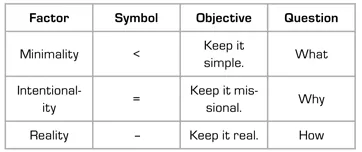
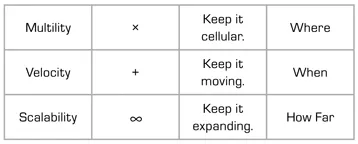
The main ideas of Deliberate Simplicity are outlined in six sections. The first three (minimality, intentionality, reality) explain how less is more. The last three (multility, velocity, scalability) expand on how more is better. The modular approach I have taken to writing about Deliberate Simplicity mirrors the modular approach we have taken in ministry. Each of the six chapters can stand on its own but is also part of a greater whole.
The differences between a Deliberately Simple church and a traditional church need to be discussed, because when you are in the middle of a paradigm, it is sometimes hard to imagine any other paradigm. Upside Down Map Co. of Derby, England, recently teamed up with Map Link Inc. of Santa Barbara, California, to print a road map of California with north and south reversed to make map reading easier for drivers heading south. Why didn’t I think of that? Probably because I was stuck in a paradigm that says a map always has to be laid out with N pointing up. When you get out of the box, you can see new possibilities.
Fifty years ago a church “map” invariably involved a church with a steeple, a seminary-trained minister in a three-piece suit or robe, a pew-filled sanctuary, hymnals, an organist, and a sermon delivered from behind a wooden pulpit. Today, if you participate in a Deliberately Simple church, you will most likely meet in a rented auditorium, sit on a stackable chair, sing along with pro...
Table of contents
- Cover Page
- Title Page
- Copyright Page
- Contents
Trusted by 375,005 students
Access to over 1.5 million titles for a fair monthly price.
Study more efficiently using our study tools.
Frequently asked questions
Yes, you can cancel anytime from the Subscription tab in your account settings on the Perlego website. Your subscription will stay active until the end of your current billing period. Learn how to cancel your subscription
No, books cannot be downloaded as external files, such as PDFs, for use outside of Perlego. However, you can download books within the Perlego app for offline reading on mobile or tablet. Learn how to download books offline
Perlego offers two plans: Essential and Complete
- Essential is ideal for learners and professionals who enjoy exploring a wide range of subjects. Access the Essential Library with 800,000+ trusted titles and best-sellers across business, personal growth, and the humanities. Includes unlimited reading time and Standard Read Aloud voice.
- Complete: Perfect for advanced learners and researchers needing full, unrestricted access. Unlock 1.5M+ books across hundreds of subjects, including academic and specialized titles. The Complete Plan also includes advanced features like Premium Read Aloud and Research Assistant.
We are an online textbook subscription service, where you can get access to an entire online library for less than the price of a single book per month. With over 1.5 million books across 990+ topics, we’ve got you covered! Learn about our mission
Look out for the read-aloud symbol on your next book to see if you can listen to it. The read-aloud tool reads text aloud for you, highlighting the text as it is being read. You can pause it, speed it up and slow it down. Learn more about Read Aloud
Yes! You can use the Perlego app on both iOS and Android devices to read anytime, anywhere — even offline. Perfect for commutes or when you’re on the go.
Please note we cannot support devices running on iOS 13 and Android 7 or earlier. Learn more about using the app
Please note we cannot support devices running on iOS 13 and Android 7 or earlier. Learn more about using the app
Yes, you can access Deliberate Simplicity by Dave Browning in PDF and/or ePUB format, as well as other popular books in Theology & Religion & Christian Church. We have over 1.5 million books available in our catalogue for you to explore.