- 208 pages
- English
- ePUB (mobile friendly)
- Available on iOS & Android
eBook - ePub
About this book
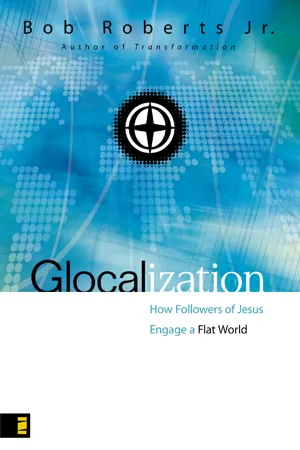
If you want to know where and how the church is going to grow, think local and global. Think glocal.Glocal is Bob Roberts' term for the seamless connectedness between the local and global. That connection is affecting the church in ways that never could have been imagined in the first-century church, or even the twentieth-century church. And it's creating unprecedented opportunities for individuals and churches—for you and your church—to live out their faith in real time across the world.Glocalization offers a vision of the unprecedented changes of our times and how they are impacting the church. Discover how these changes will transform the way churches define their mission and how Christians relate to one another and to the world. This provocative book turns the traditional mission-agency model upside down and shows how transformed people and churches can make a glocal (global and local) impact.Glocalization offers an exciting vision for churches and individuals who want to reach this changing world for Christ.
Information
Topic
Theology & ReligionSubtopic
Christian ChurchWhy Christians
Should Engage
Glocalization
Today
1
The Whole World Has Gone
Glocal!
Glocal!
Issues That Comprise a Glocal World
I remember when I first truly realized the world had gone glocal. It was September 11, 2001. Prior to that, I’d been working globally in various development projects and was reading about globalization. Now it was screaming loud and nonstop on television, radio, and print media. The global nature of the world had finally hit home through this single day of terrorism on American soil. We’d had global involvement in the terrorists’ world and they, in turn, had sent us a local response. I realized that, as author Thomas Friedman had asserted in his book by the same title, the world was now flat.1We could no longer hide behind a thin veil of feeling safe “way over here.” Here was there — and vice versa.
Where Friedman uses the term to describe the modern phenomenon of comprehensive connectedness between technology, travel, vocation, business, communication, and the like, I was now seeing the world flattening in a new way. Not just in a Friedman sense where we realize we are no longer isolated villages, but more like a blown-out tire that has gone just about as far as it can and is digging deep into the asphalt pavement. What was happening to the world?
That night at supper, my wife, our kids, and the newly arrived exchange student from Hanoi, Vietnam, sat around the table. I began to sob and couldn’t stop, no matter how hard I tried. I realized many more lives would be lost as more attacks came and America retaliated. What would this mean for my seventeen-year-old son? What would it mean for this Vietnamese visitor at our table? How would he view us?Were his parents afraid for him?
Later that same evening, I walked outside in my backyard as I often did to count the number of airplanes landing and departing from the nearby airport. The most I ever counted was thirty-three. If you look up at the sky from anywhere in the metroplex, you always see planes dotting the horizon. Now, it was strange; there was not a single plane in the sky. I sat in a swing and just looked up and listened; how odd not to hear any planes at all. It had never been that quiet. Not since the days of Wilbur and Orville Wright had every plane in America been grounded. The world was now very different and still is, nor will it ever be the way it was.
A New Term for a New Flat World
I knew that 9/11 would impact me as a pastor, but I could not have imagined the impact that one event was going to have on my life and ministry. The initial response of the church was to be a place of comfort and hope, and people in record attendance sought solace there. The second response was far smaller, but I believe more in line with the future of the role of the church, and it continues to grow. People began responding to the injustice placed on the Afghans and their need of opportunities in health, education, and the like with a sense of urgency and compassion. Thus, some churches and humanitarian groups began to try to provide some basic needs. Prior to 9 – 11, Afghanistan was just this faraway place the Russians had invaded in 1979. Now, it was affecting all our lives.
September 11 was the hinge movement of the door. But many things had quietly been going on prior to that that would make that day possible and the world as we know it today different. A new civilization — “Glocalization” — was forming. “Glocal” is another term for the flat earth that describes the seamless integration between the local and global, and it is not surprising that this term originated in the East.2It was popularized in the early 1990s by Roland Robertson, a sociologist from Scotland and a pioneer in the study of globalization.3Leonard Sweet later introduced it to the Christian world.
When I heard it, it really stuck. I have since become convinced that it is as important of a term to the twenty-first century as “postmodern” and “seeker” issues combined were to the twentieth century. We live in a glocal world. And while secular authors, news, and research organizations are working tirelessly to understand and communicate it, the church has been comparatively slow in its response. If Friedman is right about living in a new flat world — and he is — what does it mean for the church and for believers?
In the past, we have been content to live in blissful ignorance. Acts 1:8 instructs us, “But you will receive power when the Holy Spirit comes on you; and you will be my witnesses in Jerusalem, and in all Judea and Samaria, and to the ends of the earth.” We, as the church, have interpreted it to mean the very opposite of a globally connected world. Our premise has been this: First, we build a strong and big church here. Second, when we’re big and strong, we go to our whole country. Third, we go to those near us when we’ve reached our country — maybe Canada or Mexico. Finally, when we’re really strong, we take on the world! Even if it’s not explicitly said that way, it is what is practiced.
This is not how the church worked in Acts, nor is it the way the world will be transformed for Christ. Acts 1:8 describes glocal in action. This passage was not describing the one-two-three steps but the dimensions in which the church must be working at all times. It wasn’t determining the sequence, but the spheres. This is fascinating because it is exactly what the world has become two thousand years later! The local and the global have come together at many different dimensions.
We scale what we can of the omnipotence of God by how we connect with the Holy Spirit. We scale what we can of the omniscience of God by the study of God’s Word and discipleship. There are only two ways to scale the omnipresence of God. One is prayer — it takes us from here and now to there and then. The second way to scale it is glocalization. We live here and serve here; yet we also go and serve there. For the most part, the church has innovated her Sunday morning worship and programs. It’s time to go deeper. We must innovate the real purpose and be true to the DNA of the church and the transformed life.
What does this look like for believers and the church? What are the implications of how the church and believers will relate to the world and one another? That is what this book is all about. However, first let me set up the philosophy and thinking behind the reality of glocalization.
Glocal Is Comprehensive Connectedness
As Thomas P.M. Barnett explains in The Pentagon’s New Map, the rules have all changed for this new global order. We will only be effective if we understand this new flat world and how it operates.
Not long ago, I had the members of our church stand up, invert the collar of the person in front of them and call out the nation where the shirt was made: China, India, Vietnam, Mexico, Chile, Kenya, Egypt, Spain. Finally, someone called out United States. Business has become a glocal enterprise.
Travel is the most desirable form of glocal and has been around for years. But now, glocal is in the everyday fabric of daily life in every dimension and domain. We are not alone, and neither are they. And “they” are not as far away as we once thought.
The greatest merger to take place has not been between behemoth communication and telecom companies; they will continue to come and go. The greatest merger is between everybody’s everyday local and global experience. The whole world truly has gone glocal.
Everyone Impacted
Rome was the first to develop a network of roads and highways where all roads really did lead to Rome. Germany’s invention of the Gutenberg press forever changed communication. However, not since these two has anything changed society as much and even more as the information highway.
No one is exempt from the impact of glocalization — and it’s getting more and more widespread all the time. As I write, my wife is in Kenya — her first time there. She accompanied an African pastor’s wife from the metroplex area to speak to fellow pastors’ wives. The other day, I heard on the news that an earthquake had just rocked Kenya. Alarmed, I tried several times to call to check on her, but to no avail. Ironically, I’d just reached her by cell phone days earlier in the middle of the Serengeti Desert. It’s a barren desert, but because it’s a popular place for tourists, the safari animals roam among several cell towers! However, when she was in a Kenyan city, I couldn’t reach her!The global world is still connecting, and it’s only going to accelerate in the future.
Business, art, communication, travel, goods, and ser vices are all expanding tremendously. Babel is no longer a biblical tower; it is an internet server that has connected us and continues to connect us in ways that are just plain unimaginable.
The world has not gone loco, but it seems as if there is no sanity in the response to glocalization. People either “hunker in the bunker” and ignore it, trying to return to their perception of the good ole days. Or they’re filled with greed, engulfing and exploiting everything they can get their hands on. There is a better way — a way in which you can learn to hold onto the values of who you are and who God made you to be, while seeing this new world we’re living in as an opportunity to grow as a person and to experience life. But in order to navigate this new global era, the old maps won’t do. You’ve heard of GPS, which stands for Global Positioning System. Glocalization is GPS for Christians — think of it as Glocal Positioning System. Throughout this book, I’ve placed what GPS refers to as “waypoints” or locations on the global map to be able to find where you are and where you want to go next.
Glocal Positioning System
GPS is a way of locating a point in three dimensions in space anywhere on earth. It is arguably one of the most important inventions in recent history. It operates from a network of satellites placed in orbit around planet earth, each broadcasting a specific signal, much like a normal radio signal. Using different signals from various satellites, GPS software is able to calculate the position of the receiver. The principle is similar to triangulation: If you can identify three places on a map, render a bearing on where they are and draw three lines on the map, then you will find your approximate position where the lines intersect.
In the same way, we must orientate ourselves to this strange new “flat” world in which we find ourselves — where we’re closer and more connected than ever before. Fortunately, God has provided us with old models and other familiar watermarks to get our bearings. However, we must be open to recognizing the new waypoints he wants us to explore as we engage societies and advance the kingdom, so that when we see it happening, we know why and what to do next.
Not Dominion, Connection
War is one of the oldest expressions of glocal, though it has been more from the vantage point of domination than merging. It starts locally in one part of the world and takes its intentions to another part. The local and the global merge — glocal. It’s everywhere and in every form. Pharaoh, Alexander the Great, Genghis Khan, and others connected the world, but it was through global domination and the imposition of the victor’s customs and culture upon the victims. I have a friend who is a descendant of Ghinghis Khan, but that world will likely not exist again.
However, there is something substantially different about modern glocalization. Glocal connects everyone, but unlike war, it doesn’t do away with anyone’s culture and customs. It can actually strengthen them and facilitate transformation. The whole basis of connection is not domination, but information and connectedness that allow for the integration of anyone, anywhere, anytime.
Global convergence is very different from global domination. Hitler was the last, and leaders like Bin Laden will not succeed, not because of our military efforts, but because of his own people. As young and emerging nationals see other nations develop and realize the negative impact people like that have on progress, they will stop them.
There is no doubt about it. America may be hated, but those who impose terror will be hated even more. Marx was right: economic issues drive class, society, and humanity. Too bad America couldn’t have seen the present future better during the Vietnam War. What Marx failed to understand was the power of dream that leads to initiative. What America failed to understand was that wars could be won by free enterprise, thought, and engagement more than expensive bullets and bombardment.
What does this mean for today? I believe the best thing the West can do for an emerging nation is to stabilize nations around it and do business with them. As neighbors see neighbors prospering, they will demand their governments give them the same chance.
America wants to see peace and democracy in Iraq (which can’t be the American version, by the way). What would happen if the same amount of resources developing armed forces was spent on developing Lebanon and Jordan and, yes, even the West Bank? Everyone hates American bullets but loves American dollars!
Glocal Is Multiple Convergence of Domains
The fi rst book I ever read that helped me O. Wilson’s Consilience. Perhaps it’s strange that a man who rejected his Southern Baptist roots and became a zoologist and an “Enlightenist” Harvard professor could do so much to teach another pastor with Southern Bap...
Table of contents
- Cover Page
- Title Page
- Copyright Page
- Dedication
- Contents
- Waypoints and Figures
- Acknowledgments
- Part One Why Christians Should Engage Glocalization Today
- Part Two Getting Practical about What We Can Do
- Part Three How the WorkWill Be Done(Key Values)
- T-Model (Transformation Model)
- Endnotes
- About the Publisher
- Share Your Thoughts
Trusted by 375,005 students
Access to over 1.5 million titles for a fair monthly price.
Study more efficiently using our study tools.
Frequently asked questions
Yes, you can cancel anytime from the Subscription tab in your account settings on the Perlego website. Your subscription will stay active until the end of your current billing period. Learn how to cancel your subscription
No, books cannot be downloaded as external files, such as PDFs, for use outside of Perlego. However, you can download books within the Perlego app for offline reading on mobile or tablet. Learn how to download books offline
Perlego offers two plans: Essential and Complete
- Essential is ideal for learners and professionals who enjoy exploring a wide range of subjects. Access the Essential Library with 800,000+ trusted titles and best-sellers across business, personal growth, and the humanities. Includes unlimited reading time and Standard Read Aloud voice.
- Complete: Perfect for advanced learners and researchers needing full, unrestricted access. Unlock 1.5M+ books across hundreds of subjects, including academic and specialized titles. The Complete Plan also includes advanced features like Premium Read Aloud and Research Assistant.
We are an online textbook subscription service, where you can get access to an entire online library for less than the price of a single book per month. With over 1.5 million books across 990+ topics, we’ve got you covered! Learn about our mission
Look out for the read-aloud symbol on your next book to see if you can listen to it. The read-aloud tool reads text aloud for you, highlighting the text as it is being read. You can pause it, speed it up and slow it down. Learn more about Read Aloud
Yes! You can use the Perlego app on both iOS and Android devices to read anytime, anywhere — even offline. Perfect for commutes or when you’re on the go.
Please note we cannot support devices running on iOS 13 and Android 7 or earlier. Learn more about using the app
Please note we cannot support devices running on iOS 13 and Android 7 or earlier. Learn more about using the app
Yes, you can access Glocalization by Bob Roberts Jr. in PDF and/or ePUB format, as well as other popular books in Theology & Religion & Christian Church. We have over 1.5 million books available in our catalogue for you to explore.