- 437 pages
- English
- PDF
- Available on iOS & Android
eBook - PDF
About this book
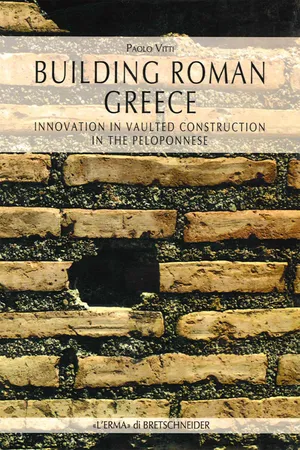
This book discusses a selection of 29 vaulted Roman buildings in the Peloponnese dating from the 1st century BC to the 3rd century AD. The research was carried out over a period of ten years through the summer of 2013. It was awarded the "Grand Prix" of the EU Prize for Cultural Heritage/ Europa Nostra Award in May 2014. This work fills a gap in the study of Roman construction, which has generally failed to seek innovation in building techniques outside of Central Italy. The research has revealed the importance of Roman architecture in the Peloponnese and its contribution to the development of construction techniques. The significance of these structures had been hitherto only partially recognised and understood, because the few publications to have dealt in any depth with Roman architecture in the Peloponnese were conditioned by an excessive focus on the city of Rome, attributing only relative importance to the specific nature of local building traditions. For the first time, a study systematically and analytically evaluates Roman construction in Greece. Most of the buildings included in the study had not been previously analysed nor were they even known to specialists. In earlier discussions of Roman architecture in Greece, the construction aspects had been treated cursorily. Scholars were basically focused on comparisons with Rome, thus failing to understand the peculiarities of the construction process. This study offers a detailed layout of the ways in which solid-brick vaulting and concrete vaulting were employed, showing that local workmen were experienced and expert enough to use inventiveness in dealing with technical and structural problems, thus creating a construction tradition distinct from the one in use in Rome. The author analyses on one hand the Italic construction tradition and on the other, the development of a local construction techniques, which were also influenced by eastern vaulting tradition imported from Parthia. The new methodological approach of the research is based on on-site study, with sketches, drawings and descriptions, through which it was possible to recognise and understand the construction solutions adopted in each building. The first-hand observations and technical drawings and/or descriptions of the construction characteristics eventually made it possible to identify and understand a building style based on the widespread use of brick for walls and vaults that was to become particularly influential in the late antique period, when Eastern building techniques became more markedly different from the ones adopted in the Western part of the Empire. This methodology becomes a reference point for future research on similar regional contexts and historical periods that share the same construction principles, rooted in the use of mortar as a bonding material.
Information
Subtopic
Roman Ancient HistoryIndex
HistoryTable of contents
Trusted by 375,005 students
Access to over 1.5 million titles for a fair monthly price.
Study more efficiently using our study tools.
Frequently asked questions
Yes, you can cancel anytime from the Subscription tab in your account settings on the Perlego website. Your subscription will stay active until the end of your current billing period. Learn how to cancel your subscription
No, books cannot be downloaded as external files, such as PDFs, for use outside of Perlego. However, you can download books within the Perlego app for offline reading on mobile or tablet. Learn how to download books offline
We are an online textbook subscription service, where you can get access to an entire online library for less than the price of a single book per month. With over 1.5 million books across 990+ topics, we’ve got you covered! Learn about our mission
Look out for the read-aloud symbol on your next book to see if you can listen to it. The read-aloud tool reads text aloud for you, highlighting the text as it is being read. You can pause it, speed it up and slow it down. Learn more about Read Aloud
Yes! You can use the Perlego app on both iOS and Android devices to read anytime, anywhere — even offline. Perfect for commutes or when you’re on the go.
Please note we cannot support devices running on iOS 13 and Android 7 or earlier. Learn more about using the app
Please note we cannot support devices running on iOS 13 and Android 7 or earlier. Learn more about using the app
Yes, you can access Building Roman Greece by Paolo Vitti in PDF and/or ePUB format, as well as other popular books in History & Roman Ancient History. We have over 1.5 million books available in our catalogue for you to explore.